

 Sydney
 0452 243 240
Blog
Government incentives for EV chargers in NSW and eligible products


A home charger does not automatically qualify for a government rebate. Government incentives for EV chargers in NSW are tied to specific program rules, with support aimed at eligible fleets and charging sites rather than a universal payment for households.
It’s reasonable to want clear guidance on whether your charger and installation could qualify for support, particularly as program names and eligible products can change. First distinguish a home charging installation from a business or public charging project, then assess the relevant eligibility criteria before planning the work.
This guide explains which NSW programs may help, how home charging support differs from fleet and site funding, and what to expect from assessment and payment. It also explains how programs specify eligible chargers, so you can understand the requirements before choosing an installation pathway.
Key Takeaways
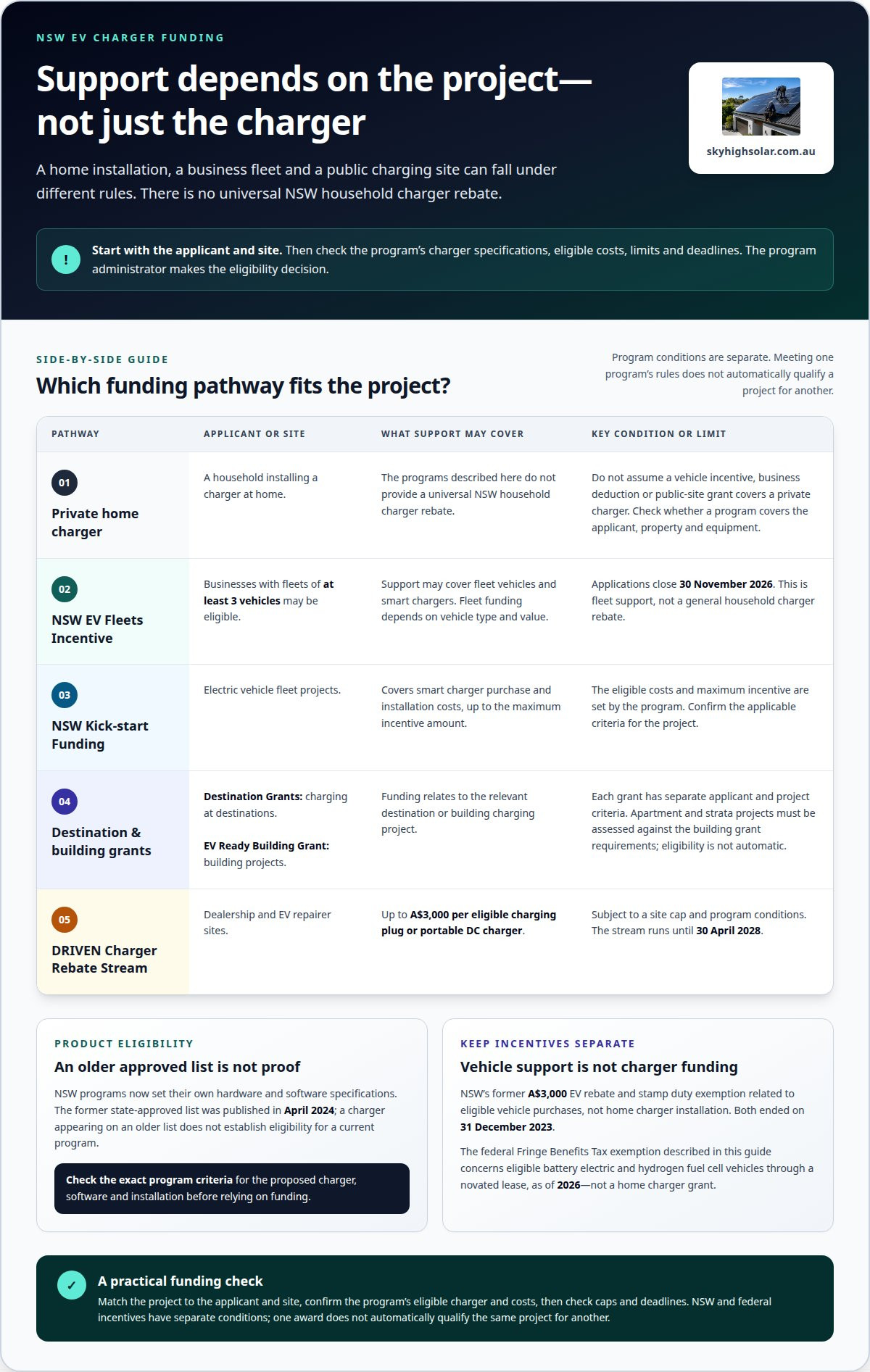
- NSW no longer uses one approved list of EV chargers and software; eligibility depends on the requirements of each program.
- Businesses with fleets of at least 3 vehicles may be eligible for NSW EV Fleets Incentive support for vehicles and smart chargers.
- The DRIVEN Charger Rebate Stream can offer up to A$3,000 per eligible charging plug or portable DC charger, subject to a site cap and program conditions.
- Don’t assume a household charger qualifies for a rebate. The available support depends on whether a program covers your situation and the charger it specifies.
Changes to how NSW Government programs specify eligible products
NSW programs set charger eligibility through their own requirements, rather than a single state-wide approved product list. This affects which hardware and software may qualify for funding.
Eligible product specifications
Eligible product specifications are the hardware and software conditions a funding program sets for supported charging infrastructure. In 2021, the Electric Vehicle Council and NSW Government created approved AC charger and software lists for co-funding programs. The previous list was published in April 2024.
NSW Government programs no longer rely on a single approved list. Instead, each program sets product specifications to suit its funding purpose. The Electric Vehicle Council will not run further Expression of Interest processes to update a state-approved list. A charger’s presence on an older list therefore does not establish its eligibility for a current program.
A professional can help match a proposed charger and software to the relevant program criteria and organise the technical and installation details needed for an application. The program administrator makes the eligibility decision.
Eligibility and application deadlines
Eligibility and application deadlines are the program rules that determine who can apply, for which purchases, and by when. For the NSW EV Fleets Incentive, applications close on 30 November 2026. Its support concerns fleet vehicles and smart chargers, so it isn’t a general household charger rebate.
There is a separate rule for an eligible EV purchase made before the former consumer rebate and stamp duty benefits ended. A purchaser who bought or placed a deposit on an eligible EV before 1 January 2024 could remain eligible for the rebate and stamp duty refund while awaiting delivery. This relates to the vehicle purchase, not automatically to charging equipment.
For a declined NSW EV Rebate application, an objection must be lodged within 60 days of the decision letter. NSW also provides a concessional registration rate for zero-emission and low-emission vehicles; that vehicle benefit is separate from charger funding. Distinguishing vehicle incentives from charger grants helps identify the relevant eligibility rules and deadline.
Current NSW EV grants and programs
NSW and federal grants support defined EV charging projects, not every private charger. For government incentives for EV chargers in NSW, the applicant, site and charging purpose determine which funding stream may be suitable.
Current NSW EV grant programs
Current grant programs are funding streams for specific applicants and charging projects.
NSW Destination Grants support charging at destinations, while the EV Ready Building Grant supports building projects. NSW also has fleet funding. Each program has separate applicant and project criteria. Apartment and strata projects should be assessed against the building grant’s requirements, not assumed to qualify automatically.
Combining NSW and federal incentives
Combining incentives means using more than one funding stream for a project. NSW and federal programs have separate eligibility and eligible-cost conditions, so receiving one grant does not automatically make a project eligible for another.
For a business planning charging infrastructure, identify each grant’s purpose and match project costs to its criteria. The DRIVEN grant supports dealership and EV repairer sites, while NSW grants cover other project types. Tax deductions are separate from grants, and government incentives for EV chargers in NSW do not create a universal rule for combining tax treatment with funding.
Potential savings from NSW incentives
Potential savings depend on the funding a project may receive if it meets a program’s conditions.
Eligible businesses may also be able to access fleet support, with funding depending on vehicle type and value. These programs do not set a household saving for a private charger. For apartment or business sites, the relevant grant conditions and eligible project scope determine potential support.
Installation costs covered by NSW incentives
Covered costs are the charger purchase or installation expenses a program allows in its funding calculation. NSW Kick-start Funding for electric vehicle fleets covers smart charger purchase and installation costs, up to the maximum incentive amount.
Other grants have their own eligible cost categories. Public fast-charger, destination and EV-ready building projects serve different sites, so their covered costs may differ. The DRIVEN Charger Rebate Stream runs until 30 April 2028.
Home EV charging assistance in Australia
Home charging assistance means public funding that helps households install charging equipment. In NSW, the programs discussed here focus on fleets, public charging, destinations and buildings, rather than a universal household charger rebate. That distinction matters when you’re planning a private installation.
South Australia previously offered eligible households up to A$2,000 to install a home smart charger, under its 2022/23 budget. That subsidy was a South Australian program, not a NSW rebate. NSW’s former A$3,000 electric vehicle rebate and stamp duty exemption related to eligible vehicle purchases, not home charger installation; both ended on 31 December 2023.
Federal support also needs to be separated by purpose. It isn’t a household charging grant. Eligible battery electric and hydrogen fuel cell vehicles may receive a Fringe Benefits Tax exemption through a novated lease, as of 2026. That vehicle tax treatment doesn’t pay for a home charger.
When budgeting for a home, check whether a program covers the applicant, property and charging equipment before relying on a rebate. A consumer installing a home charger should not treat a vehicle purchase incentive, public-site grant or business deduction as household charger funding. A tax deduction also differs from a rebate: it affects taxable income, while a rebate reduces eligible costs. The rules depend on the specific program and its purpose.
Interest-free loans are another form of assistance, but the loan example applies to eligible ACT residents, not NSW households. For a Sydney property, assess the electrical setup and installation requirements separately from vehicle rebates or public grants. This keeps your budget focused on costs and funding that relate to your property.
Application assessment and payment timing
Application assessment means reviewing an incentive claim against a program’s eligibility and evidence requirements. Payment timing depends on the scheme, so a charger grant and a vehicle rebate may follow different processes.
For a completed NSW EV rebate application, Revenue NSW allows up to 8 weeks for review. Approved rebates are transferred to the nominated bank account within 5 business days, according to Revenue NSW. These timeframes apply to the vehicle rebate process, not automatically to EV charger grants.
That distinction matters because the former A$3,000 rebate related to eligible vehicle purchases, not charger installation. The vehicle rebate and stamp duty exemption ended on 31 December 2023. Current charger programs assess applications under their own rules, which can cover eligible applicants, equipment, sites and costs.
During grant assessment, the program determines whether a proposed project meets its criteria. A complete application should match the applicant and site to the funding stream and link the proposed charger and installation scope to eligible costs. Missing or inconsistent details can affect the assessment.
Vehicle registration is a separate process that records a vehicle for road use and may relate to vehicle incentives. It does not establish eligibility for a charger grant. Likewise, a zero-emissions vehicle benefit or stamp duty exemption should not be treated as payment for charging infrastructure.
To plan an application, identify the relevant scheme, then match the project details to its criteria. Keep vehicle purchase, charger equipment and installation costs distinct in the application. A professional can document the proposed charger installation and its scope, while the program administrator decides eligibility and payment timing.
Discuss your EV charging installation to clarify the project scope before planning the work.
Sky High Solar and Electrical: SigenStor Integrated Solar Inverter & EV DC Charger
Sky High Solar and Electrical can help you plan an EV charging installation around your property’s electrical setup and energy needs. The SigenStor Integrated Solar Inverter & EV DC Charger brings solar and EV charging into one named product offering, providing a relevant option when you’re considering both technologies together.
For a broader home energy project, the installation can be considered alongside a 6.6kw or 10kw solar panel system, or a FOX ESS CQ7 High Voltage Storage Battery. The right configuration depends on the project requirements; a grant’s eligibility rules remain separate from equipment selection. A professional assessment can clarify how the proposed installation fits your property and intended use.
If you’re planning an EV charger alongside solar or storage in Sydney, contact Sky High Solar and Electrical to discuss your installation.
Plan your charging setup with confidence
Understanding government incentives for EV chargers in NSW helps separate funding eligibility from the design choices that shape a useful installation. Consider how you’ll charge, how the charger fits your property’s electrical setup, and whether solar integration matters to your household or business.
This planning keeps the project focused on practical needs instead of making a grant the starting point. A suitable system should fit your site and intended use, whether you’re installing a standalone charger or planning a wider energy upgrade. Incentives may influence the timing or scope, but the installation still needs to work for you over the long term.
When you’re ready to discuss the project and its electrical requirements, contact Sky High Solar and Electrical. A considered plan is a positive step towards reliable EV charging and a more efficient energy setup.
Frequently Asked Questions
Are there any incentives for installing EV charging stations at home in Australia?
Australia does not have one nationwide rebate for every household charger installation. For a detached home, assess charger installation separately from incentives tied to the vehicle or a larger project. In an apartment complex, charging may be part of shared building infrastructure, making the building, applicant and proposed project relevant to any building-focused funding pathway.
Which Australian states offer the best EV incentives?
There’s no single best state for every buyer, because benefits can target vehicles rather than chargers. Queensland applies a concessional stamp duty rate of 2% to eligible EVs valued up to A$100,000. Victoria uses a concessional rate of A$8.40 per A$200 of a green vehicle’s full market value. These examples help compare vehicle purchase incentives, but neither is a home charger rebate.
What government incentives are available for EV chargers in NSW in 2026?
NSW fleet funding includes support for smart charging ports alongside eligible battery electric fleet vehicles. Kick-start funding can support up to 10 vehicles registered and used predominantly in NSW, with one smart charging port per funded vehicle. Across rounds and allocations, the program supports up to 15 battery electric vehicles and smart charging ports in total. These provisions are relevant to eligible fleet projects.
Does the NSW Government offer rebates for home EV charger installation?
The programs covered here do not include a general NSW household rebate for installing a charger at a private home. If you’re planning home charging, treat the charger and electrical installation as separate from any vehicle purchase benefit. For shared residential properties, identify whether the proposal involves an individual dwelling or common building infrastructure before considering a building grant pathway.
Who is eligible for EV charger incentives in NSW, and what are the conditions?
Eligibility depends on the funding stream, applicant and project purpose. A fleet application may need to show how funded vehicles will be registered and used in NSW, and how each proposed smart charging port relates to a funded vehicle. Building and destination projects have different criteria. The proposed charger and software must also meet the relevant program’s specifications.
What are the deadlines and funding limits for EV charger incentive programs in NSW?
Each funding stream sets its own application window and allocation, so there is no single deadline or funding limit across all NSW programs. These are program allocations, not payments per applicant; project limits and closing dates depend on the relevant round and funding option.