

 Sydney
 0452 243 240
Blog
Commercial Solar Tax Benefits NSW: The 2026 Business Guide


Is your Sydney business essentially subsidising the grid while your competitors use the tax office to fund their energy independence? Most local directors feel the sting of rising commercial electricity tariffs, yet they remain understandably hesitant due to the complexity of claiming multiple rebates or navigating shifting federal thresholds. It’s difficult to find a clear path forward when the rules seem to change every financial year. This 2026 guide cuts through the noise to show you exactly how to leverage commercial solar tax benefits nsw to slash your overheads and improve your green credentials for stakeholders.
We’ll provide a clear roadmap for your transition, covering everything from the recent expansion of the Small-scale Renewable Energy Scheme (SRES) to 1MW to the new NSW battery incentives commencing on 1 September 2026. You’ll discover how a structured approach to asset write-offs and peak demand reduction certificates can significantly lower the effective cost of a 10kW system or a larger commercial array. By the end of this guide, you’ll have the clarity needed to transform your roof into a high-performing financial asset that stabilises your cash flow for the long term.
Key Takeaways
- Transform escalating electricity bills into depreciable, tax-deductible assets that strengthen your business’s long-term balance sheet and green credentials.
- Capitalise on the 2026 expansion of the Small-scale Renewable Energy Scheme (SRES) to claim significant upfront rebates for systems up to 1MW.
- Maximise your immediate cash flow by navigating the latest federal instant asset write-off thresholds for premium solar and battery storage hardware.
- Discover how to stack NSW-specific incentives, such as the Peak Demand Reduction Scheme (PDRS), to subsidise commercial-grade storage and EV charging infrastructure.
- Follow a structured implementation roadmap to ensure your system design and switchboard upgrades qualify for all available commercial solar tax benefits nsw.
Why NSW Businesses are Switching to Commercial Solar in 2026
For Sydney business owners, the utility bill has long been viewed as an unavoidable operational cost. However, as we move through 2026, the volatility of the NSW energy market has turned these bills into a significant risk factor for cash flow stability. By adopting a system that captures commercial solar tax benefits nsw, businesses are effectively converting a monthly liability into a high-yield, tax-deductible asset. This shift is part of a broader “electrify everything” movement among local SMEs, where traditional gas dependencies or inefficient fleet costs are replaced by clean, self-generated power. The current landscape is unique because of the “stackable” nature of 2026 incentives. You aren’t just choosing between a federal rebate or a state incentive; you’re often able to combine both to accelerate your return on investment.
The Financial Logic of Commercial Solar Power
Accountants increasingly favour solar investments because they move energy costs from Operating Expenditure (OPEX) to Capital Expenditure (CAPEX). Under the Renewable Energy (Electricity) Act 2000, the framework for generating certificates provides a reliable mechanism to offset initial costs. For many Sydney small businesses, a 10kW solar panel installation represents the “sweet spot” for ROI. It’s large enough to cover significant daytime loads, such as refrigeration, machinery, or office cooling, while remaining within the most favourable thresholds for immediate tax deductions. This protects the business against future grid price shocks, ensuring that energy costs remain predictable for the next decade. When you integrate high-performance hardware like a FOXESS Three Phase 10.0kw Hybrid Inverter, you aren’t just saving money; you’re building a sophisticated energy hub that’s ready for the next phase of commercial electrification.
Building Brand Equity Through Sustainability
Beyond the balance sheet, a visible commitment to renewable energy builds substantial brand equity. Sydney consumers are more eco-conscious than ever, and they’re actively choosing to partner with businesses that demonstrate genuine environmental responsibility. Implementing a robust solar strategy allows you to improve your Environmental, Social, and Governance (ESG) reporting, which is a key metric for modern stakeholders and potential investors. If you’re ready to explore the technical side of this transition, our commercial solar installation pillar guide provides a deep dive into the hardware and engineering required for a premium setup. By aligning your sustainability goals with the latest commercial solar tax benefits nsw, you create a narrative of innovation and long-term viability. This isn’t just about “going green”; it’s about positioning your business as a forward-thinking leader in a competitive Sydney market.
Federal Incentives: STCs, LGCs, and the 2026 Battery Expansion
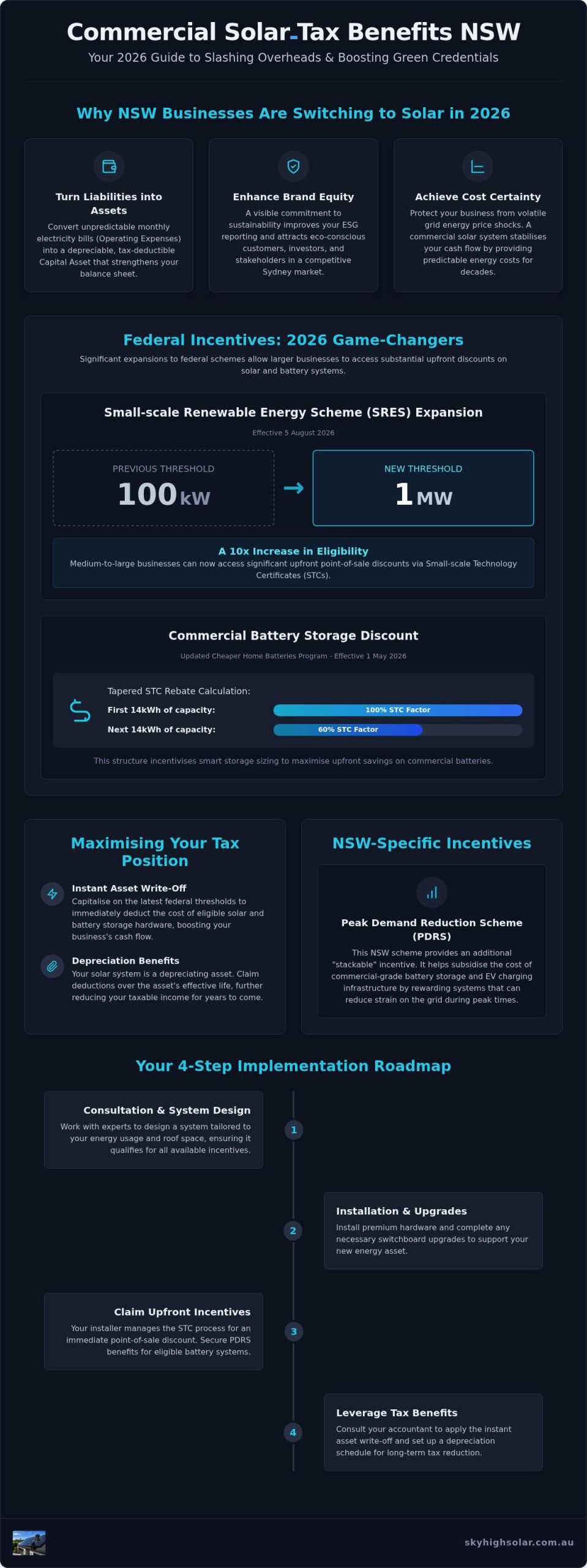
Federal support for renewable energy remains a cornerstone of the financial case for solar, but the rules have evolved significantly as of August 2026. The most substantial change involves the Small-scale Renewable Energy Scheme (SRES). On 5 August 2026, the Federal Government announced an increase in the eligibility threshold from 100kW to 1MW. This expansion allows medium-to-large Sydney businesses to access upfront certificates that were previously reserved for smaller installations. STCs are applied as a point-of-sale discount rather than a traditional rebate, which means the financial benefit is realised immediately upon installation. For larger sites exceeding the new 1MW limit, Large-scale Generation Certificates (LGCs) continue to provide ongoing revenue based on the actual electricity produced by the system.
Claiming the 30% Battery Discount
The Cheaper Home Batteries Program underwent a major structural change on 1 May 2026, introducing a tapered STC calculation that now rewards businesses for smart storage sizing. Under these rules, the full STC factor applies to the first 14kWh of usable capacity, while 60% applies to the next 14kWh. This makes high-quality storage solutions, such as the FOX ESS CQ7 High Voltage Storage Battery, exceptionally cost-effective for Sydney SMEs looking to bridge the gap between daytime generation and evening peak demand. To remain eligible for these commercial solar tax benefits nsw, all equipment must be Clean Energy Council (CEC) approved and installed by accredited professionals. Integrating these federal incentives with the NSW Energy Savings Scheme ensures that your capital works harder, providing a faster path to total energy independence. If you’re unsure which hardware qualifies, a professional commercial solar consultation can clarify your eligibility before you commit to a design.
STCs vs LGCs: Which applies to your Sydney business?
Choosing between STCs and LGCs depends entirely on your system’s scale and your preference for immediate versus long-term returns. STCs are calculated based on a “deeming period” that effectively prepays the expected carbon abatement of your system until the scheme concludes in 2030. Because this deeming period reduces by one year every January, businesses that act earlier in the 2026 calendar year capture a higher certificate yield. In contrast, LGCs require the installation of sophisticated metering to track every megawatt-hour generated. While LGC spot prices have shown some volatility in 2026, trading around $7.10 in early August, they offer a recurring income stream for major commercial sites. Most Sydney small businesses find that the upfront simplicity of STCs provides the best cash flow advantage, particularly when deploying a 10kW or 30kW array to offset high daytime operational costs. For a comprehensive breakdown of how to structure these returns alongside chattel mortgages and operating leases, our guide to commercial solar investment NSW covers the full spectrum of 2026 business finance options.
Maximising the Instant Asset Write-Off and Depreciation
While federal certificates provide an immediate point-of-sale discount, the most significant fiscal gains often occur during tax time. For eligible Sydney SMEs, the ability to write off the cost of new equipment can dramatically improve end-of-year cash flow. This is where the interplay of federal policy and commercial solar tax benefits nsw becomes most apparent. Beyond the hardware itself, necessary infrastructure works like switchboard upgrades are typically included in the total cost of the asset. This means your entire transition to renewable energy, including the essential safety and compliance components, works to reduce your taxable income. Businesses can generally claim the full GST amount as an input tax credit on their next Business Activity Statement (BAS), which further reduces the initial capital outlay and simplifies procurement.
Immediate Deductions for Solar Hardware
For the 2026 financial year, the instant asset write-off threshold is set at $20,000 for eligible small businesses. This allows for an immediate deduction of the business portion of the cost of a 6.6kW or 10kW system in the first year it’s used or installed. The deduction applies to the net cost after STCs have been subtracted, covering everything from the solar panels and FOXESS hybrid inverters to the battery racking systems. It’s a powerful incentive for businesses looking to upgrade their fleet infrastructure, as explored in our Commercial EV charging station installation case study. By writing off these assets immediately, you lower your tax liability while simultaneously reducing your monthly overheads.
Long-term Depreciation Strategies
Larger commercial arrays that exceed the instant asset write-off threshold aren’t left behind. These systems are managed through multi-year depreciation schedules, typically using either the Prime Cost or Diminishing Value methods. Choosing the right strategy depends on whether you prefer a consistent deduction over time or a larger benefit in the early years of the system’s life. Solar is classified as a capital improvement for your commercial property, which can enhance the overall valuation of the premises while providing ongoing commercial solar tax benefits nsw. We always recommend consulting with a qualified BAS agent or tax professional to ensure your depreciation schedule aligns perfectly with current ATO rulings and your specific business structure. This methodical approach ensures that your investment in high-tier hardware, like the SigenStor integrated system, delivers maximum financial value throughout its long operational life. To protect that long-term value, scheduling regular solar panel servicing in Sydney is essential to prevent efficiency losses from dust accumulation and coastal corrosion from silently eroding your depreciation returns. To explore how different finance structures such as operating leases can further optimise your depreciation position, the 2026 NSW commercial solar investment finance guide provides a detailed comparison tailored to Sydney businesses.
NSW-Specific Benefits: ESS and Peak Demand Reduction
While federal STCs provide a solid foundation, the NSW state government offers additional layers of support that transform a standard installation into a high-yield financial strategy. These state-based programmes are designed to reward businesses for reducing their reliance on the grid during times of high stress. By stacking these incentives with federal support, Sydney business owners can significantly improve their project’s internal rate of return. This isn’t just about passive savings; it’s about active participation in the NSW energy market. New rules under the NSW Energy Security Safeguard came into effect on 1 July 2026, refining how businesses can monetise their energy flexibility through certificates that represent verified carbon abatement and peak demand reduction.
Trading Energy Savings Certificates (ESCs)
The NSW Energy Savings Scheme (ESS) remains a powerful tool for commercial entities. When you undertake an energy-saving project, such as a large-scale solar installation or a comprehensive LED lighting upgrade, you generate Energy Savings Certificates (ESCs). These certificates have a tangible market value and can be sold to Accredited Certificate Providers (ACPs) to provide an additional cash injection for your project. For a standard 30kW office system, the volume of ESCs generated can represent a meaningful percentage of the total project value. Because the ESS is a performance-based scheme, it encourages the use of high-efficiency hardware that delivers long-term reliability. To ensure you capture every available certificate, it’s essential to work with installers who understand the rigorous documentation required by the NSW government.
The Peak Demand Reduction Scheme (PDRS)
The most significant development for 2026 is the commencement of new commercial battery incentives under the Peak Demand Reduction Scheme (PDRS). Starting on 1 September 2026, the PDRS introduces specific incentives (BESS4 and BESS5) for battery storage systems ranging from 20kWh up to 30MWh. This scheme creates Peak Reduction Certificates (PRCs), which were trading at approximately $3.50 as of June 2026. By installing a smart system like the SigenStor Integrated Solar Inverter and EV DC Charger, your business can qualify for these demand-response rewards. These batteries don’t just store energy; they intelligently discharge during peak periods to support the Sydney grid, which in turn reduces the “demand charges” on your energy bill. This dual benefit of certificate income and reduced peak tariffs makes high-capacity storage a cornerstone of modern commercial solar tax benefits nsw. If you’re ready to see how these state incentives apply to your specific site, we recommend booking a professional energy audit to map out your potential certificate yield.
Implementation: Securing Your Commercial Solar Tax Benefits
Moving from the theoretical potential of solar to a fully commissioned, tax-optimised system requires a methodical approach. To ensure your business captures the full spectrum of commercial solar tax benefits nsw, the transition must be documented correctly from day one. This process begins with a professional energy audit of your Sydney premises. We analyse your site’s specific load profile to determine the ideal system size, ensuring you don’t over-invest in capacity you can’t utilise or under-invest and miss out on significant peak demand savings. This data-driven foundation is what allows your accountant to project accurate ROI and depreciation schedules with confidence.
Once the design is finalised, the physical infrastructure must meet both electrical safety standards and tax-eligibility criteria. A critical part of this is ensuring your switchboard upgrade is performed by a specialist who understands commercial compliance. Because these works are essential for the solar system’s operation, they are typically bundled into the total depreciable asset value. We also verify the Clean Energy Council (CEC) approval status of every component, from high-performance Enphase microinverters to FOX ESS storage solutions. Finally, we provide a detailed quote that clearly separates hardware costs from installation services. This level of transparency is vital for your BAS agent when they are claiming GST credits and applying for the instant asset write-off.
Working with Sky High Solar and Electrical
Our role as a Visionary Specialist is to remove the complexity from your energy transition. Local Sydney expertise is non-negotiable when dealing with the specific grid requirements of Ausgrid and Endeavour Energy. We ensure that your commercial system design not only meets these technical standards but is also optimised for the latest NSW incentive rules. Our team assists with the comprehensive technical documentation required for your tax claims, providing the peace of mind that comes from working with a steady, experienced hand. We don’t just install panels; we build intelligent energy hubs that future-proof your business against the rising costs of the late 2020s.
Your 2026 Commercial Solar Checklist
To streamline your application for commercial solar tax benefits nsw, we recommend having a clear roadmap. Start by gathering 12 months of interval data from your energy provider. This allows us to create a precise model of your daytime generation versus consumption. We then work through our partner network to facilitate your NSW ESS certificates, ensuring you receive the maximum market value for your energy savings. Whether you are starting with a 10kW solar system or a much larger array, following this checklist ensures no incentive is left on the table. Protecting that investment with ongoing professional solar panel servicing in Sydney ensures your system continues to perform at the output levels your tax strategy depends on. By aligning your technical installation with a robust tax strategy, you transform your roof into one of your most productive business assets.
Future-Proofing Your Sydney Business with Solar
The 2026 energy landscape offers a rare alignment of federal support and state-based incentives for Sydney business owners. By leveraging the expanded 1MW SRES threshold alongside the new NSW Peak Demand Reduction Scheme, you can transform your monthly electricity liability into a high-performing, tax-deductible asset. We’ve seen how a structured approach to hardware selection and professional auditing ensures you capture every available certificate while stabilising your long-term cash flow. Navigating these commercial solar tax benefits nsw requires a partner who understands both the electrical complexity and the regulatory requirements of the Sydney grid.
As Sydney-based electrical specialists and CEC Accredited Installers, Sky High Solar is committed to delivering premium energy solutions. Our status as authorised FOX ESS and SigenStor partners ensures your system is built with the most advanced hardware available today. If you’re ready to secure your energy independence and optimise your next tax return, take the first step toward a smarter energy footprint. Request a 2026 Commercial Solar Tax Analysis for Your Sydney Business today. We look forward to helping you build a more sustainable and profitable future.
Frequently Asked Questions
Is commercial solar still tax-deductible in Australia in 2026?
Yes, solar remains a fully tax-deductible business expense for Australian companies. You can generally claim the cost of the system through the instant asset write-off scheme or via long-term depreciation schedules. This allows your business to reduce its taxable income while simultaneously lowering monthly operational overheads through reduced electricity bills.
How does the Instant Asset Write-Off apply to solar panels for my NSW business?
Eligible NSW small businesses can immediately deduct the business portion of the cost of a solar system up to the $20,000 threshold in the first year of installation. This applies to the net cost of the hardware after any federal rebates have been applied. It’s a highly effective way to improve first-year cash flow for SMEs investing in 6.6kW or 10kW arrays.
Can I claim the GST back on a commercial solar installation?
Yes, if your business is registered for GST, you can claim the full GST amount paid on the solar installation as an input tax credit. This is typically done on your next Business Activity Statement (BAS) following the purchase. Because solar is a significant capital investment, this credit provides a substantial and immediate reduction in the net cost of the system.
What is the difference between STCs and LGCs for commercial systems?
STCs provide an upfront discount for systems up to 1MW, following the federal government’s threshold increase on 5 August 2026. In contrast, Large-scale Generation Certificates (LGCs) apply to systems exceeding this limit and generate ongoing revenue based on the actual electricity produced. Most Sydney SMEs prefer STCs because they provide immediate financial relief at the point of sale.
Are there specific solar rebates for small businesses in Sydney?
Sydney businesses can access commercial solar tax benefits nsw through a combination of federal STCs and the state-based Energy Savings Scheme (ESS). These programmes work together to reduce the initial purchase price and reward your business for verified energy efficiency. Combining these with the latest battery incentives ensures you capture the maximum available support for your transition.
Does the ATO allow depreciation on commercial battery storage?
Yes, the ATO classifies commercial batteries as depreciable assets with a defined effective life. High-quality storage units, such as the FOX ESS CQ7, can be depreciated over several years to provide ongoing tax relief. If the battery cost falls under the current $20,000 threshold, it may also be eligible for an immediate deduction under the instant asset write-off rules.
How do NSW Energy Savings Certificates (ESCs) work?
ESCs are market-based certificates created under the NSW Energy Savings Scheme when a business implements energy-saving measures. A professional solar installation reduces your grid dependency, which generates these certificates. You can then sell ESCs to accredited providers, effectively creating a secondary cash injection that further offsets the cost of your commercial solar tax benefits nsw strategy.
Can I combine federal solar rebates with NSW state incentives?
Yes, you can “stack” multiple incentives to achieve the fastest possible return on investment. Many Sydney businesses successfully combine federal STCs with NSW state incentives like Energy Savings Certificates (ESCs) and Peak Reduction Certificates (PRCs). This multi-layered approach is particularly effective when installing integrated systems that include both solar generation and smart battery storage.