

 Sydney
 0452 243 240
Blog
Solar battery rebate nsw


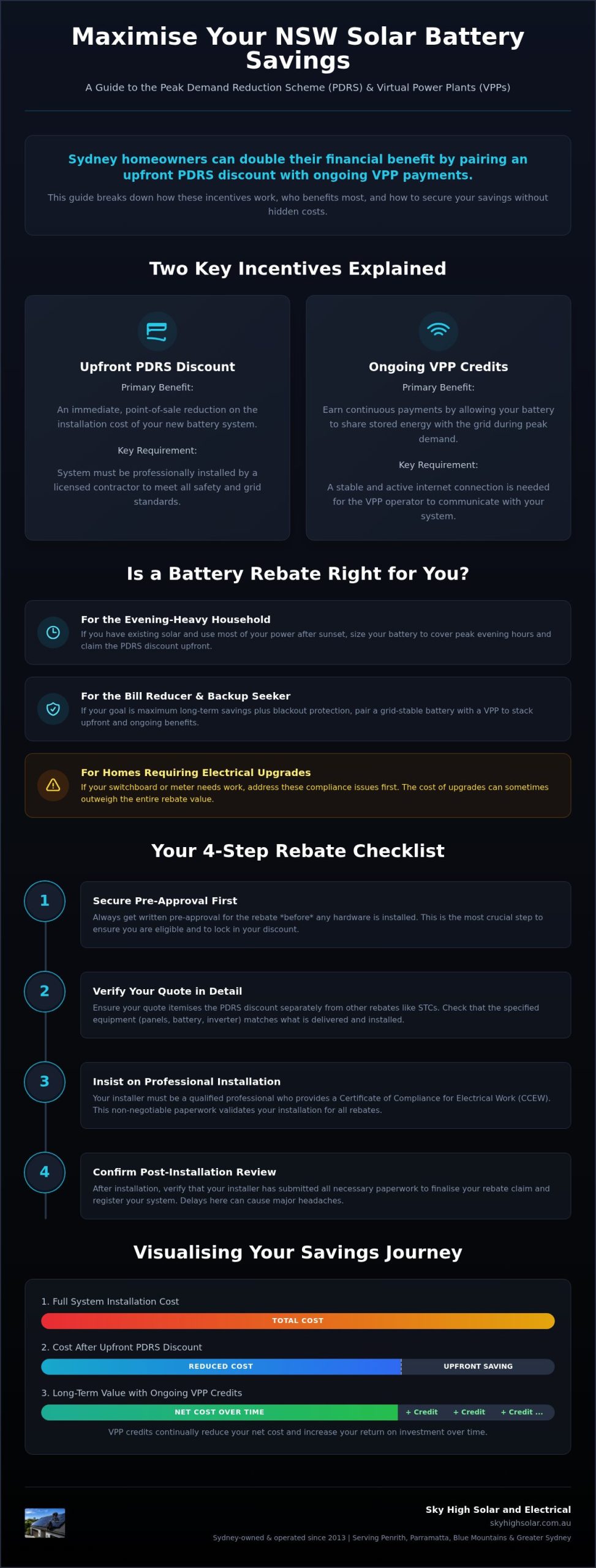
TL;DR: NSW homeowners can claim an upfront PDRS discount based on battery capacity plus ongoing credits by joining a Virtual Power Plant (VPP).
- Upfront PDRS discounts scale with usable capacity and require professional installation for eligibility.
- Except when existing electrical board upgrades are required, as these costs can outweigh rebate savings.
- Recommendation: Best for evening-heavy households who secure written pre-approval before any hardware installation begins.
- The article’s table shows that VPP participation requires an active internet connection for grid-sharing credits.
The battery rebate (PDRS) offers upfront savings based on total usable capacity and network integration. Homeowners in Sydney can double their financial benefit by pairing grid-stable battery storage with ongoing Virtual Power Plant (VPP) payments. Taking advantage of these incentives lowers your power bills while securing reliable backup power for your home.
Match the rebate to your load before you buy
A battery rebate (PDRS) cuts upfront installation costs for homeowners across Sydney. Clients who claim the government battery discount (upfront payments for grid-stable battery storage) reach household energy independence faster than those who wait on export credits alone. These incentives lower the barrier when you add storage to rooftop solar (133% oversizing rule) setups.
Three common situations shape the right next step:
- Evening-heavy household with existing rooftop solar: size usable capacity to cover peak hours and claim the PDRS discount at point of sale.
- Homeowner who wants bill reduction plus backup: pair a grid-stable battery with a VPP so upfront savings and ongoing credits stack.
- Site that still needs board or meter work: fix compliance and paperwork paths first, or upgrade costs can erase the rebate.
To learn more about sizing and returns, read our Solar Battery Cost NSW: 2026 Guide to Prices, Rebates & ROI.
Joining a battery virtual (VPP) adds ongoing savings by feeding stored energy back into the grid during peak demand. Relying only on a money back for solar (feed-in tariff) has clear limits, because grid export rates fluctuate.
Careful planning prevents common installation headaches. Some buyers face substituted gear, uninstalled panels, or delayed meter trade-outs. Check equipment lists before signing, and verify your installer submits the installation paperwork (CCEW) promptly. Proper coordination helps your solar battery (Hybrid HV inverter) setup clear battery installed (post-installation review) approval without delay. To verify your state portal credentials, visit Service NSW 2026.
One user posted in the forum.cleanenergyreviews.info thread "Melbourne South East & Mornington solar installers":
"Does this figure account for STC rebates? $6200 seems a little dear for that system if so, and I’d say $9k for Seraphim and Enphase ~4.75kW seems high too." (source)
Quoted system estimates often confuse buyers who cannot verify whether point-of-sale discounts were applied. Comparing component specifications stops you from overpaying for hardware substitutions.
Rebate amounts scale with capacity and network setup
Your actual battery rebate (PDRS) depends directly on system capacity and operational setup. Direct incentive claims need a clear check before you sign system contracts. Many consumers hit frustration when promised panels or refunds do not appear, so confirming eligibility upfront matters. Correct claims usually mean working with qualified professionals who handle official submissions.
For stronger long-term return, upfront incentive discounts outperform a plan that leans only on future trading.
| Incentive Structure | Primary Benefit | Operational Requirement |
|---|---|---|
| Direct PDRS Discount | Instant point-of-sale reduction | Professional installation |
| Battery virtual (VPP) | Ongoing grid sharing credits | Active internet connection |
Protect the investment with clear pricing breakdowns. A solar battery needs accurate configuration to access state benefits. Your installer must process the official installation paperwork (CCEW) to validate each claim. Secure a complete Solar Battery Installation & Storage Sydney | Home Battery setup so eligibility for current state incentives stays intact.
Stay cautious when chasing money back for solar. High export rates often mask weaker upfront system value. Government battery discount (upfront payments for grid-stable battery storage) policies reward systems that support grid stability. A battery installed must meet precise state standards to qualify. Rooftop solar (133% oversizing rule) regulations also shape total system capacity limits.
Tip: Ensure your written quote itemizes the PDRS discount separately from STC rebates so hidden fees do not creep in.
VPP credits add ongoing savings beyond the upfront cut
Joining a VPP lets you share stored power from your solar battery with the electricity grid during peak demand periods. The network ties home energy systems into a smart energy hub. Participating households receive financial credits for supplying stored energy when power networks carry heavy loads across Sydney.
Entering a grid-sharing program can lock your system into automated discharge events. Check contract obligations carefully, because some providers limit how much emergency reserve stays in the home system. Audit ongoing management fees against promised returns before you sign.
Balance immediate hardware savings against daily energy flexibility. A VPP suits households that want larger financial offsets. Staying independent suits families that put total backup control first during local outages.
Professional sizing keeps system output aligned with daily household demand. A qualified Solar Panel Installation | Solar Power Company Sydney designs custom layouts that lift daily yields. Payback depends heavily on current feed-in tariff (money back for solar) rates, which have dropped significantly in NSW recently. Proper panel orientation keeps total output strong through peak sunlight hours.
Writing in the forum.cleanenergyreviews.info thread "Melbourne South East & Mornington solar installers", a participant stated:
"I hope your Solar installers are going to use a Tilted Racking or you will only harvest approx. 4 hours of Peak energy, and that equates to 18kWh of energy if panels are installed Flat & not tilted." (source)
Mounting panels flat rather than tilted limits daily output hours, direct sun exposure, and total system efficiency. Sound racking angles help generate enough baseline power for battery incentives and VPP network contributions to pay off.
When the rebate costs more than it saves
Applying for a battery rebate (PDRS) makes little sense if your current electrical setup needs large upgrades that outweigh potential savings.
In field inspections, households often stall when rushed installs skip proper site assessments. Sub-contractors move fast without checking whether the existing board can safely handle high power throughput.
Homeowners then spend weeks chasing the electricity provider and installer for follow-up work or unissued refunds. Picking an installer only because they advertise low upfront payments for grid-stable battery storage often leads to that administrative mess. You end up in phone queues waiting on essential installation paperwork (CCEW).
A poorly matched setup plus lower money back for solar rates leaves the unit underused. A small budget system suits low evening energy users, whereas a 10kW Solar System with Battery Cost Sydney: 2026 Price Guide fits heavy energy consumers across Sydney.
Claiming incentives without reviewing hardware quality is like buying a discounted sports car without an engine. Weak components degrade fast in harsh weather. Accredited installers who own the full post-installation review process spare you that later grind.
Request an itemised site assessment before you lock the rebate path.
Pre-approval first: keep the rebate intact
You must secure written pre-approval before installing your energy storage system to claim the rebate. Many homeowners lose funding by completing installation paperwork (CCEW) before government sign-off.
From practical installation work, early submission stops unexpected paperwork rejections. Strict state procedures protect your financial return.
- Select an approved provider: Choose a certified installer who calculates your eligible battery rebate (PDRS) discount.
- Submit pre-approval documents: Your provider submits technical specifications to the scheme administrator prior to any site work.
- Receive conditional approval: Wait for formal written clearance from state regulators.
- Complete the installation: A qualified electrician fits your solar battery following local grid standards.
- Finalise post-installation review: The installer lodges post-work data to apply the discount to your invoice.
Treat approval the same way you treat a building permit before pouring concrete. According to the NSW Digital Design System 2026, state digital channels require exact identity and documentation checks to process incentives correctly.
Sky High Solar and Electrical has been Sydney-owned and operated since 2013, acting as a steady hand in a rapidly evolving industry. The team handles regulatory steps so your savings stay protected.
Tip: Never allow an installer to fit your battery before receiving written conditional approval under the Peak Demand Reduction Scheme (PDRS) or you forfeit the entire incentive.
Frequently asked questions
How much rebate can I get for a solar battery in NSW?
You can access government battery discount (upfront payments for grid-stable battery storage) savings that scale directly with your usable storage capacity. The state incentive reduces installation costs based on battery size. Smaller systems receive lower incentive amounts; larger installations secure higher upfront savings. Contact the team for a tailored assessment of your system setup.
Can I claim a second discount for an existing battery?
Connecting your existing system to an eligible network scheme opens secondary financial incentives. Homeowners with an existing solar battery can claim further benefits by joining an approved network program. You do not need a brand-new storage unit to qualify for these network connection bonuses.
Who is eligible for the doubled incentive?
NSW residents adding approved energy storage to an existing or new system can access these state government programs. You must install eligible equipment through an accredited installer to claim the battery rebate (PDRS). Local guidance through program requirements has been available from the Sydney-owned team since 2013.
How does a VPP work and what are its benefits?
A battery virtual (VPP) links individual home storage units into a smart network that shares power during peak grid demand. Participation lowers electricity bills and adds income through network rewards. Home backup power stays protected while the system helps stabilise the local Sydney electricity grid.
Does the VPP rebate impact payback times?
Joining a virtual network speeds return on investment by adding recurring rewards on top of initial installation savings. You earn ongoing credits above standard money back for solar. High-rate chasing still carries trap risk under strict annual caps, yet the extra program payments shorten total system payback periods.
Claim Your Solar Battery Rebate NSW
Securing a solar battery rebate (PDRS) in 2026 reduces upfront energy costs across Sydney, which brings the same decision full circle: match capacity to your load, stack VPP only when reserve rules fit, and clear pre-approval before any hardware goes on the wall.
Sky High Solar and Electrical manages the full application path. The team handles your installation paperwork (CCEW) and coordinates the grid connection.
Contact the Sydney team for a transparent, itemised quote on your battery upgrade.