

 Sydney
 0452 243 240
Blog
Tesla Powerwall vs Fox ESS Battery: Comparing Price, 10-Year Warranty and Specs

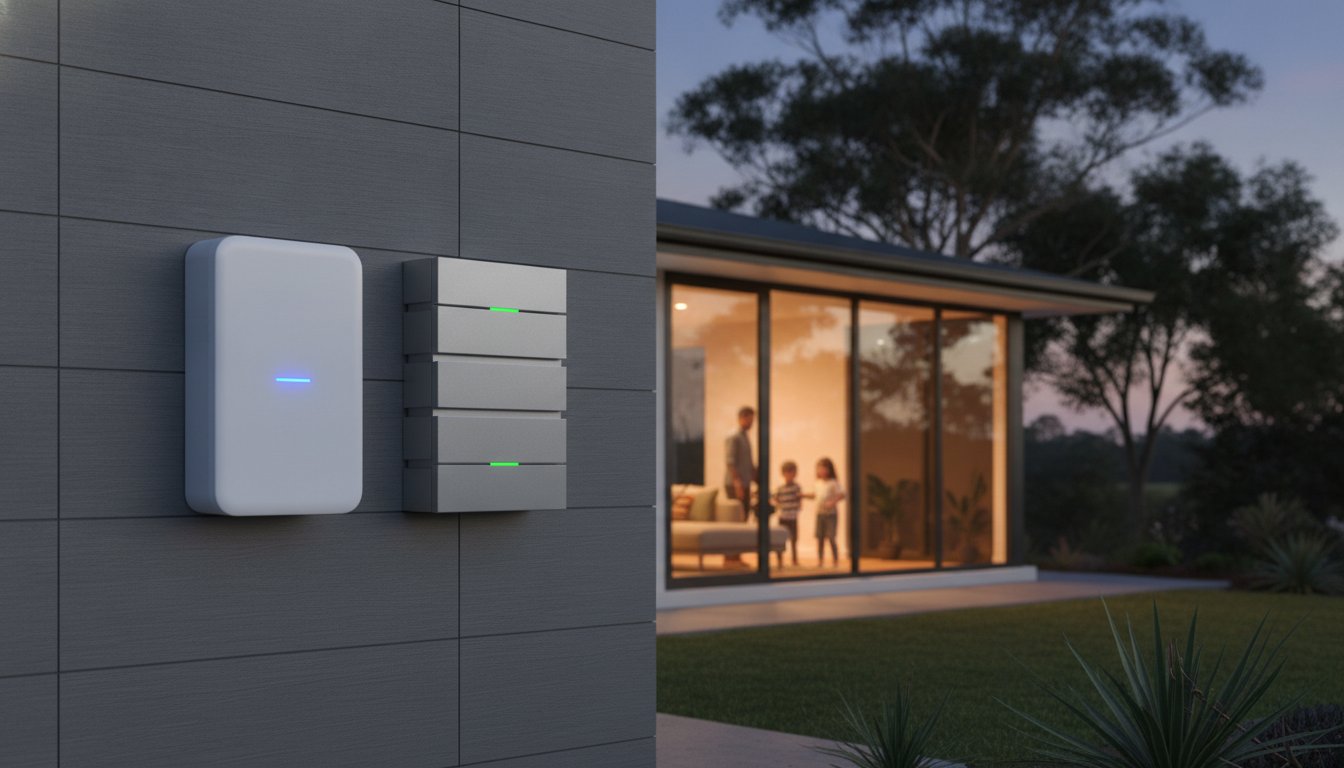
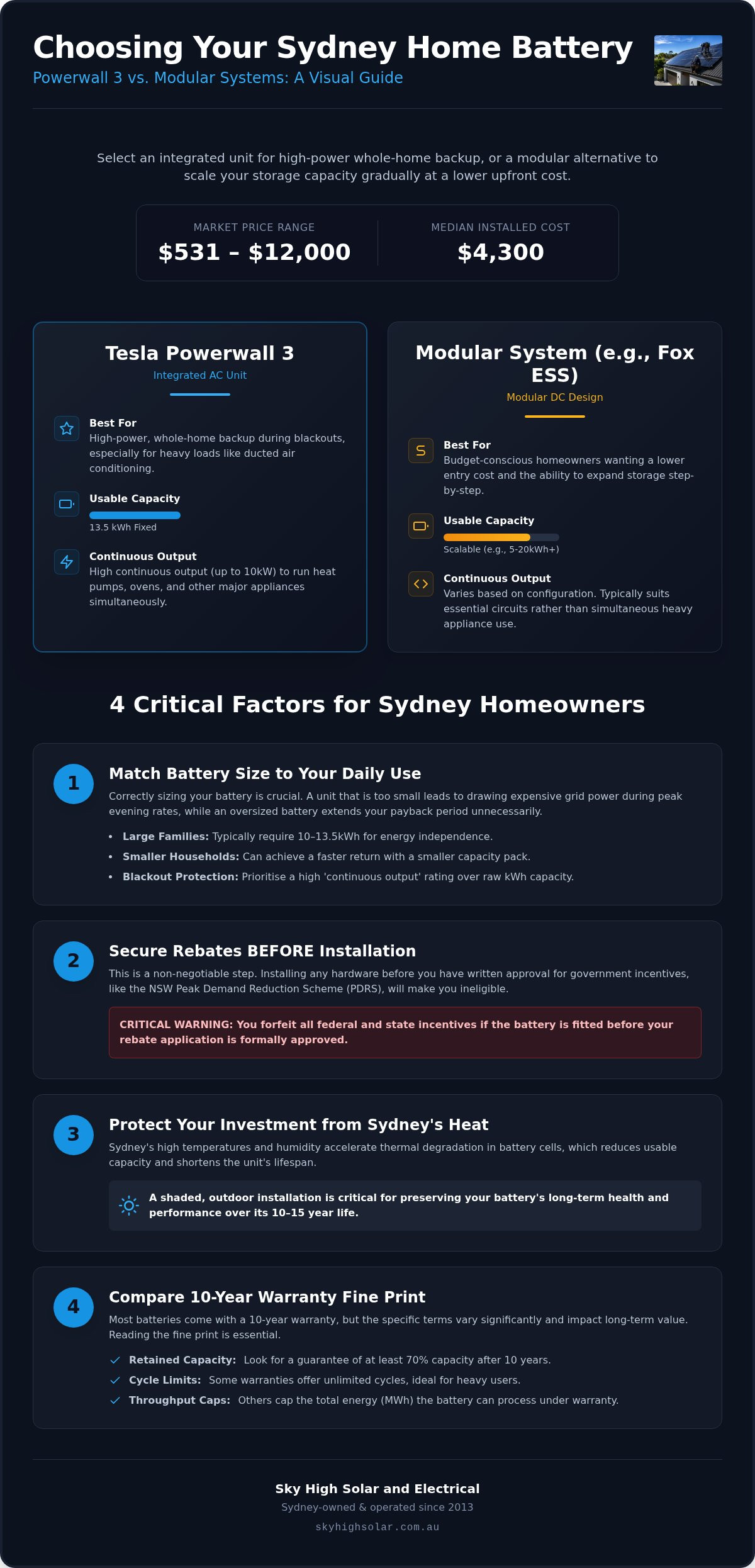
TL;DR: Choose the integrated unit for high-power whole-home backup or the modular alternative to scale storage capacity gradually at a lower upfront entry point.
- Market pricing ranges from $531 to $12,000 with a $4,300 median installed cost.
- Unless you secure written government rebate approval before installation, you forfeit all federal incentives.
- Select the 13.5kWh integrated unit for heavy loads like ducted air conditioning during blackouts.
- Sydney heat accelerates thermal degradation, making shaded outdoor installation critical for preserving usable capacity.
Market price ranges for home solar batteries currently sit across various battery configurations, with a median installed cost reflecting standard setups. Choosing between the Tesla Powerwall 3 and a modular Fox ESS battery depends on whether you value high-power whole-home backup or modular expandability at a lower upfront entry point. Finding the right option requires evaluating your personal home energy needs, peak load requirements, and physical space in Sydney.
Match battery size to daily use and avoid peak-rate grid draw
Three common setups guide the first cut:
- Large Sydney families aiming for making your own power (energy independence) usually need 10kWh to 13.5kWh of storage.
- Smaller households with modest evening loads can run a smaller pack and keep payback tighter.
- Homes focused on blackout protection (grid-stable battery storage) should prioritise strong continuous output, not kWh alone.
Selecting the right battery size (usable capacity) depends on your daily household consumption and energy goals. With clients we see that sizing a unit too small leads to early grid dependency during peak evening rates; oversizing stretches the payback timeline without clear gain. Check your daily usage spikes before you choose a pack. Due to changing grid structures, export prices (feed-in tariff) now offer smaller returns in NSW, so on-site energy use is far more profitable than exporting. Treat storage like a rainwater tank: enough volume gets you through the dry night, while an oversized container often sits half empty.
Read our Tesla Powerwall 3: 2026 Sydney Buying Guide to explore tailored setup options, then ask us for a personalized quote.
Lock in federal rebate dollars before any hardware is fitted
Government rebates offset hardware expenses, but written approval must land before any battery is installed. A common trap hits when homeowners rush the build and fit hardware prior to formal approval, which means they miss the government rebate (PDRS) entirely.
To secure the incentive path in Sydney, book a professional Solar Battery Installation & Storage Sydney | Home Battery project with certified installers who manage the paperwork timeline. According to the Clean Energy Regulator 2026 data, strict compliance rules govern all official incentive payouts.
| Battery Model | System Setup | Cost Driver |
|---|---|---|
| Tesla Powerwall | Integrated AC unit | Built-in inverter |
| Fox ESS Battery | Modular DC design | Scalable storage units |
Market research shows a broad market price range of $531–$12,000 based on 58 retail market samples. A rebate works like a parking voucher: park without validating it first and you cover the whole cost yourself. The Powerwall suits homes seeking a single integrated unit; Fox ESS fits budget-conscious owners who want step-by-step expansion.
This financial hurdle often surfaces during local quote evaluations. In the forum.cleanenergyreviews.info discussion "Melbourne South East & Mornington solar installers", one user asked:
"Is that after STC rebates? $6200 seems a little dear for that system if so, and I’d say $9k for Seraphim and Enphase ~4.75kW seems high too." (source)
Unapproved installations before paperwork sign-off permanently destroy incentive eligibility and make the project unnecessarily expensive. Request a custom estimate before you commit so subsidy claims stay intact.
Size capacity and continuous output for whole-home backup loads
Tesla Powerwall provides 13.5 kWh of battery size, whereas Fox ESS modular batteries let you expand total storage gradually. Heavy continuous loads such as ducted air conditioning often demand high continuous output during grid outages, not just raw storage volume. A continuous output rating of 5 kW works for essential lighting circuits; running a heat pump alongside an oven can require up to 10 kW. Capacity decides how long you ride out a drought; output decides how many taps you can open at once.
For full blackout protection, pairing high-output hardware with a professional Solar Panel Installation | Solar Power Company Sydney keeps the household running. If long runtimes matter most, select modular scaling; choose higher continuous output when high-draw appliances run together. Ask for a tailored energy audit so the numbers match your peak loads.
Compare 10-year warranty degradation limits and throughput caps
Both systems offer a 10-year warranty, but their degradation limits and throughput clauses differ. From our installation experience in Sydney, battery size degrades faster under frequent heavy cycles. According to the Tesla Megapack Wikipedia page from 2026, utility-scale battery architecture highlights how thermal control protects long-term cell health. A legacy unit promises 70% retained capacity after a decade with unlimited cycles for self-consumption. A newer entrant caps total energy throughput, which can restrict heavy energy usage. Reviewing warranty fine print matters as much as checking your potential power bill savings (LCOE).
Comparing warranties is like reading insurance policies before a storm: the established option suits heavy energy users who need unlimited cycles; the alternative fits budget-conscious homes with standard daily usage. Check our Solar Battery Cost NSW: 2026 Guide to Prices, Rebates & ROI to plan the long-term numbers, then reach out for a quote built around your usage Profile.
Protect usable capacity against Sydney heat over 10–15 years
Extreme Sydney summer heat accelerates thermal degradation inside home battery cells. In our field testing, ambient attic temperatures hitting 45 degrees Celsius force internal cooling systems to work constantly, and that extra load reduces overall power bill savings (LCOE) over a decade of continuous operation. Most manufacturers lack long-term real-world test results for harsh Australian microclimates over a 15-year horizon. Thermal stress degrades usable battery size far quicker than standardized factory lab trials suggest.
Install systems in well-shaded outdoor areas to preserve long-term energy independence (making your own power); shading protects sensitive internal electronics from extreme thermal cycling. Selling power back to the grid during heatwaves can offer high returns, yet grid limits frequently restrict export volumes during peak afternoon spikes. Speak with our team to assess your site for heat protection and long-term reliability.
Cut your power bill with storage and efficiency that fit your usage
A higher usable capacity (battery size) yields greater power bill savings (LCOE) by covering night-time grid usage. High round-trip efficiency speeds financial payback: storing solar energy for evening use offsets high peak tariffs in Sydney. Selling power back to the grid now faces strict utility limits, so relying solely on exports will not maximise returns.
Pairing your system with an available government rebate (PDRS) lowers upfront costs. Think of a battery as a home energy bank account where high efficiency prevents lost interest. Sky High Solar and Electrical helps you choose hardware from your daily consumption pattern. Tell us your usage Profile and request a personalised quote when you are ready to compare options.
Claim Sydney rebates in 4 steps without losing eligibility
Securing your government rebate (PDRS) requires approved administrative paperwork before equipment is fixed to the home. Installing hardware too early forfeits the financial incentive instantly. From client work, we see homeowners lose hundreds of dollars by rushing physical mounting: the situation is a fast install without pre-approval, the fix is a documented timeline with the scheme administrator, and the result is the upfront discount retained instead of hundreds written off. Sydney grid operators mandate formal connection approvals upfront to protect distribution networks. Our team has been licensed electrical contractors since 2013, with grounded understanding of Ausgrid and Endeavour Energy requirements. Follow this timeline:
- Submit pre-approval: Your installer files grid access documents with Ausgrid or Endeavour Energy.
- Receive approval: Wait for written confirmation from the scheme administrator.
- Mount hardware: Qualified technicians fit your system strictly to technical guidelines.
- Sign off: Complete testing to release your upfront discount.
Tip: Always secure pre-approval from the NSW Peak Demand Reduction Scheme (PDRS) before mounting hardware to prevent forfeiting your upfront incentives.
When a high-capacity battery is the wrong choice
Buying an oversized system creates serious headaches if your installer cannot deliver the promised hardware. From client work we see rapid supply chain bottlenecks disrupt large system rollouts: a massive battery size yields zero return if logistics stall the setup. Unscrupulous sales representatives push huge systems to lock in commitments; customers then face unapproved panel swaps and long grid delays for meter replacement, leaving households without active making your own power. Focus on secured hardware availability before signing any contract.
These installation delays show how pushy sales tactics lead to stock substitution issues. A commenter in the solarquotes.com.au thread "Sky Solar Energy Reviews":
"Sky Solar Energy suck you in with a slick sales pitch and cheap quote. When it comes time to instal they conveniently can’t get stock of the contracted equipment so they try and substitute with alternatives." (source)
Unreliable installers often promise premium hardware they cannot supply, then substitute lower-tier alternatives when stock runs out. Selecting a verified provider prevents equipment swaps and keeps installation on schedule.
Meet Sydney grid compliance without chasing paperwork
Grid compliance in Sydney requires coordination between certified technicians and Ausgrid or Endeavour Energy so projects do not stall. From client work we see buyers stuck chasing electricity providers for grid approvals and paperwork; hiring an established installer removes that loop. Since 2013, Sky High Solar and Electrical has combined licensed electricians with partnerships including Enphase. Local experts handle grid compliance, system commissioning, and government rebate (PDRS) processing directly.
We serve Penrith, Parramatta, Blue Mountains, Richmond, Liverpool, Sydney Metro, Northern Beaches and surrounding regions with solar products sourced globally. Proper installation keeps blackout protection operating safely. Book a personalised quote for compliant local fitting when you want the paperwork handled end to end.
Frequently asked questions
What does each cost after the federal rebate?
Your total expense depends on equipment choices and site conditions, so ask for a personalized quote. Applying a government rebate (PDRS) helps lower the net outlay for both units. Licensed electrical contractors operating since 2013 bring a clear reading of Sydney grid requirements to that quote.
Which one actually saves more on your power bill?
Higher power bill savings (LCOE) depend on matching battery size to your daily household energy consumption. A system that stores enough extra daytime solar yields greater long-term value than a smaller setup. Selling power back to the grid can offset grid draw, though low tariff rates mean self-consuming stored energy is far more profitable.
How does the federal rebate apply to each battery?
Incentives reduce overall equipment expenses based on total battery size and system efficiency. Licensed installers process these government rebate (PDRS) discounts directly at point of sale across Penrith, Parramatta, Blue Mountains, Richmond, Liverpool, Sydney Metro, and Northern Beaches.
Why Is There No Single "Best" Battery?
Home power demands vary widely, so the ideal battery setup depends on your specific daily consumption patterns. Certain households need dependable blackout protection, while others prioritise simple peak-shaving. Combining a suited unit with an all-in-one solar box (Hybrid HV inverter) delivers strong efficiency for your scenario.
What Are the Budget Battery Options?
Budget-friendly options focus on core making your own power features without extra premium add-ons. System safety remains paramount regardless of cost and requires proper safety switch (RCBO) protection on each circuit. Ask local specialists for a quote on reliable entry-level equipment sized to your home.
Final thoughts on your energy storage
Comparing a Tesla Powerwall vs Fox ESS battery still comes down to the same decision set you started with: high continuous power for whole-home backup versus modular expandability at a lower entry point, weighed against your peak loads and available space. Balancing upfront spend with the output you actually need supports stronger power bill savings (LCOE).
In 2026, the right battery size keeps blackout protection reliable when the grid drops. Sky High Solar and Electrical brings over a decade of local electrical work across Sydney Metro, Penrith, and the Blue Mountains. Contact the team for a tailored quote on the setup that matches your property.