

 Sydney
 0452 243 240
Blog
Solar Battery Cost NSW: 2026 Guide to Prices, Rebates & ROI


By mid-2026, over 186,000 NSW households have already integrated storage into their energy systems, yet many still pay more than necessary because they miss out on the latest point-of-sale discounts. It’s understandable to feel hesitant when technology and regulations move so quickly. Between shifting federal incentives and the persistent anxiety of Sydney grid blackouts, determining the true solar battery cost nsw can feel like a moving target for even the most diligent homeowner.
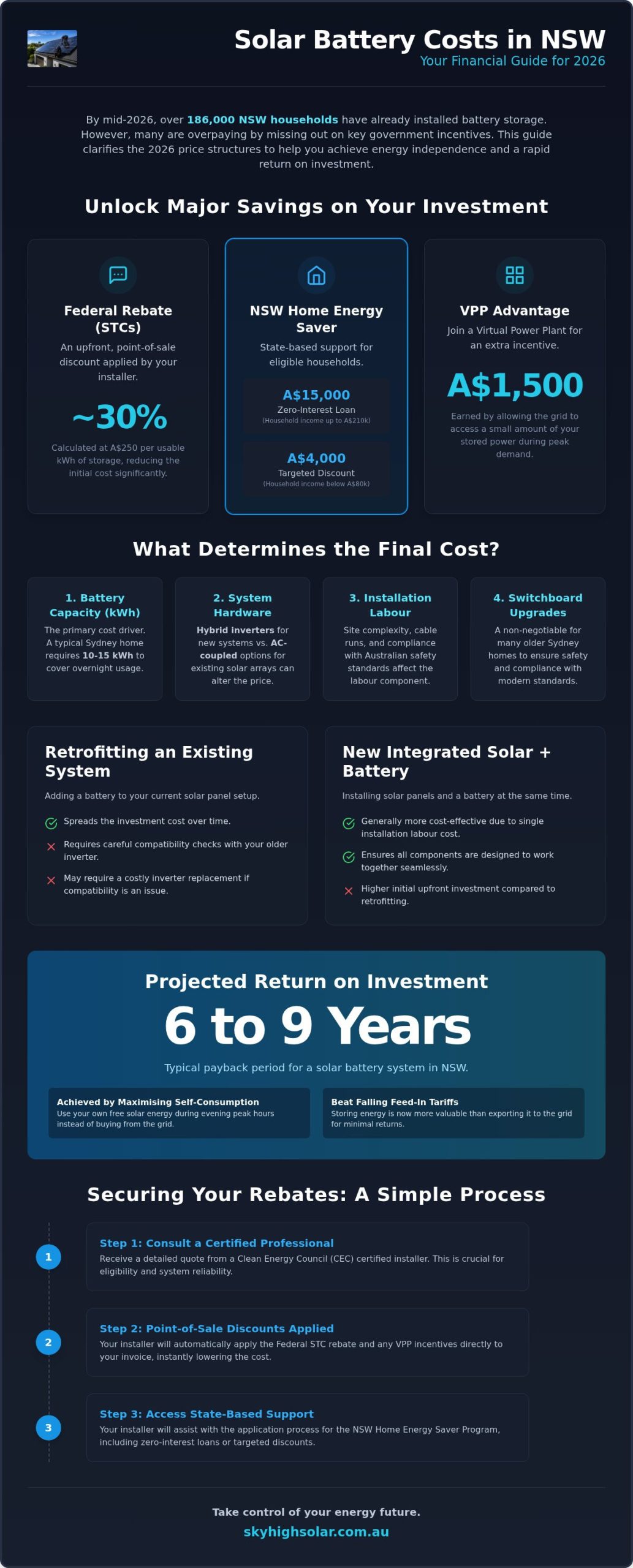
We believe that transitioning to a smarter home should be transparent and rewarding. This guide provides the clarity you need by breaking down the 2026 price structures, including the approximately 30 per cent upfront federal discount and VPP incentives of up to A$1,500 that can slash your payback period to as little as six years. You’ll learn how to access the newest Home Energy Saver loans and understand the STC multiplier changes scheduled for the end of the year. We will examine high-performance systems like the FOX ESS CQ7 and Tesla Powerwall 3 to show you exactly how to achieve near-zero power bills and total energy independence during peak times.
Key Takeaways
- Realise how a combination of the 30% federal point-of-sale discount and NSW VPP incentives can significantly reduce the initial solar battery cost nsw.
- Identify the eligibility criteria for the 2026 Home Energy Saver program, including zero-interest loans and targeted discounts for eligible households.
- Evaluate the technical advantages of high-voltage systems like the FOX ESS CQ7 and Tesla Powerwall 3 for ensuring energy independence during peak periods.
- Determine your projected return on investment by understanding how self-consumption and falling feed-in tariffs influence a six-to-nine-year payback period.
- Master the step-by-step process for claiming government rebates, ensuring your system is installed by a certified professional to guarantee long-term reliability.
Calculating the Cost of Solar Batteries in NSW for 2026
Understanding the total investment required for energy storage involves more than just looking at a single price tag. The primary driver of any solar battery cost nsw is the usable capacity, measured in kilowatt-hours (kWh). Larger households in Sydney typically require 10kWh to 15kWh of storage to cover overnight usage; however, the cost per kWh often decreases as the system size increases. Choosing a high-voltage system like the FOX ESS CQ7 provides a balance between high performance and long-term value, ensuring your home remains powered through peak evening periods.
The technical architecture of home energy storage systems also dictates the final invoice. If you’re installing a new system, a hybrid inverter is often the most efficient choice because it manages both your panels and battery. For those adding storage to an existing array, an AC-coupled system might be necessary. While AC-coupled options allow for flexibility, they can sometimes involve higher hardware costs due to the need for a dedicated battery inverter. Beyond the core components, professional installation labour accounts for a significant portion of the budget. Sydney’s diverse architecture, from heritage terraces to modern multi-storey builds, means site complexity can vary. Factors such as cable run lengths, the need for fire-rated backing boards to meet Australian safety standards, and local council compliance all play a role in the final quote.
The Switchboard Factor: A Sydney Necessity
Many older homes in Sydney still rely on outdated electrical infrastructure that isn’t ready for modern storage. We often find that switchboard upgrades are a non-negotiable step in the installation process. Moving from old ceramic fuses to modern RCBOs (Residual Current Breakers with Overcurrent protection) ensures your system is safe and compliant. Additionally, the mandatory smart meter rollout in NSW provides the granular data needed for effective battery monitoring, though it may require minor wiring adjustments during your upgrade.
Retrofitting vs. New Solar + Battery Systems
Adding a battery to an existing 6.6kW system is a popular way to evolve, but it requires careful compatibility checks. Older inverters often lack the intelligence to communicate with modern lithium-iron phosphate batteries, which may necessitate an inverter replacement. Conversely, installing solar panels and a battery simultaneously is usually more cost-effective. You’ll save on labour by having the team on-site once and avoid the “double-up” costs of purchasing separate monitoring hardware later. This integrated approach ensures every component is designed to work together from day one.
NSW Solar Battery Rebates and Incentives in 2026
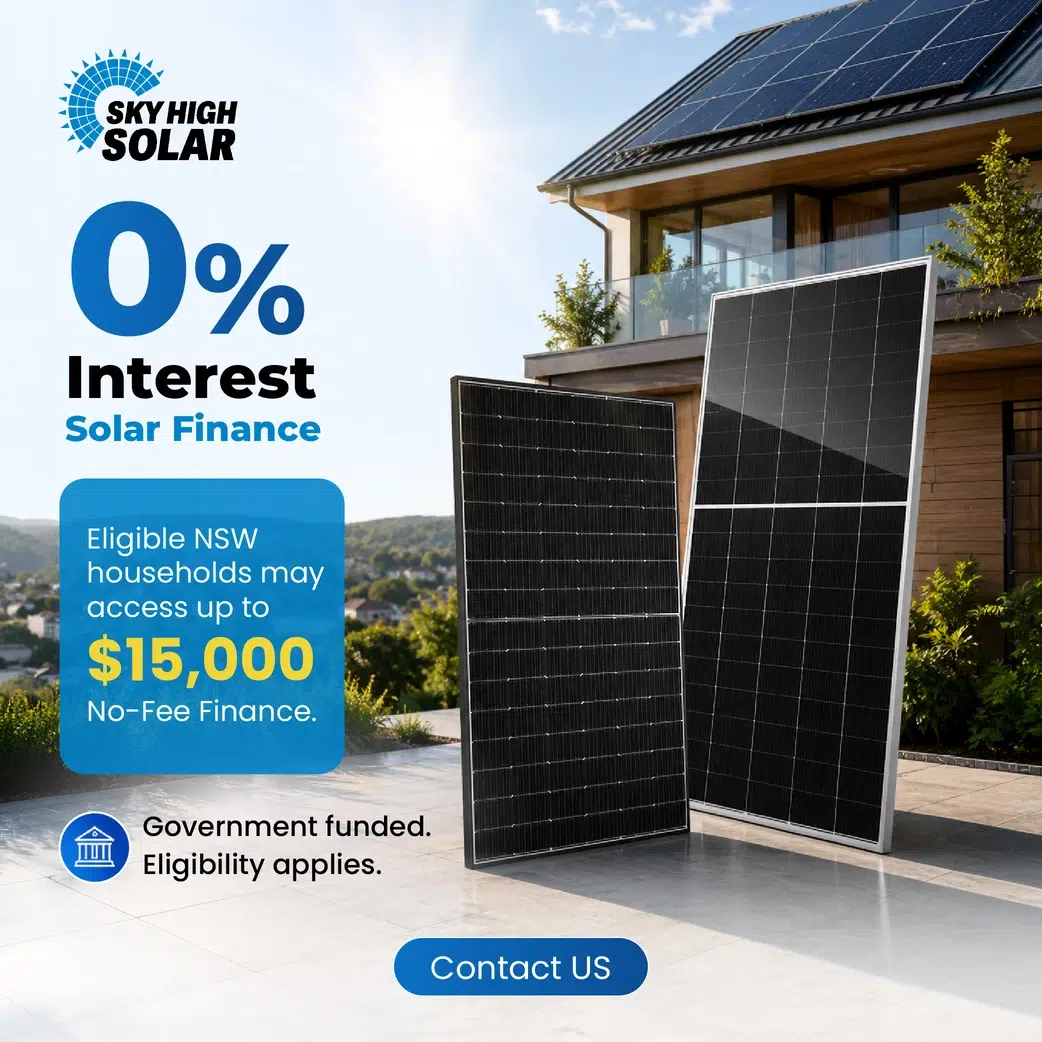
The 2026 landscape for reducing your solar battery cost nsw has evolved from simple cash-back offers into a more sophisticated suite of point-of-sale discounts and low-interest financing. While the standalone state installation rebate was suspended in July 2025 to avoid overlap, the current NSW battery incentives offer significant relief for families looking to secure their energy future. The cornerstone of state support is the Home Energy Saver Program. This initiative provides zero-interest loans of up to A$15,000 for households with a combined income of up to A$210,000. Later in 2026, targeted discounts of up to A$4,000 will also become available for households with an income below A$80,000, ensuring that energy independence remains accessible to all.
Federal support remains a vital component of the financial equation. As of May 2026, the federal rebate is calculated at a rate of 6.8 Small-scale Technology Certificates (STCs) for every usable kilowatt-hour of storage. This translates to an upfront discount of approximately A$250 per usable kWh, or roughly 30 per cent of the total system cost. Unlike older rebate models, this is applied directly to your invoice by the installer. It removes the need for you to wait for a reimbursement check and effectively lowers the solar battery cost nsw from day one. These STC values are scheduled to decrease at the end of the year, making the current period an ideal time to lock in higher savings.
The VPP Advantage in Sydney
Joining a Virtual Power Plant (VPP) has become one of the most effective ways to lower your initial investment. By allowing the grid to occasionally draw on a small portion of your stored power during peak stress events, you can claim an additional incentive of up to A$1,500. This is paid on top of federal discounts and is valued at approximately A$36 to A$37 per kWh of capacity. For Sydney residents, this doesn’t just lower the bill; it helps stabilise a grid that often feels the strain during summer heatwaves. Balancing your own energy independence with this minor grid support requirement is a strategic move that pays dividends.
Maximising the Federal Battery Rebate
To secure the full 30 per cent discount under the Cheaper Home Batteries Program, your hardware must be on the approved list of high-quality components. Brands like FOX ESS are frequently chosen because they meet these stringent efficiency and safety standards. Combining these federal STCs with a VPP sign-up often results in a payback period of under eight years. If you’re unsure which combination of incentives applies to your specific property, it’s a good idea to request a tailored assessment from a specialist who understands the local Sydney regulations.
Comparing the Best Solar Batteries for Sydney Homes
Choosing a storage solution requires a balance between initial investment and long-term reliability. In the current market, your choice of hardware significantly influences the overall solar battery cost nsw. While many homeowners look for the lowest entry price, the most successful installations in Sydney prioritise systems that offer high round-trip efficiency and robust thermal management. It’s about finding a partner for your home that delivers consistent power when the grid fails or when peak pricing kicks in.
For those seeking a premium experience, the Tesla Powerwall 3 tesla home battery remains a popular benchmark due to its high power output and integrated design. However, the SigenStor Integrated Solar Inverter & EV DC Charger is rapidly gaining ground among forward-thinking households. It offers a unique modular approach that combines battery storage with a dedicated EV DC charger, removing the need for separate, bulky hardware in the garage. Meanwhile, Enphase IQ Batteries provide a modular alternative that’s ideal for homes already utilising microinverter technology, allowing you to expand your storage capacity as your family’s needs grow.
FOX ESS CQ7 vs. Tesla Powerwall 3
When comparing the FOX ESS CQ7 against the Tesla standard, the conversation often turns to high-voltage (HV) architecture. HV systems are becoming the residential standard across NSW because they allow for faster charging and discharging rates with less energy lost as heat. The CQ7 is particularly well-regarded for its value-per-kWh, offering a sophisticated management system and a ten-year warranty backed by local Sydney support. For a deeper look at how the full FOX ESS range performs in real-world NSW conditions, our comprehensive fox ess battery review for 2026 examines long-term reliability, the impact of the A$1,500 NSW PDRS rebate, and how its modular design compares to traditional all-in-one systems. It provides a stable, high-performance alternative for those who want premium features without the “brand tax” often associated with more famous competitors, helping to keep the total solar battery cost nsw manageable.
Efficiency and Thermal Performance in the Sydney Climate
Sydney’s humidity and intense summer heat pose specific challenges for battery chemistry. We consistently recommend Lithium Iron Phosphate (LFP) batteries over Nickel Manganese Cobalt (NMC) variants. LFP chemistry offers superior thermal stability, making it a safer choice for installation in Australian garages or on external walls where temperatures can spike. To maximise this hardware, pairings like GoodWe hybrid inverters are a reliable choice. These inverters are engineered to handle the fluctuating temperatures of the NSW coast while maintaining high conversion efficiency. This ensures that every bit of sunshine is captured and stored safely, protecting your investment for the next decade and beyond.
How to Claim Your NSW Battery Rebate: A Step-by-Step Guide
Moving from the research phase to a physical installation requires a clear, methodical approach to ensure you don’t leave money on the table. While the potential to lower your solar battery cost nsw is significant, the eligibility for various 2026 incentives depends heavily on following the correct administrative sequence. This isn’t just about technical compliance; it’s about ensuring every document is lodged correctly to lock in your point-of-sale discounts and VPP incentives from the outset.
The journey begins with a professional energy audit and site inspection. A specialist will assess your current consumption patterns and determine if your existing infrastructure can support a high-voltage system. Once your needs are defined, you must choose a Clean Energy Council (CEC) accredited installer. This is a mandatory requirement for both federal STCs and the NSW Home Energy Saver program. Your installer will then provide a quote that clearly outlines the “net” price. This means all rebates are deducted upfront, so you aren’t left waiting for a government reimbursement. After the physical installation, your electrician must submit a Form C (Certificate of Compliance for Electrical Work) to the relevant authorities, which serves as the official record of a safe, compliant connection. Finally, once the system is live, you can activate your VPP connection to claim that additional incentive of up to A$1,500.
Finding a Qualified Sydney Installer
Selecting a local provider is often more effective than dealing with national call centres that may not understand the specific requirements of the Sydney grid. Local Sydney residential solar solutions specialists are equipped to handle the unique challenges of older suburban switchboards and coastal weather conditions. When interviewing potential contractors, always ask for their specific battery certifications and their NSW electrical licence number. A truly professional team will handle the entire rebate application process on your behalf, ensuring the technical data matches the government’s strict criteria for the 2026 Home Energy Saver loan and discount schemes.
Navigating the Paperwork
The administrative side of a battery upgrade can be daunting, but it’s the key to minimising your solar battery cost nsw. For the Home Energy Saver application, you’ll generally need proof of household income, a recent rates notice, and your most recent electricity bill. At Sky High Solar and Electrical, we manage these lodgements as part of our comprehensive service, moving you from the initial deposit to a fully rebated installation within a typical four-to-six-week window. This proactive management removes the complexity, allowing you to focus on the long-term benefits of energy independence. If you’re ready to see how these incentives apply to your home, book a site assessment today to get started.
Is a solar battery worth it in NSW in 2026?
Is the investment in energy storage justifiable for the average household? In 2026, the financial case for energy storage has reached a tipping point. While the initial solar battery cost nsw remains a consideration, the combination of declining feed-in tariffs and rising peak electricity rates makes self-consumption the most logical path forward. Most homeowners now see a typical payback period of six to nine years, especially when participating in a VPP. However, the decision to install a battery isn’t purely about the ledger. It’s about hedging against energy market volatility expected between 2027 and 2030.
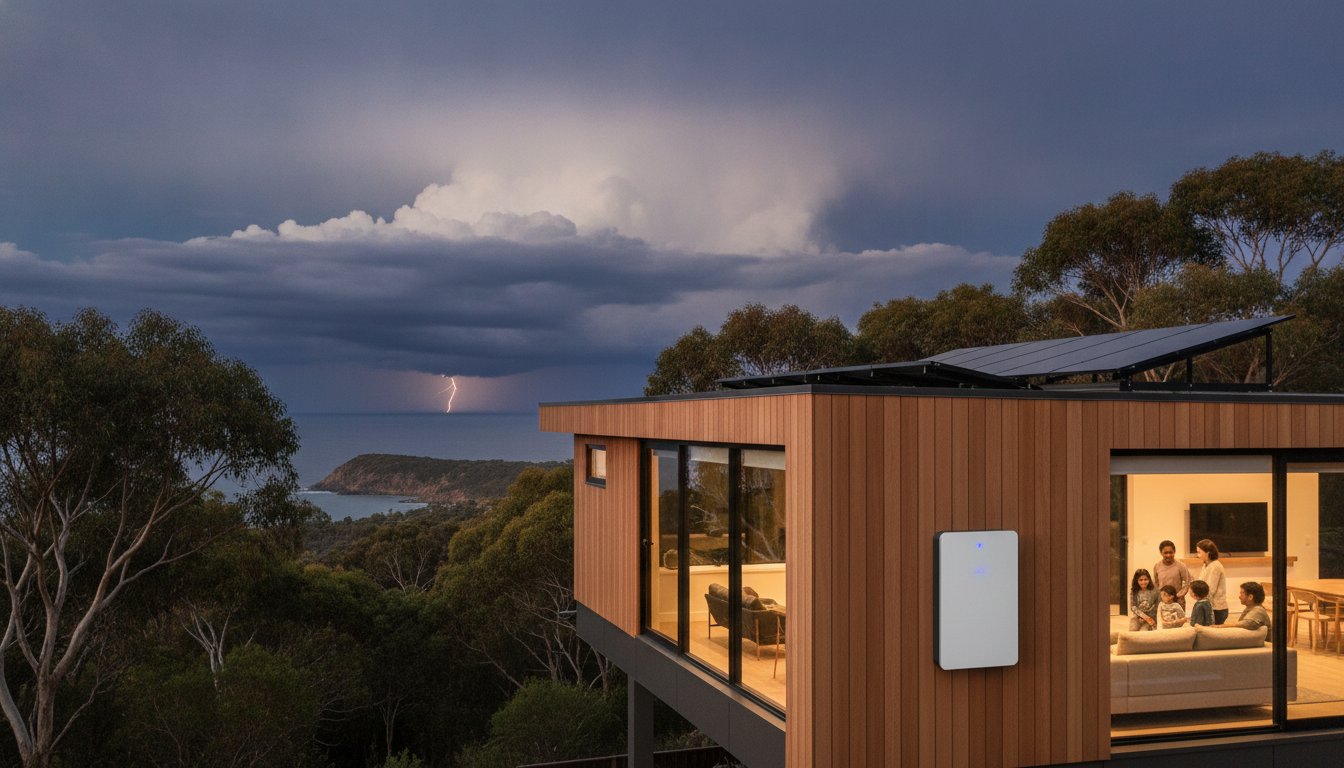
Achieving energy independence also provides a vital safety net against grid instability. Sydney residents frequently face the risk of blackouts during extreme weather events. A high-quality system with backup capabilities ensures your essential appliances stay powered, providing a level of security that a standard solar-only array cannot offer. This “independence factor” is becoming a primary motivator for families who want to future-proof their homes against both rising costs and external infrastructure failures.
Integrating EV Charging with SigenStor
As Sydney moves toward an electric transport future, the SigenStor Integrated Solar Inverter & EV DC Charger has emerged as a game-changer for new installations. By choosing an integrated system from the start, you avoid the redundant costs of purchasing and installing a separate EV wallbox later. The logic is simple: you charge your vehicle using the “free” excess solar energy stored in your battery during the day. This integrated approach reduces the total solar battery cost nsw by streamlining hardware requirements and simplifying the electrical work needed in your garage.
Final Verdict for Sydney Homeowners
If your quarterly power bills are consistently high and you have a 6.6kW solar system that exports most of its energy for a low feed-in tariff, the time to act is now. The cost of inaction is real; every day you wait is a day of lost savings and continued reliance on an expensive grid. For those with lower usage or who are planning to move soon, waiting might seem tempting, but the scheduled reduction in federal STC incentives at the end of 2026 suggests that the best value is available today. Your next step should be to request a custom solar battery quote to see exactly how the numbers stack up for your property.
Future-Proof Your Sydney Home Today
The transition to a smarter, more resilient home is no longer a distant vision; it’s a practical reality for Sydney residents in 2026. By understanding the true solar battery cost nsw and leveraging the current 30 per cent federal discount alongside VPP incentives, you can secure a system that pays for itself while providing essential blackout protection. Whether you’re integrating an EV charger with SigenStor or opting for the high-voltage efficiency of the FOX ESS CQ7, the key is choosing a partner who manages every detail, from switchboard upgrades to rebate lodgement.
At Sky High Solar and Electrical, we’ve been serving the Sydney community since 2013 as licensed electrical contractors. Our team consists of certified FOX ESS and Tesla installers dedicated to removing the complexity of modern energy transitions. We ensure your installation is seamless, compliant, and optimised for maximum long-term value. Don’t let another high power bill or grid failure dictate your lifestyle. Take the first step toward total energy independence and Get a Tailored Solar Battery Quote for Your Sydney Home. Your journey toward a more sustainable and secure home is just one conversation away.
Frequently Asked Questions
How much does a 10kWh solar battery cost in NSW after rebates?
A 10kWh system typically ranges between A$8,000 and A$10,000 before incentives are applied. Once the 30 per cent federal point-of-sale discount and VPP incentives are factored in, the net solar battery cost nsw often drops to a much more accessible level. Final pricing depends on your specific installation complexity and whether your home requires an essential switchboard upgrade to meet modern safety standards.
Is the NSW solar battery rebate still available in 2026?
The standalone NSW installation rebate was suspended in July 2025, but significant government support remains active through other channels. Homeowners can currently access the federal Cheaper Home Batteries Program and the NSW Home Energy Saver scheme. These initiatives provide substantial upfront discounts and zero-interest loans of up to A$15,000, ensuring that energy storage remains a financially viable transition for Sydney families.
What is the payback period for a solar battery in Sydney?
Most Sydney households achieve a full return on investment within six to nine years. This timeframe is heavily influenced by your level of self-consumption and whether you participate in a Virtual Power Plant. As grid electricity prices continue to fluctuate, the ability to avoid expensive peak-hour charges accelerates your total savings, making the long-term value of storage increasingly evident for local residents.
Can I add a battery to my existing 6.6kW solar system?
You can certainly add storage to an existing 6.6kW array. This is usually achieved by installing an AC-coupled battery or by replacing your current inverter with a modern hybrid model. While retrofitting requires careful compatibility checks by a licensed professional, it’s a common way for homeowners to evolve their energy systems without the need to replace their entire solar panel setup.
Do I need to upgrade my switchboard for a solar battery?
Older Sydney homes often require a switchboard upgrade to safely accommodate a modern storage system. Replacing outdated ceramic fuses with modern RCBOs is a non-negotiable safety requirement for accredited installers. This ensures your property meets Australian electrical standards and can safely handle the bidirectional energy flow required for efficient battery charging and discharging during peak periods.
Which is better: Tesla Powerwall 3 or FOX ESS CQ7?
The best choice depends on your specific priorities for performance and long-term value. The Tesla Powerwall 3 is a premium, integrated solution known for its high power output and sleek design. Conversely, the FOX ESS CQ7 is a high-voltage specialist that offers exceptional value-per-kWh, making it a strong contender for those looking to optimise their solar battery cost nsw without sacrificing reliability.
How does a VPP (Virtual Power Plant) reduce my battery cost?
Joining a VPP reduces your initial investment by providing an upfront incentive of up to A$1,500. This payment is offered by VPP providers in exchange for minor grid support during peak events and is applied on top of existing federal rebates. It effectively lowers the barrier to entry while helping to stabilise the local Sydney grid during periods of extreme energy demand.
Does a solar battery provide power during a blackout?
A solar battery provides power during a blackout if it’s installed with dedicated backup functionality. Systems like the SigenStor or Tesla Powerwall 3 tesla home battery are designed to automatically disconnect from the grid and power essential circuits. This ensures your lights, refrigeration, and internet remain active even when the surrounding Sydney network experiences a failure, providing vital peace of mind.