

 Sydney
 0452 243 240
Blog
How to Calculate Your Home’s Energy Use and Appliance Costs

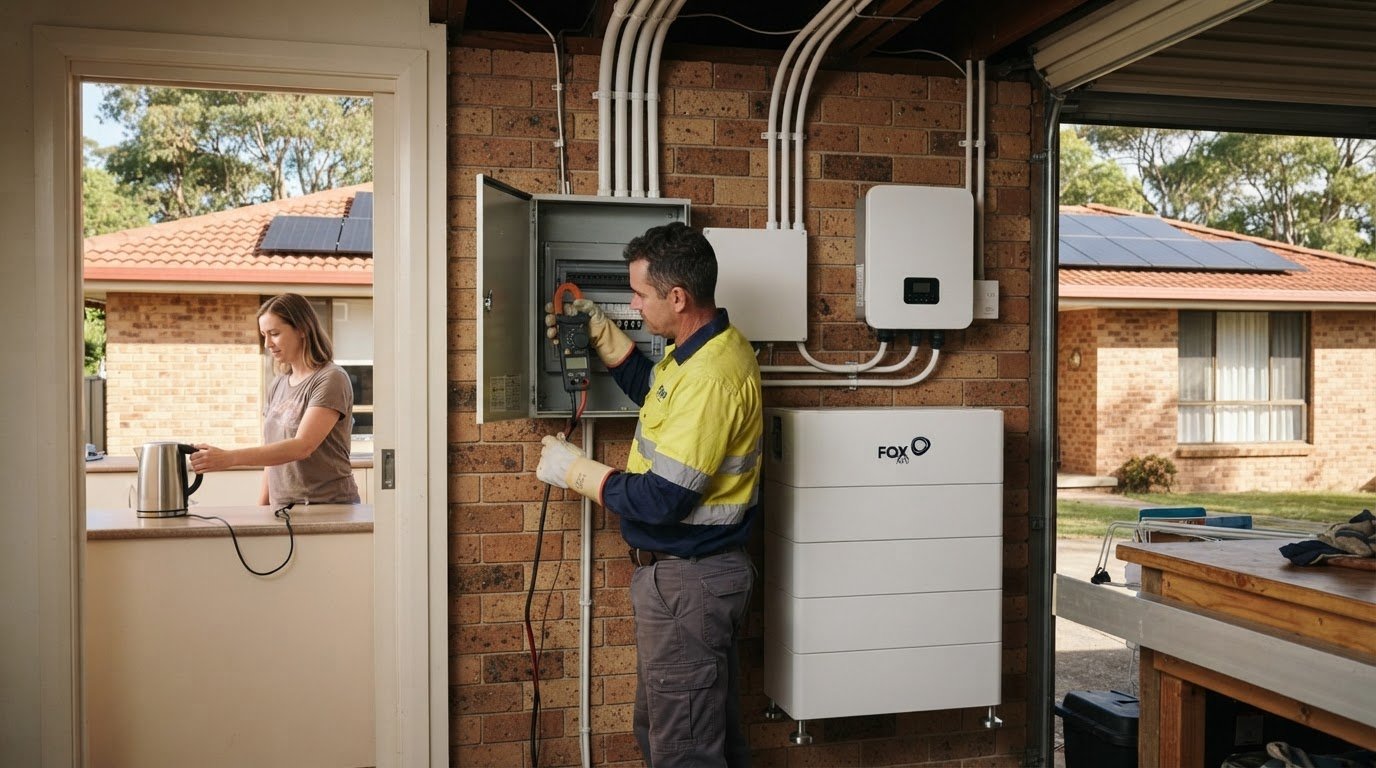
When calculating my home’s energy consumption, start with each appliance’s power rating, how long it runs and your electricity rate. These details help you estimate household electricity use and its cost.
Your electricity bill shows measured overall use, while appliance estimates help explain how daily routines contribute to it. Comparing both gives you a clearer picture of your household’s energy needs.
This guide shows how to estimate appliance costs, compare electricity use across bills and use your household energy profile to begin planning solar in Sydney.
Key Takeaways
- Convert an appliance’s watts to kilowatts by dividing by 1,000, then multiply by its running hours to estimate energy use.
- Use your bill’s usage figures and your electricity tariff to understand household consumption and estimate running costs.
- Compare daily usage across bills from different times of year to spot changing patterns in your home’s electricity use.
- Use your average daily consumption as a starting point for solar planning, with system size shaped by your household’s energy needs.
How do I calculate my appliance electricity costs?
Estimate each appliance’s energy use from its power rating and running time. Then apply your retailer’s usage rate to calculate an approximate cost.
-
Convert appliance watts to kilowatts
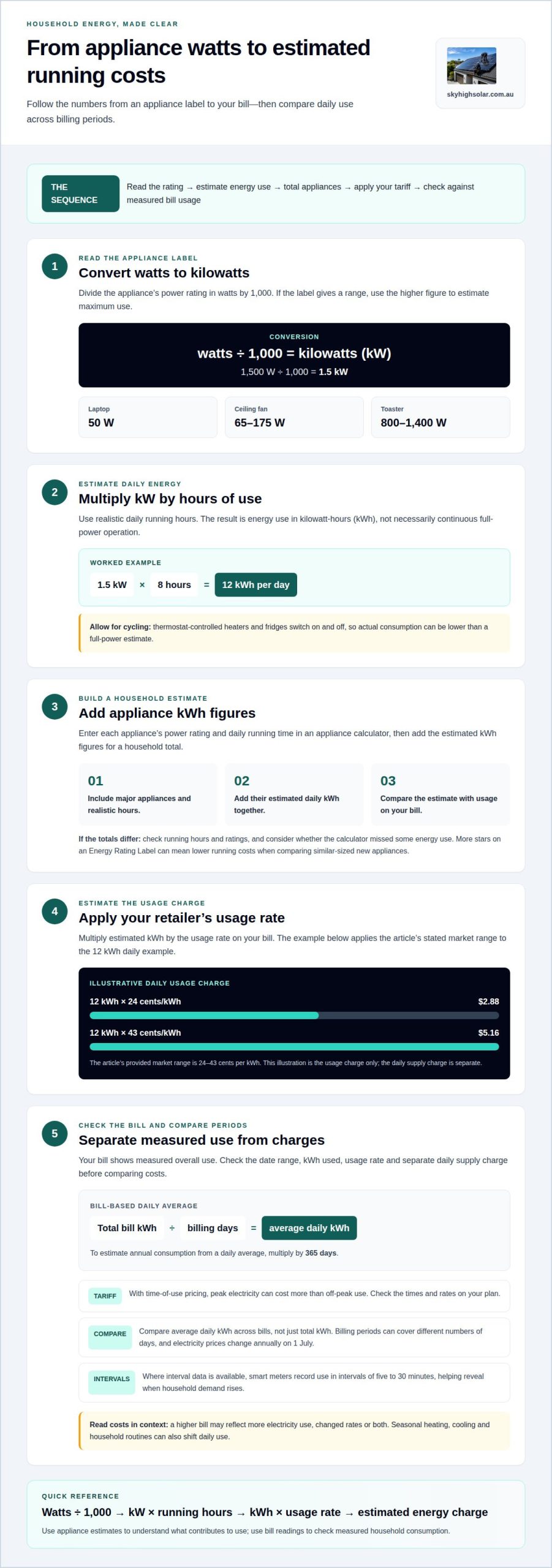
Read the appliance label, then divide its wattage by 1,000 to convert watts to kilowatts (kW). For example, a 1,500 W appliance uses 1.5 kW when operating at full power. Common household examples include laptops at 50 W, ceiling fans at 65-175 W, and toasters at 800-1,400 W. If a rating shows a range, use its higher figure to estimate the maximum cost.
-
Calculate daily appliance energy use
Multiply the appliance’s kilowatt rating by the hours it runs each day. A 1.5 kW appliance running for 8 hours uses 12 kilowatt-hours (kWh). This estimates daily energy use, not necessarily continuous full-power operation: thermostat-controlled heaters and fridges cycle on and off, so actual consumption can be lower. Record realistic running hours to make your estimate more useful.
-
Estimate usage with an appliance calculator
Enter each appliance’s power rating and daily running time in an appliance calculator, then add the estimated kWh figures for a household total. Include major appliances and compare the estimate with the usage on your bill. A large difference may mean appliances run longer than expected, a rating was entered incorrectly, or the calculator missed some energy use. Energy Rating Labels can also help you compare similar-sized new appliances: more stars can mean lower running costs.
-
Apply retailer rates to estimate costs
Multiply estimated kWh by your retailer’s usage rate to estimate the energy charge. Check your bill for the applicable rate. To reduce consumption, choose efficient appliances and avoid unnecessary running time. Compare unusually high estimates with your actual bill usage.
Why is the electricity bill calculator important?
A bill-based calculator connects measured household use with the charges on your electricity account. Comparing usage and tariff details can help show whether a change is due to consumption, pricing or both.
-
Calculate daily usage from a bill
Take the total kWh used during a billing period and divide it by the number of days covered. Use that daily average to estimate annual consumption by multiplying by 365 days. Check the bill’s date range, as estimated readings or different period lengths can affect comparisons. Repeat the calculation for each bill when you want to review use across the year.
-
Read usage, supply charges and tariffs
Separate electricity use, measured in kWh, from the daily supply charge, which appears as a distinct bill item. Then identify the tariff applied to your consumption. Australian bills generally show usage for the billing period, often on the second page under “Total kWh used”. The Australian Government’s Energy Made Easy sample bill can help you find usage and charge details.
-
Understand costs and peak periods
Australian electricity rates vary, with the provided market range sitting between 24 and 43 cents per kWh. Your actual usage rate and tariff determine how consumption affects charges. Under time-of-use pricing, peak-period electricity can cost more than off-peak use. Check the times and rates shown on your plan, then consider shifting flexible tasks, such as laundry, to a lower-rate period where practical.
-
Monitor household energy use
Use your retailer’s app or online account to review consumption trends, where interval data is available. Smart meters record electricity use in intervals of five to 30 minutes, helping reveal when demand rises. There isn’t one representative figure by state and household size in the information here; household use varies with occupancy, climate, home size and appliances. Small routine changes can help reduce avoidable use.
Comparing average daily usage and cost across bills
- Gather bills covering a year and arrange them by billing period. Add the electricity usage in kWh for each period to estimate annual household consumption. A full year captures seasonal changes that a single bill may miss. If bills cover different numbers of days, use the average daily usage shown on each bill, where available, for a more consistent comparison.
- Compare average daily usage, not just the total kWh printed on each bill. A longer billing period can show higher total consumption even when daily habits remain similar. Record each period’s daily kWh alongside its dates, then look for increases or reductions across the year. Ergon Energy advises comparing average daily electricity usage across financial years, because electricity prices change annually on 1 July.
- Separate electricity use from bill costs before drawing conclusions. For each period, compare the usage charge, daily supply charge and applicable tariff. A higher bill can reflect increased use, changed rates or both. If daily kWh stays similar while the usage charge rises, a rate change may explain the difference. Check the dates and tariff details on each bill before comparing costs.
- Use the comparison to investigate changes in household routines. Note whether daily use increases in seasons when heating, cooling or other appliances run more often. Compare that period with similar dates in another year rather than assuming one change explains the result. Keeping a simple record of daily kWh and charges makes unusual shifts easier to spot and supports informed energy decisions.
Sizing a solar system from daily energy use
- Start with your household’s average daily kWh, calculated from bills covering a year. This provides a useful baseline for solar planning. Remember that kWh measures energy consumed, while kW describes system capacity. Account for seasonal changes, as one bill may not reflect shifts in heating, cooling or household routines throughout the year.
- Consider how much rooftop generation could match your demand. Solar output varies with roof orientation, shade, weather and the timing of sunlight. Daily consumption alone cannot determine the right system capacity. Consider it alongside the roof’s generation potential and when your household uses electricity.
- Map your electricity use throughout the day. Solar can power appliances while the system is generating; electricity beyond immediate use can be exported or stored in a battery. Stored energy can supply household demand later. The grid still supplies electricity when demand exceeds available solar generation and stored energy. A battery shifts when you use grid electricity, but does not remove the need to account for it.
- Compare system capacity options against your usage pattern and roof conditions. Available residential installations include 6.6kW and 10kW systems, but those figures alone don’t show which suits your home. Consider daytime demand, evening use, roof layout and whether storage is part of your plan. A properly sized system balances generation with the electricity you can use or store. Discuss solar system sizing using your daily energy profile and household priorities.
If your household also uses LPG, record that expense separately when reviewing energy priorities. Keep its unit cost distinct from electricity use when considering solar sizing: it does not show how much rooftop capacity is appropriate. Separating electricity demand from other household energy costs keeps the solar decision focused on your usage profile, roof conditions and storage preferences.
Use LPG costs as context for household budgeting, not as a substitute for daily electricity data. When comparing options, consider the costs and uses of different energy sources without assuming one determines the right solar system. Your electricity profile remains the basis for assessing how generation, household use and storage fit together.
Sky High Solar and Electrical
Sky High Solar and Electrical helps turn household energy figures into practical solar planning in Sydney. Daily usage, daytime demand and evening consumption can guide decisions about system capacity and whether battery storage suits your routine.
For homes considering solar, available options include 6.6kw and 10kw Solar Panel Installation, alongside the FOX ESS CQ7 High Voltage Storage Battery and SigenStor Integrated Solar Inverter & EV DC Charger. The right combination depends on how your household uses electricity and what you want your system to support. Your energy calculations provide a useful starting point for that discussion.
Contact Sky High Solar and Electrical to discuss your household’s energy use and solar options in Sydney.
Turn your energy profile into a practical plan
Revisit calculating my home’s energy consumption as your household routines change. New appliances, a different work schedule or changes in who is at home can shift electricity needs. Reviewing your energy profile over time helps align future decisions with how you live.
Let your energy goals guide the next steps. Decide whether you want to prioritise daytime solar use, stored energy for later or flexibility for future household changes. These priorities can help shape a plan around your needs.
A clear picture of your energy use gives you a practical foundation for thoughtful decisions about your home’s energy future.
Frequently Asked Questions
How much power does heating and cooling use?
Heating and cooling use depends on the appliance’s input rating, operating time and how often its thermostat cycles. Convert the rating to kilowatts, then multiply by the hours it operates to estimate energy use. For example, a 2.4 kW appliance running for 3 hours at full input uses 7.2 kWh. Actual consumption may be lower if it cycles on and off.
How do I calculate household energy consumption in kWh from electricity meter readings?
Subtract the earlier reading from the later reading for the same electricity register. The difference is the kWh consumed between those readings. Make sure both readings use the same register and cover the dates you want to measure. If your meter has separate import and export registers, use import readings to calculate electricity drawn from the grid, not solar power exported.
How do I read an Australian electricity meter, including smart meters?
Find the electricity register on your meter, usually displayed in kWh, and note its reading and date. A digital meter may cycle through different registers, so identify the one for household consumption. Your retailer’s billing or monitoring tools may also provide smart meter usage information. Match the register and dates to your bill when comparing readings.
How can I estimate an appliance’s energy use from its wattage and hours of use?
Divide the appliance’s watts by 1,000 to get kilowatts, then multiply by its operating hours. For example, a 150 W monitor used for 4 hours consumes 0.6 kWh. To estimate weekly use, multiply that daily amount by the days you use it. The result reflects rated input, so appliances that cycle on and off may consume less.