

 Sydney
 0452 243 240
Blog
Choosing a home EV charger for solar, vehicle and power needs

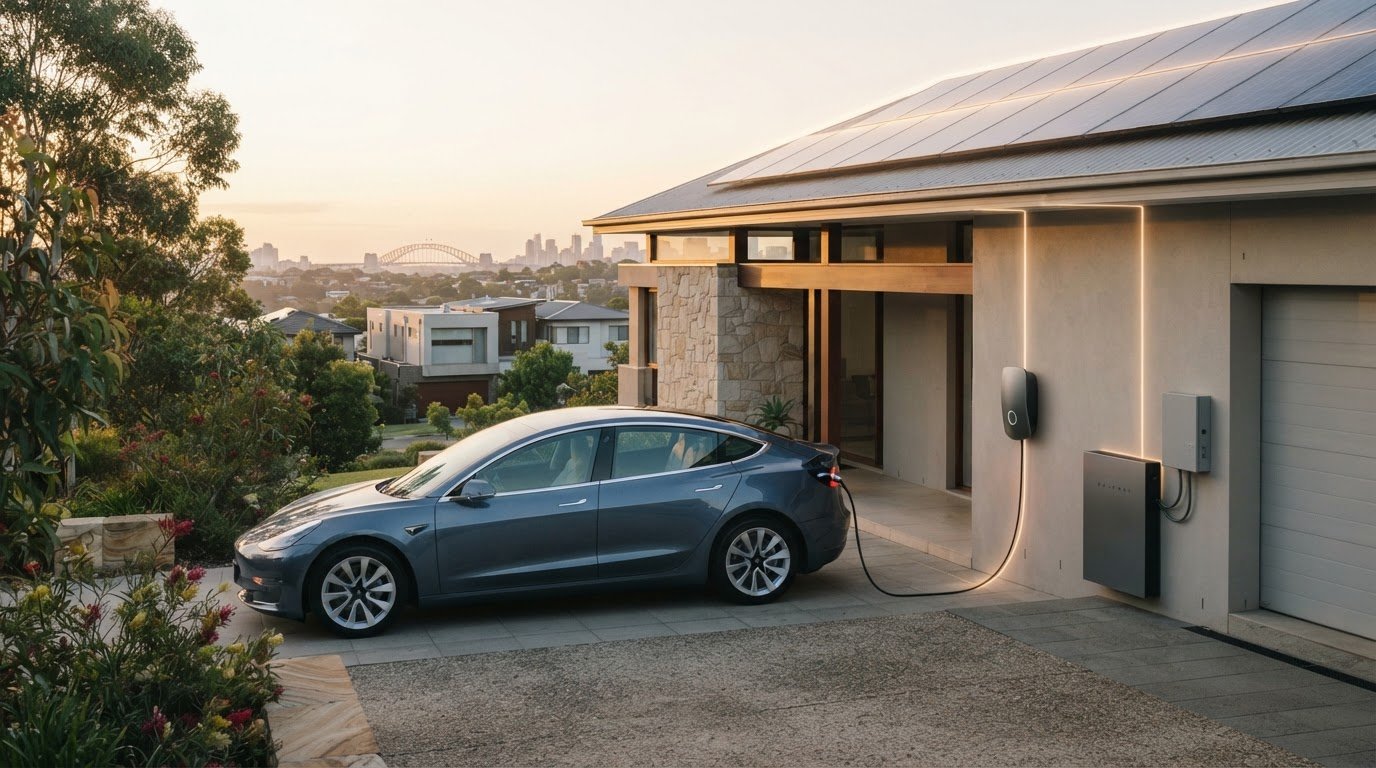
The highest-powered charger isn’t automatically the best choice for home charging. A 7 kW single-phase charger is a practical starting point for most Australian EV owners, while a solar-aware charger may suit you better if using your own solar generation is a priority. The best EV charger for home use in Australia depends on how well it matches your vehicle, household power supply and energy setup.
It makes sense to weigh charging speed, solar use and vehicle compatibility together: a charger that suits one home may not suit another. The right fit can make everyday charging more convenient and help you use your home’s energy more effectively.
This guide compares charger options by power, solar integration, vehicle compatibility and home setup. You’ll learn what to consider with single-phase and three-phase power, when a faster charger may be worthwhile, and how to narrow the choice for your needs in Sydney.
Key Takeaways
- Match charger power to your home’s electrical supply and your vehicle’s onboard charging capability.
- For solar charging, consider how the charger can work with your solar generation and any home battery storage.
- Compare home charger options by charging speed, vehicle connection and suitability for your energy setup.
- Include switchboard capacity and installation requirements in your planning, not just the charger itself.
- Explore how solar installations and integrated charging or battery options could fit your home’s energy needs.
What is the best EV charger for home use in Australia in 2026?
A 7 kW single-phase charger suits many homes, while three-phase supply can support higher-powered charging. For Sydney households, the best fit depends on the vehicle, electrical supply, switchboard condition and charging routine. When planning your installation with Sky High Solar and Electrical, professional guidance ensures your setup complies with all local requirements and maximises efficiency.
Home charger and installation costs
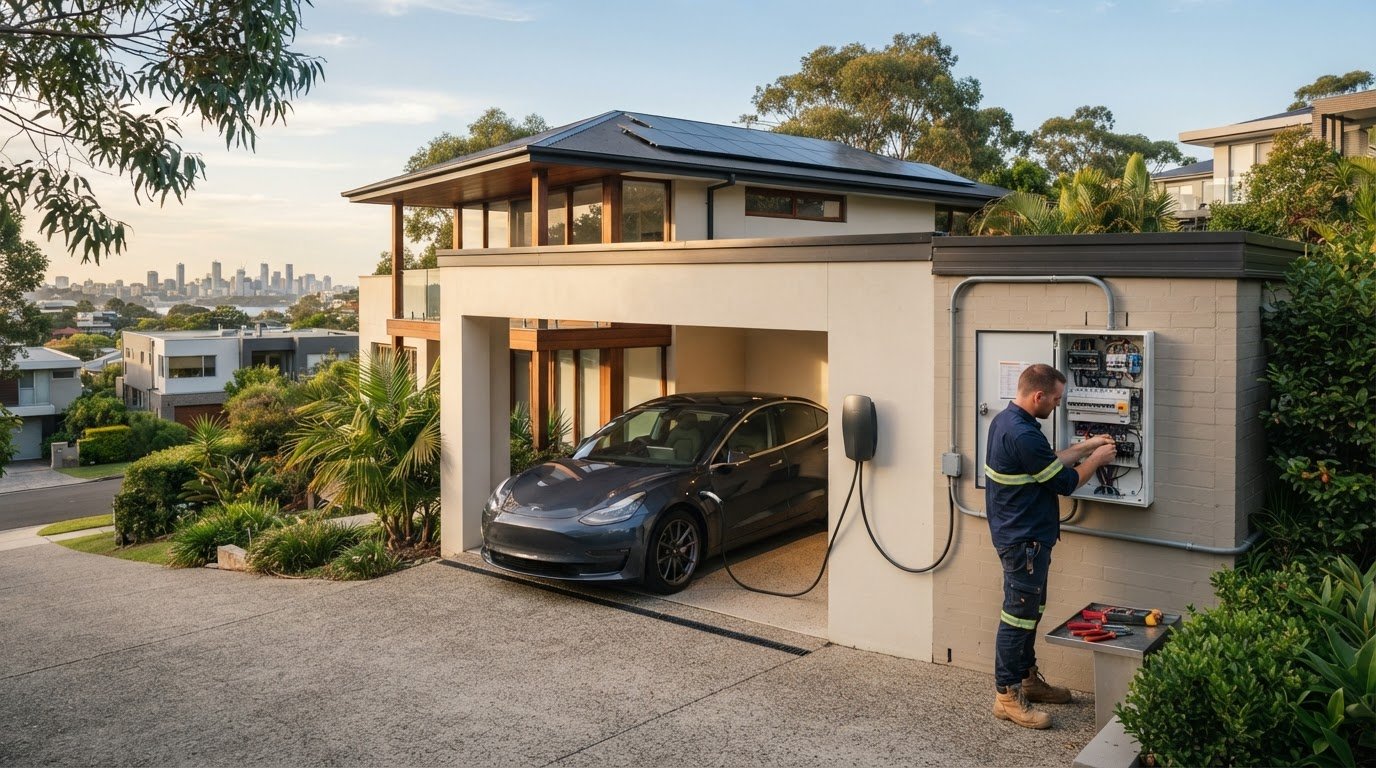
A home charging setup includes the charger and the electrical work needed to connect it. The total cost depends on the unit, cable route, distance from the switchboard and any work needed to prepare the site. Solar integration can also affect equipment and installation requirements, so consider it as part of the complete setup.
For a useful comparison, separate charger hardware from installation labour and electrical work. An accessible switchboard and straightforward cable route call for a different scope than longer cabling or additional board work. In Sydney, the parking layout and distance from the switchboard help determine what the installation involves.
Switchboard and electrician requirements
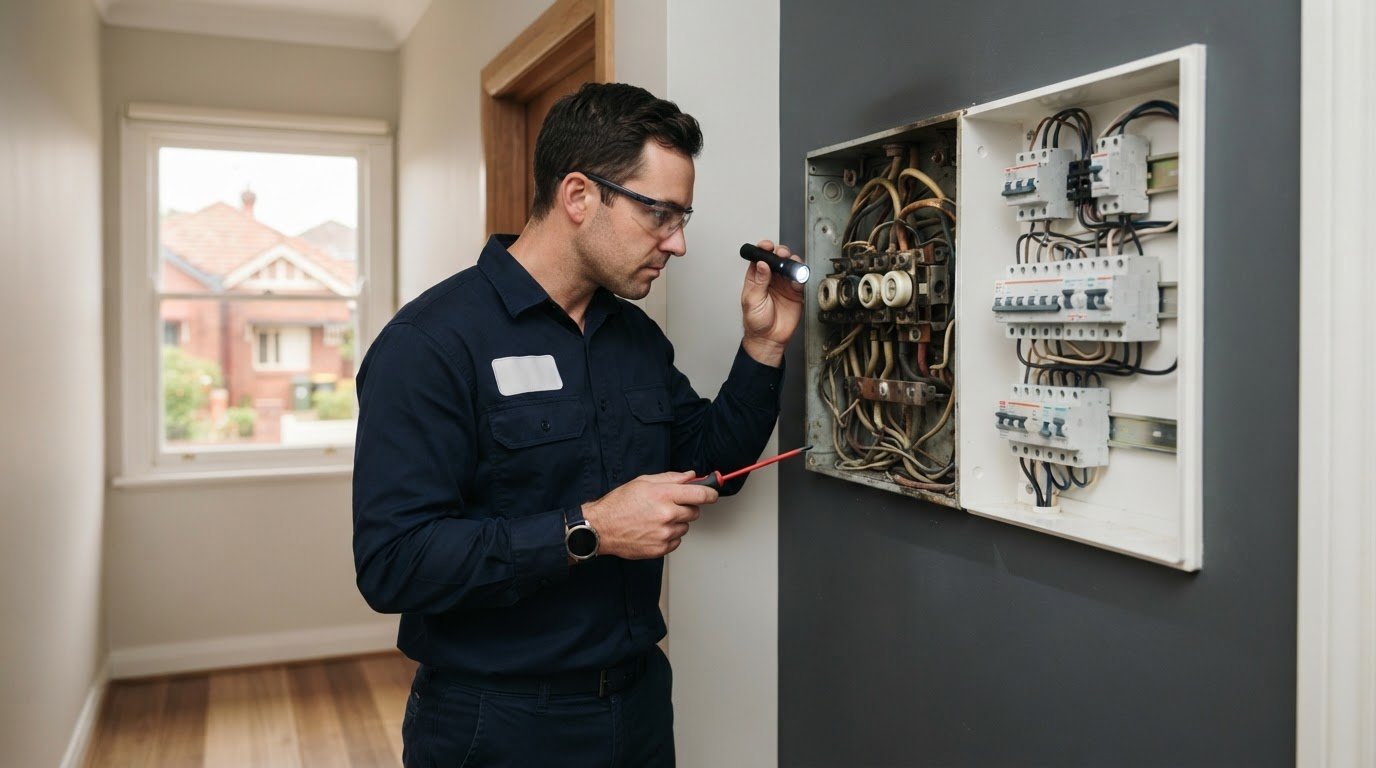
A dedicated home EV charger must be installed by a licensed electrician in Australia. The electrician assesses switchboard capacity, charging load, cable routing and protective equipment. If the existing board cannot accommodate the additional circuit, the required electrical work becomes part of the installation plan.
Include AS3000 in the installation discussion, alongside the charger’s electrical requirements and the home’s supply. This keeps attention on installation design, not only the unit’s advertised output. In a Sydney home with an older or crowded board, switchboard condition can influence the work needed before charging begins.
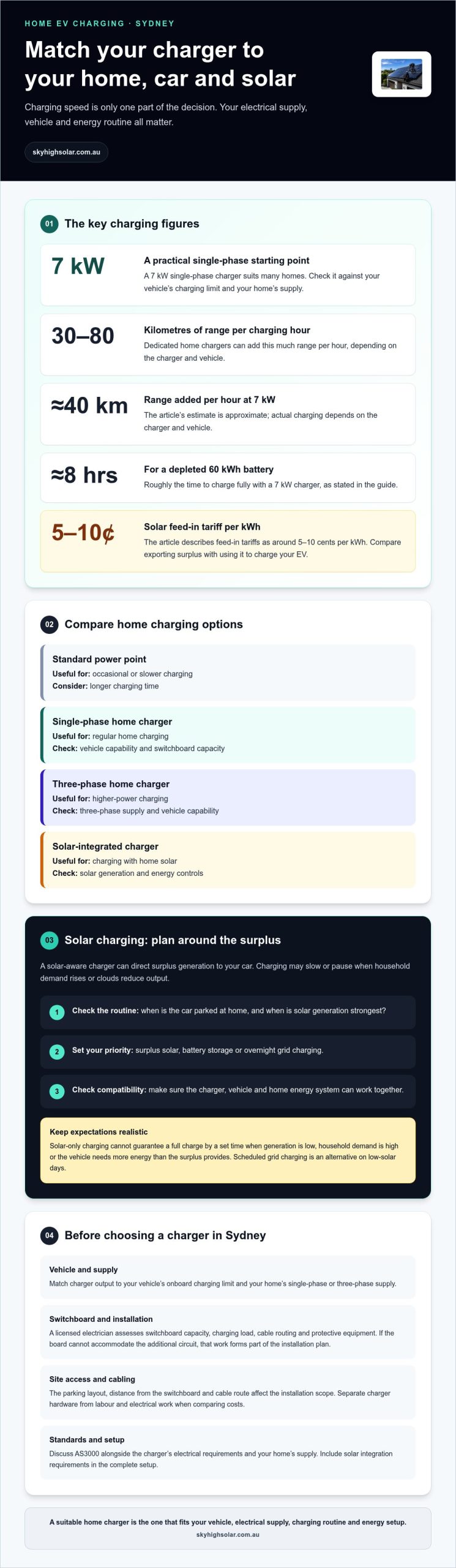
| Home charging option | Typical use | Key consideration |
|---|---|---|
| Standard power point | Occasional or slower charging | Longer charging time |
| Single-phase home charger | Regular home charging | Vehicle and switchboard capacity |
| Three-phase home charger | Higher-power charging | Three-phase supply and vehicle capability |
| Solar-integrated charger | Charging with home solar | Solar generation and energy controls |
Dedicated chargers can add 30 to 80 km of driving range for each hour of charging, depending on the charger and vehicle. A 7 kW charger adds around 40 km per hour, while a depleted 60 kWh battery takes roughly eight hours to charge fully at that rate.
Choose a charger that matches your vehicle’s charging limit and home supply, then factor in installation needs and solar priorities. In Sydney, a switchboard assessment helps establish a practical setup before you select a charger.
Which EV charger is best for solar panels?
A smart charger with surplus-solar charging suits households aiming to charge an EV from daytime solar generation. Smart charging and an off-peak electricity plan can also work together, depending on when your solar system produces power and when your vehicle is home. Their value comes from matching charging times to your household’s energy use.
Solar-only charging directs surplus generation to your vehicle instead of drawing from the grid. It suits households that can charge during sunny hours, but output varies with weather, household demand and solar system configuration. If your car is away during the day, overnight charging may be more practical, using stored energy or grid supply depending on your setup.
A solar-smart charger manages the available supply. In surplus mode, it can adjust charging to use excess solar generation; when household demand rises or clouds reduce output, charging may slow or pause. Solar feed-in tariffs are described as around 5-10 cents per kWh, so using surplus for charging may be worth considering alongside the value of exporting it.
Battery integration adds another decision. If the battery serves household loads first, less solar may be available for the car during the day. Prioritising EV charging may leave less energy stored for later. Decide which load matters most, then set charging schedules around your routine. A smart charger can coordinate charging, but it can’t create surplus when solar generation is low.
For a solar-only setup, consider these practical steps:
- Review when the car is parked at home and when solar generation is strongest.
- Choose whether surplus solar, battery storage or overnight grid charging takes priority.
- Check that the charger, vehicle and home energy system can work together.
Zappi is one solar-charging option to compare, but charging still depends on available surplus. Solar mode can’t guarantee a full charge by a set time when generation is low, household demand is high or the vehicle needs more energy than the surplus provides. Scheduled grid charging is a practical alternative on low-solar days.
Off-peak plans are most useful when your vehicle is home during cheaper periods; compare the tariff schedule with your driving routine. An EV DC charger is a direct-current charger that connects to solar or battery systems, reducing conversion losses compared with AC chargers. For integrated charging, the SigenStor Integrated Solar Inverter & EV DC Charger combines a solar inverter with EV DC charging.
Comparison of Australian home EV charger models
Compare home chargers by vehicle compatibility, power, solar use and documented features. A model name alone won’t tell you how well a charger suits your EV or home electrical setup.
Vehicle compatibility
Compatibility depends on your vehicle’s charging connector and onboard AC charging limit. Check both before comparing a charger’s maximum output with your home supply. For an Australian EV, a charger rated above the vehicle’s limit won’t make it charge faster. Also consider whether your solar system or inverter can coordinate charging from available surplus.
Use the vehicle manual and charger specifications together: match the connector, charging type and supported power. This helps distinguish basic connection compatibility from the practical charging rate your vehicle can accept.
| Option | Documented comparison point | Useful selection focus |
|---|---|---|
| Standard granny cable | Power point charging option | Occasional charging needs |
| 7 kW single-phase charger | Dedicated home charging option | Vehicle and supply compatibility |
| 22 kW three-phase charger | Higher-power home option | Vehicle, supply and usage pattern |
| Tesla Wall Connector | Four-year warranty | Warranty and vehicle fit |
| GoodWe home EV charger | 50ºC maximum operating temperature; 2-year warranty | Operating conditions and warranty |
| Evnex E2 Plus | Model name | Compare specifications and controls |
| Evnex E2 Core | Model name | Compare specifications and controls |
The GoodWe home EV charger has a homeowner rating of 4.6 out of 5, based on 65 ratings. Treat that as one comparison point alongside connector fit, output, solar functions and warranty, rather than as a substitute for checking the vehicle’s limits.
OCPP compatibility and future-proofing
OCPP is a communication protocol used between chargers and charging-management systems. Compatibility can matter if you want flexibility in managing charging infrastructure rather than relying on one control setup. Check the exact charger model’s supported protocol and version against the system you plan to use.
For Evnex E2 Plus and E2 Core, compare their published charging output, solar functions, OCPP support and control options side by side. That gives you a practical basis for choosing between the two, without assuming that “Plus” automatically means a specific feature.
Before deciding, compare your vehicle’s charging limit with each charger’s output, then assess solar surplus management and any required control system. Choose a model whose documented features suit your current setup and likely charging routine.
Single-phase and three-phase charging power
Your home’s supply sets the practical ceiling for charger power, while your vehicle determines how much it can accept. Compare those limits with your charging routine and rooftop solar plans before choosing an installation.
Single-phase charging
A dedicated single-phase charger delivers 7 kW, a practical level for many Australian owners. It can add around 40 km of driving range per hour, depending on the vehicle. That makes it suited to regular charging at home without needing three-phase supply.
Check the vehicle’s onboard charger limit as well as your electrical supply. If the vehicle accepts less power than the wall charger can provide, it won’t charge at the charger’s full rating. For example, a 7 kW charger cannot deliver its maximum rate to a vehicle with a lower AC charging limit.
Single-phase power can also suit rooftop solar integration. The charger’s power and the solar system’s available surplus affect how much charging can come directly from the panels. An inverter, such as a Fronius unit, is one part of the home energy setup to consider, but the charger and solar controls must work together for coordinated charging.
Three-phase charging
Three-phase power supports home charging at up to 22 kW. A 22 kW charger can deliver roughly three times the charging speed of a 7 kW single-phase charger, provided the vehicle can accept that power. The higher rating alone doesn’t guarantee faster charging for every electric vehicle.
For a 22 kW installation, confirm that the property has three-phase supply and that the vehicle’s onboard charger supports the rate. This option suits drivers who regularly travel more than 400 km per day, according to the comparison guidance. For shorter regular journeys, the extra charging capacity may not change your everyday routine.
Use this comparison to narrow the choice:
- Single-phase, 7 kW: Suits homes with single-phase supply and vehicles that accept this rate.
- Three-phase, up to 22 kW: Suits compatible homes and vehicles where faster charging serves a clear need.
- Solar-integrated charging: Consider the inverter, panels, charger controls and available surplus together.
Build quality matters, alongside electrical compatibility and useful features. Compare the charger’s stated construction, warranty and control options, then consider whether solar integration can direct available surplus to your vehicle. A premium-looking unit won’t overcome a supply or vehicle limit.
For a Sydney home, assess the supply type, vehicle limit and likely charging schedule as one decision. Choose 7 kW when it meets those needs; choose three-phase charging when the supply, vehicle and regular driving demands justify the higher capacity.
Charger choices by vehicle and home energy setup
The right charger depends on how your vehicle accepts power and how your home supplies it. Match the vehicle, connector, phase power and solar priorities before comparing specific models.
Start with the vehicle manual. Confirm its charging connector and maximum AC charging rate, then compare these with the charger’s output. A higher-rated wall unit won’t make your vehicle charge faster than its onboard limit allows. Check connector compatibility first, then compare charging speed.
For a household with single-phase supply, a 7 kW charger is a common practical match. Three-phase homes can support charging up to 22 kW, but the vehicle must also accept that rate. If its onboard charger accepts less, the extra capacity won’t increase charging speed. Choose the power level around both limits, not the charger rating alone.
Solar changes the decision. If your car is home during daylight, a smart charger can direct available solar surplus towards charging. If it’s usually away, overnight charging may suit your routine better, using grid supply or stored energy. A solar system with a battery also needs a clear priority: charging the car can reduce energy available for household use or later storage.
Use this practical sequence to compare your setup:
- Vehicle: Match the connector and onboard AC charging limit.
- Home supply: Identify whether the property has single-phase or three-phase power.
- Routine: Note when the vehicle is usually parked at home.
- Energy priority: Decide whether solar surplus, battery storage or overnight grid charging matters most.
For context, the average Australian drives 33 km a day. That figure helps frame daily charging needs, but your own driving pattern matters more. A vehicle used for short local trips has different charging demands from one driven long distances regularly. The best fit is the charger that replenishes the energy you use within your usual parking window.
Don’t assume a charger will manage solar or battery energy automatically. Solar integration depends on the charger’s controls and how your home energy system is configured. Model names such as Ocular or myenergi are only a starting point: compare each model’s documented output, connector and energy-management features with your vehicle and home.
Build quality matters, but compatibility comes first. A well-made charger still needs to match your vehicle’s connector, your home’s available power and your charging routine. Compare these factors before choosing a higher-power unit or prioritising solar charging.
Use the vehicle manual and your home energy setup to map out the right combination of connector, power and charging schedule. Plan your home EV charging setup around those practical requirements.
Sky High Solar and Electrical: 6.6kw Solar Panel Installation
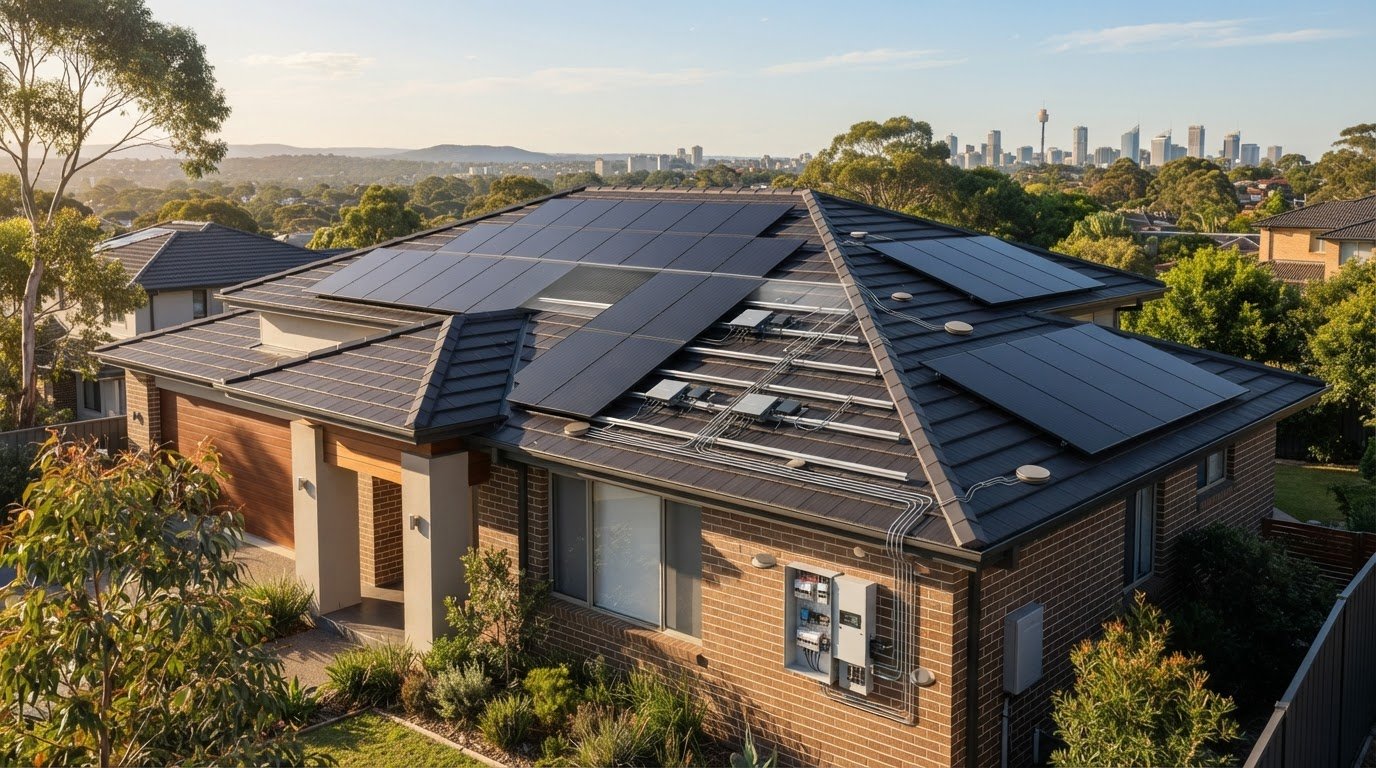
Sky High Solar and Electrical provides EV charging solutions and can help align a home solar system with your charging and energy plans. Whether you’re installing solar alongside a charger or adding charging to an existing setup, consider how generation, storage and vehicle charging will work together.
Available options include 6.6kw and 10kw Solar Panel Installation, the FOX ESS CQ7 High Voltage Storage Battery, and the SigenStor Integrated Solar Inverter & EV DC Charger. The SigenStor option brings solar inverter and EV DC charging together, while a battery can store energy for later household use. The right combination depends on your vehicle, home power supply and charging routine.
For a coordinated solar and EV charging plan, contact Sky High Solar and Electrical to discuss your home’s setup.
Make your home charging plan work for the long term
Your EV and energy needs may change, so consider your future plans when choosing a charger. Before settling on the best EV charger for home use in Australia, decide what matters most: charging from rooftop solar, a straightforward overnight routine or a setup that includes battery storage. That priority helps keep your charger and energy system aligned.
Sky High Solar and Electrical offers 6.6kw and 10kw Solar Panel Installation, alongside the FOX ESS CQ7 High Voltage Storage Battery. These options can inform a home energy plan built around your charging needs, rather than treating the charger as an isolated purchase.
Bring together your vehicle’s charging requirements and your household’s energy priorities, then take the next step with a clear plan. Discuss your home EV charging and solar setup with Sky High Solar and Electrical. A considered design can help you move towards a practical, lower-emissions way to charge at home.
Frequently Asked Questions
What Does Installation Actually Cost?
Installation pricing depends on the charger and the electrical work required at your property. A Sydney home with an accessible switchboard and short cable route presents a different job from one needing longer cabling or switchboard changes. A quote should separate charger hardware from labour and required electrical work, so you can compare the complete installation rather than the unit alone.
Are cheap chargers safe?
A low purchase price alone doesn’t show whether a charger is safe or suitable. Look for clear product safety and compliance information, and have a dedicated charger installed by a licensed electrician. Incomplete instructions or unclear Australian support can make installation and troubleshooting harder. Compare documented specifications, warranty terms and installation requirements alongside price, rather than choosing on cost alone.
Can I use these outdoors?
Some chargers are designed for outdoor installation, but suitability depends on the specific model and its environmental rating. Before choosing a location, match the stated rating to conditions at your home, such as rain, direct sun and coastal exposure around Sydney. The cable also needs a practical route to the vehicle without creating a trip hazard or obstructing access. Follow the manufacturer’s installation instructions.
Do EV chargers need maintenance?
Yes. Plan an annual visual inspection and occasional firmware updates. Look for visible damage to the charging cable, connector and casing, and stop using equipment that appears damaged. Keep the connector clean and dry according to the manufacturer’s care instructions. Firmware updates may address software issues or improve operation, but install only updates intended for your charger model and follow its instructions.
What are the best home EV chargers available in Australia in 2026?
The best choice depends on your vehicle, home supply and desired charging controls. Models discussed in this guide include the Tesla Wall Connector, GoodWe home EV charger, Evnex E2 Plus, Evnex E2 Core and myenergi Zappi. Compare each model’s stated features against your needs, then check vehicle connector compatibility and supported charging power. No single model suits every Australian home or EV.
How much do home EV chargers cost in Australia, including installation?
The total depends on hardware, electrical labour, cable distance and whether the switchboard needs work. A property with a clear route from the board to the parking space may need different work from a home requiring new cabling or capacity changes. The cost of a charger installation depends on the site and equipment, and is provided after a quote request.
How do popular Australian home EV chargers compare on charging speed, features and warranty?
Compare published output and controls first, then weigh warranty details. The Tesla Wall Connector lists a four-year warranty, while the GoodWe home EV charger lists a two-year warranty and a maximum operating temperature of 50ºC. These are distinct comparison points, not a complete ranking. Check each model’s current specifications, solar functions and compatibility with your vehicle before making a decision.
What charging power and connector type do Australian home EV chargers use?
Dedicated home chargers typically provide 7 to 22 kW, while connector compatibility depends on the vehicle and charger model. Match the charger connector to the vehicle inlet, then check the vehicle’s charging capability and household supply. For example, a higher-power unit won’t deliver its full rate if the vehicle can’t accept it. Use the vehicle handbook and charger specifications to confirm the pairing.