

 Sydney
 0452 243 240
Blog
ROI on Commercial Solar for Sydney Warehouses: 2026 Guide

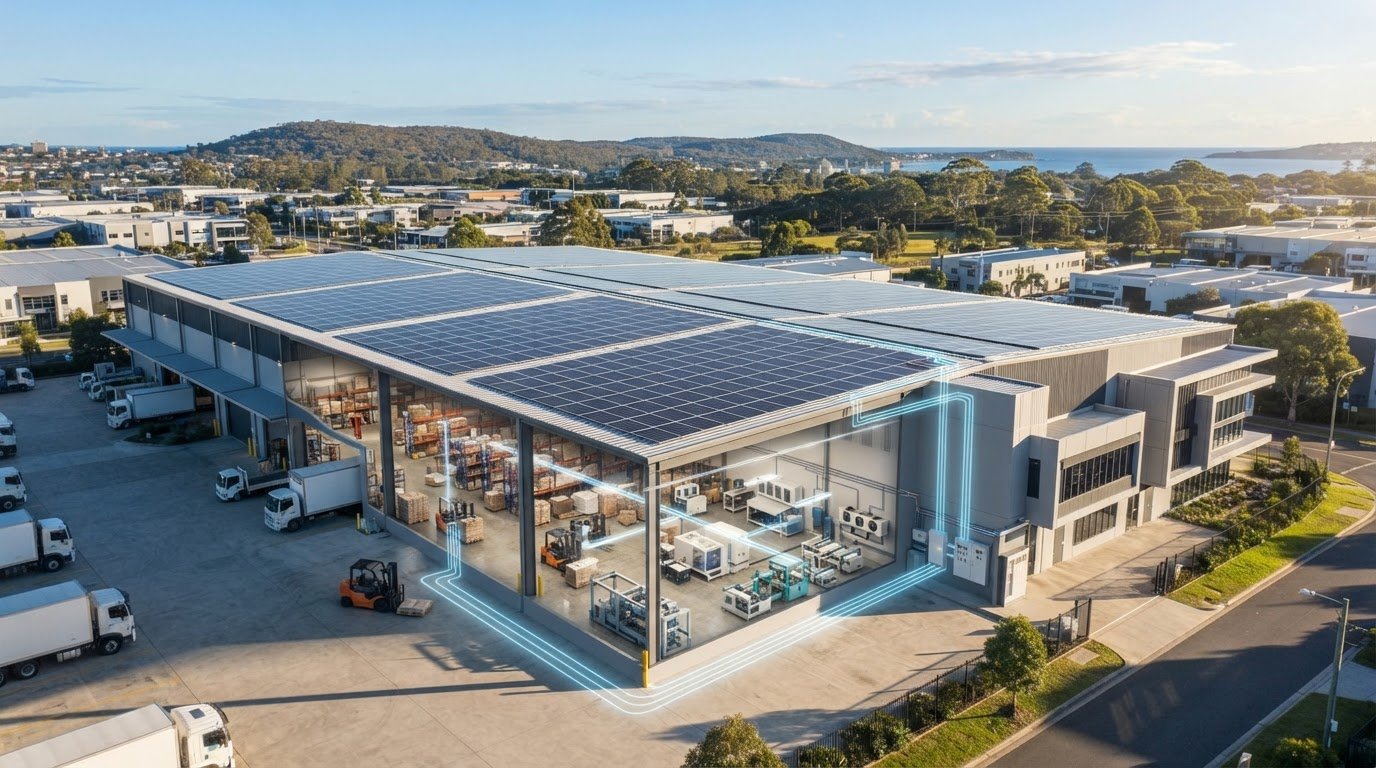
Could a warehouse with a large roof still deliver a poor solar return? Yes, if its electricity use doesn’t line up with the hours the panels generate. Assessing ROI on commercial solar for warehouses Sydney businesses can rely on means looking beyond roof size to operating patterns, on-site consumption and export limits.
To estimate how much solar your warehouse can use directly, bring together its energy data, roof conditions and electrical setup. Demand charges, export arrangements, network requirements and lease terms can all affect the business case, so a generic payback estimate won’t tell the whole story.
This guide explains how to build a transparent, site-specific view of potential returns. You’ll see how daytime loads and operating hours shape self-consumption, why exported energy may be valued differently from power used on site, and what to check before installation. It also covers the SRES expansion, which from 1 October 2026 includes eligible solar PV systems up to 1 MW, alongside relevant NSW battery incentives. By the end, you’ll know what site and energy information to gather and which practical factors can strengthen or weaken your warehouse solar business case.
Key Takeaways
- Assess the ROI on commercial solar for warehouses Sydney projects by comparing the full investment with expected bill savings and other project benefits over time.
- Use electricity bills and interval data to match system size to warehouse demand, then compare how different designs affect on-site use and exports.
- Before planning an installation, check roof condition, shading, access, metering, switchboard capacity and network requirements.
- For a leased warehouse, resolve landlord consent and agree how investment costs and benefits will be shared.
- Review current incentive eligibility alongside site constraints, then use a tailored commercial solar assessment to shape a practical project plan.
Why warehouse solar ROI in Sydney depends on more than roof size
Return on investment (ROI) compares a project’s benefits with its full investment over time. For a warehouse, benefits may include reduced grid electricity purchases and value from exported energy. The result depends on how the system fits the site’s operations and electricity arrangements.
Warehouses can have broad roof areas and daytime demand that uses the electricity panels produce. That combination can make a project worth assessing, but roof area alone doesn’t establish its value. A large array may generate more than the business can use while the sun is shining, and export arrangements affect the value of any surplus.
Quotable takeaway: A roof’s potential solar capacity is not the same as the amount of solar energy a business can use on site.
How warehouse operating hours affect solar value
A warehouse operating mainly during daylight may use more solar generation as it’s produced. A site with substantial evening or overnight demand may still draw more electricity from the grid outside solar hours. The key is not simply whether the warehouse runs at night, but the timing and size of its loads throughout the day.
Equipment schedules, refrigeration and shift patterns all matter. Refrigeration running through the day could contribute to daytime demand, while energy-intensive equipment scheduled for overnight shifts may use less solar directly. These are possibilities to test against the site’s data, not assumptions to apply to every facility. Use interval data, where available, to see when electricity is consumed and how that profile overlaps with expected solar generation.
Which Sydney site details shape the opportunity?
Start with usable roof area, not just the building’s overall footprint. Orientation, shading and visible obstructions can affect which roof sections are practical for a system and how they may perform. A site assessment connects these physical conditions with the warehouse’s energy use, giving you a sounder basis for comparing system designs. For general background on rooftop solar systems and their commercial uses, see Rooftop Photovoltaic Power Station.
Location matters too. A warehouse’s position in Sydney determines the relevant electricity network and the export arrangements for its connection. Don’t assume a nearby site has identical requirements or export capacity. Assess these details alongside metering and the way the warehouse uses power.
This is why the ROI on commercial solar for warehouses Sydney businesses need to assess is site-specific. Bring together roof information, operating schedules and interval electricity data, then consider them as one picture. Sky High Solar and Electrical provides commercial solar and electrical services to support planning around a warehouse’s energy profile and physical site conditions.
How to calculate commercial solar ROI for a Sydney warehouse
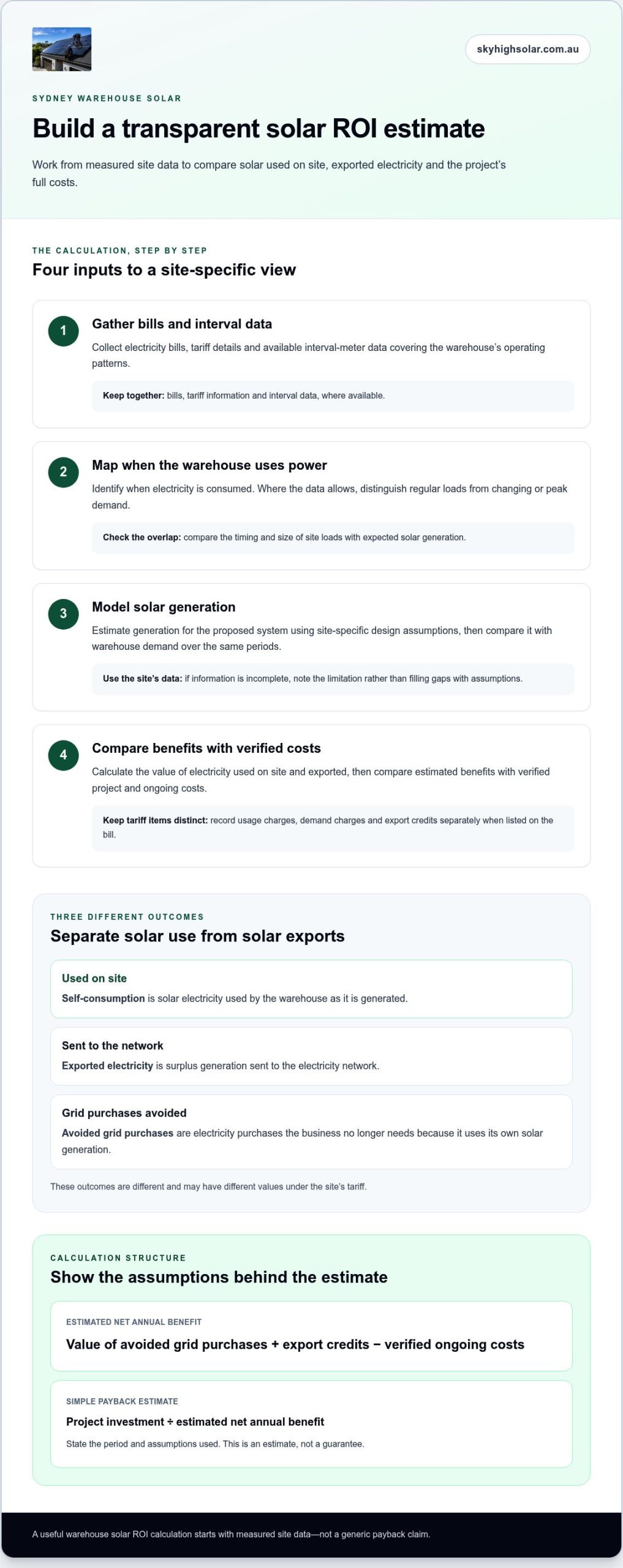
A useful ROI calculation starts with measured site data, not a generic payback claim. Estimate how much solar the warehouse can use, what surplus may be exported, and how those outcomes compare with the project’s full investment over a defined period. The ROI on commercial solar for warehouses Sydney businesses can assess depends on transparent inputs and clearly stated assumptions.
Work through the calculation in order:
- Gather bills and interval data. Collect electricity bills, tariff details and available interval-meter data covering the warehouse’s operating patterns.
- Map demand. Identify when the site uses electricity and, where the data allows, distinguish regular loads from changing or peak demand.
- Model solar generation. Estimate generation for the proposed system using site-specific design assumptions, then compare it with warehouse demand over the same periods.
- Compare outcomes. Calculate the value of electricity used on site and exported, then compare estimated benefits with verified project and ongoing costs.
Self-consumption is solar electricity used by the warehouse as it is generated. Exported electricity is surplus generation sent to the electricity network. Avoided grid purchases are electricity purchases the business no longer needs because it uses its own solar generation. These are different outcomes and may have different values under the site’s tariff.
Gather the right electricity and tariff information
Keep bills and tariff information together with interval data, if available. If the tariff lists them separately, record usage charges, demand charges and export credits as distinct items. Tariff structures vary, so use the warehouse’s actual rates and billing terms rather than a generic Sydney figure. If data is incomplete, note the limitation instead of filling gaps with assumptions.
Model savings, investment and payback transparently
Use project-specific inputs and show the calculation clearly. One simple structure is: estimated net annual benefit = value of avoided grid purchases + export credits − verified ongoing costs. Compare that benefit with the verified project investment. For a simple payback estimate, divide the investment by the estimated net annual benefit, and state the period and assumptions used. This is an estimate, not a guarantee or a universal warehouse benchmark.
Compare generation estimates with demand over matching time intervals. Solar used on site reduces purchases at the applicable usage rate; exported energy is valued under the relevant export arrangement. Treat demand-charge effects separately and include them only where the tariff and available data support a defensible estimate. Include project and ongoing costs only when verified for the specific assessment. Show any incentive as a separate input, with its eligibility and value checked for that project.
An ROI forecast is only as reliable as the assumptions behind it. Show which figures come from bills, which are modelled, and which still need verification. A tailored commercial solar assessment can bring the warehouse’s energy profile and system design into the same project-specific business case.
Compare warehouse solar options by load matching, exports and storage
Start comparisons with the warehouse’s demand profile, not a standard system size. Model how much generation each option could match to the site’s operating hours, what may be exported and whether a realistic forecast supports future demand. This makes the trade-offs clearer than comparing array capacity alone.
The options below are scenarios to assess, not performance guarantees. “Likely self-consumption” means the expected share of solar generation used on site, based on warehouse load data and the model’s assumptions.
| Option | Load match | Likely self-consumption | Exports | Future flexibility |
|---|---|---|---|---|
| Smaller solar array | May suit steady daytime demand without designing around roof capacity alone. | May be higher if generation closely follows the site’s daytime load. | May be lower, depending on demand and generation at each interval. | Review whether the design can accommodate forecast changes. |
| Larger solar array | May suit a warehouse with substantial daytime use across operating periods. | Can fall if generation often exceeds on-site demand. | May rise during periods of surplus, subject to network arrangements. | May support a credible increase in future electricity use, if forecast. |
| Solar with battery storage | May shift some stored solar energy to times when generation and demand differ. | Depends on load, battery design and when stored energy is used. | May change as surplus is stored rather than exported, subject to system operation. | Requires assessment of future loads, tariffs and system design. |
Match system size to the warehouse’s demand profile
Compare modelled generation with the site’s weekday and seasonal operating patterns. A warehouse running energy-intensive equipment during solar hours may have a different load match from one whose busiest shifts fall later in the day. Assess demand charges as a separate tariff feature. Solar may affect electricity purchases, but don’t assume it will eliminate demand charges. Include growth or electrification only when a practical load forecast supports it.
A larger array isn’t automatically the better investment. If additional generation is mostly exported, its value depends on the applicable export arrangements. A better-matched design may direct more energy to on-site use. Weigh each outcome against the project’s verified assumptions. For further project-planning context, see Commercial Solar Installation Sydney: The 2026 Business Buying Guide.
When exports or battery storage change the comparison
Surplus solar may be exported, subject to the network arrangements that apply to the site. Compare solar-only and solar-plus-battery scenarios separately, using consistent demand data and clearly stated tariff and design assumptions. Storage doesn’t create the same value at every warehouse. Its case depends on when energy is used, the tariff structure and system design. General battery concepts are covered in Solar Battery Storage Sydney: The Ultimate 2026 Homeowner’s Guide, while commercial decisions need a warehouse-specific assessment.
For the ROI on commercial solar for warehouses Sydney businesses are weighing, compare scenarios side by side: on-site use, exports, tariff effects and future flexibility. This gives decision-makers a clearer basis for choosing a design that fits the operation rather than simply filling available roof space.
Check Sydney warehouse, lease, network and NSW incentive constraints
A promising model still needs to work in the building and under the site’s electricity and property arrangements. Before relying on an ROI estimate, work through these checks. Record what’s known, what needs assessment and which assumptions could change the project case.
- Roof condition: Arrange a project-specific review of the roof’s condition and suitability for the proposed installation.
- Access and shading: Note access needs, shaded areas and roof obstructions that could affect the usable array area.
- Metering: Identify the existing meter and the consumption and export information it provides.
- Switchboard capacity: Have the electrical setup assessed against the proposed system. A switchboard upgrade may be needed if changes are required.
- Connection and exports: Identify the network entity for the exact site address, then verify the applicable connection arrangements and export settings.
Review the building and electricity connection
Roof appearance alone can’t establish structural suitability. That requires a project-specific assessment. Network arrangements also depend on location and system details. In Sydney, Ausgrid or Endeavour Energy may be relevant, but identify the network entity using the warehouse address rather than assuming coverage from its suburb. Confirm the connection and export settings for that site instead of relying on a universal export limit.
Bring these findings into the design and ROI assessment together. A roof constraint may affect the practical system layout, while connection or export settings may change how surplus generation is treated. Sky High Solar and Electrical provides commercial solar and electrical services, including switchboard upgrades and relevant electrical compliance.
Verify lease terms, incentives and tax treatment
For a leased warehouse, settle the property arrangements before treating projected benefits as available to your business. Review the lease and agree with the landlord on consent, ownership of the installed asset, responsibility for building changes, and what happens if the tenancy ends. Clarify who receives the energy-bill benefits and how investment returns are shared.
Federal incentives may affect the project in different ways. Eligible solar PV systems can receive an upfront benefit through Small-scale Technology Certificates (STCs) under the expanded Small-scale Renewable Energy Scheme (SRES). For batteries, the Cheaper Home Batteries Program also covers eligible small-business installations within its capacity limits, with certificate factors that taper by battery capacity. Confirm current scheme rules and the project’s eligibility before including either benefit in your model.
In NSW, the Peak Demand Reduction Scheme (PDRS) includes commercial battery activities. As of October 2026, BESS4 applies to eligible systems with 20-200 kWh usable capacity, while BESS5 covers eligible systems from 200 kWh to 30 MWh. Support is delivered through Peak Reduction Certificates, not a fixed rebate. Check current activity rules and eligibility for the specific installation before counting this as a project benefit.
Tax treatment depends on the business and asset circumstances. Use current Australian Taxation Office guidance and advice from a qualified tax professional before factoring deductions or depreciation into the business case. Keep tax effects distinct from bill savings and incentive benefits, so the ROI on commercial solar for warehouses Sydney decision rests on traceable assumptions.
For a site-specific review of warehouse solar and electrical considerations, arrange a commercial solar assessment with Sky High Solar and Electrical.
Turn a Sydney warehouse solar ROI assessment into a project plan
A clear assessment gives you more than a headline payback estimate. It turns site information into a practical sequence: collect the data, assess building and connection constraints, model suitable system options, then review the business case against your operating needs. Keep confirmed facts separate from estimates so decision-makers can see what the ROI on commercial solar for warehouses Sydney project depends on.
Prepare for the assessment by gathering information in four stages:
- Collect site and energy data. Bring together electricity bills, available interval data, operating hours and details of major electrical loads.
- Record building constraints. Include roof plans, known roof works, access details, shading or obstructions, and switchboard information.
- Set out property arrangements. If the warehouse is leased, note relevant lease terms and landlord discussions about consent and ownership.
- Describe expected changes. Record planned operational changes that could affect future electricity demand, with forecasts or supporting information where available.
Prepare a warehouse solar assessment brief
A short, organised brief makes it easier to connect the warehouse’s energy use with its roof and electrical conditions. Label documents by date and site, and flag missing or uncertain information rather than filling gaps with assumptions. Include expected business changes, such as altered operating hours or new electrical loads, only when there’s a realistic basis for them.
- Recent electricity bills, tariff details and available interval data
- Operating hours and major electrical equipment or loads
- Roof plans, known maintenance or roof works, and access details
- Switchboard information and any known electrical constraints
- Lease information and landlord discussions, where relevant
- Expected operational changes that may affect future demand
Move from ROI model to professionally installed system
Once the information is assembled, the system design should reflect the site assessment, the warehouse’s energy profile and applicable electrical requirements. A model is a planning tool, not a promise of savings. Review its generation, self-consumption, export and cost assumptions against the actual project information before using it to support an investment decision.
Sky High Solar and Electrical provides commercial solar solutions and electrical services, including switchboard upgrades. Sydney-owned and operated since 2013, the business brings local solar and electrical experience to warehouse project planning. Its licensed electrical contractors can provide a certificate of compliance electrical work (CCEW) for relevant electrical work, documenting that the work meets applicable Australian safety standards and is legally compliant.
With a project-specific assessment, you can move from an initial ROI model to a design and installation plan grounded in the warehouse’s needs. Discuss commercial solar for your Sydney warehouse with Sky High Solar and Electrical.
Make your next solar decision site-specific
Turn the warehouse’s operating needs into clear decision criteria. Decide which outcomes matter most to the business, such as reducing daytime grid purchases, preparing for a planned change in operations or assessing how much exported energy contributes to the case. Keep assumptions visible so your team can revisit them if the site’s usage or electricity arrangements change.
A well-grounded ROI on commercial solar for warehouses Sydney assessment should support a measured decision, not pressure you into a particular system size or promised payback. The value lies in understanding how the design fits the building, the business and its longer-term plans.
Sky High Solar and Electrical brings commercial solar and electrical experience to warehouse projects, with attention to site-specific design and electrical compliance. Plan a commercial solar assessment for your warehouse and take the next step with a clearer view of the project’s practical fit.
Frequently Asked Questions
Is commercial solar worth it for a warehouse in Sydney?
It can be, if the project’s likely benefits justify its investment for that specific site. A warehouse with a steady daytime load may use solar as it’s generated, while a site with lower daytime demand may depend more on export arrangements. To assess the ROI on commercial solar for warehouses Sydney operators are considering, compare energy bills, operating patterns and project assumptions rather than relying on a general payback claim.
Can commercial solar reduce a warehouse’s demand charges?
It may reduce demand charges if solar generation coincides with the times that determine those charges under the warehouse’s tariff. If a site’s measured peak occurs while solar is producing, the system may affect the grid electricity drawn at that time. If the peak falls outside solar hours, the effect may be limited. Check the tariff’s calculation method and interval data. Solar can’t be assumed to remove demand charges.
What happens to excess solar power generated by a warehouse?
Surplus electricity may be exported to the network, subject to the site’s connection and export arrangements. A retailer may credit exports under the applicable electricity plan, but exported energy shouldn’t be assumed to have the same value as electricity the warehouse avoids buying. Check how the meter records exports, how credits appear on bills and whether export settings affect system operation. Model surplus generation using the site’s actual arrangements.
Can a warehouse solar system be combined with battery storage?
Yes, a warehouse solar system can be designed with battery storage if the system components and electrical design support that configuration. A battery may store some solar generation for later use, but its role depends on the site’s load timing, tariff and operating strategy. A warehouse with evening loads, for example, may assess storage differently from one that uses most of its electricity during daylight. Compare a battery scenario separately from solar-only.
Does a warehouse need a battery to improve solar ROI?
No. A battery isn’t essential for a solar project to have a viable business case. A warehouse with strong daytime demand may use a useful share of generation directly, while storage adds another investment and operating assumptions to assess. Compare solar-only with solar-plus-battery using the site’s load data and tariff. A battery’s case depends on when stored energy can be used and the value of that use, not simply on spare roof capacity.
Can solar panels generate electricity on cloudy days?
Yes, solar panels can generate electricity in cloudy conditions, though output is generally lower than under clear, sunny conditions. The amount varies with cloud cover and the installation’s conditions, so don’t treat a sunny-day estimate as expected output for every day. For a warehouse business case, use generation modelling that accounts for variation across the year, then compare it with the site’s electricity use rather than assuming constant production.
Can a warehouse solar system operate during a grid blackout?
Not necessarily. A standard grid-connected solar system generally shuts down during a blackout to avoid sending electricity into a network that may be under repair. Solar panels alone shouldn’t be treated as backup power. A system needs suitable backup design and equipment to supply selected loads safely when the grid is unavailable. If continuity matters, identify the essential warehouse loads and have the backup arrangement assessed as part of the electrical design.