

 Sydney
 0452 243 240
Blog
Commercial Solar Finance: 2026 Sydney Business Guide


What if the lowest monthly repayment isn’t the best deal for your business? For Sydney operators considering commercial solar financing Australia, the right choice depends on more than the headline figure. Ownership, cash flow, energy use and contract terms all shape a project’s value.
It’s understandable to weigh a solar investment against other business priorities. Comparing a loan, lease and power purchase agreement can also be difficult because each has different costs, responsibilities and ownership outcomes. Projected savings are useful only when they reflect your site’s energy use, tariffs and proposed system design.
This guide explains how the main funding structures work, what to compare in their terms and how to assess a project using site-specific assumptions. It also outlines the incentive, tax and eligibility checks to consider before committing, without treating potential benefits as guaranteed. From site assessment and system design to electrical compliance, each step helps you make a more informed finance decision and plan for long-term value.
Key Takeaways
- Compare a loan, lease and power purchase agreement by ownership, payment structure, responsibilities and what happens at the end of the term.
- Use interval energy data to assess daytime consumption, solar exports and grid imports before estimating project cash flows.
- Evaluate commercial solar financing Australia options using consistent assumptions across the full agreement term, not just the headline repayment.
- Check current federal and NSW incentive rules, commercial eligibility and scheme dates before including potential benefits in your business case.
- Build a finance-ready project by gathering site details, defining the system scope and reviewing funding terms alongside electrical compliance requirements.
Why commercial solar financing in Australia matters to Sydney businesses
Commercial solar finance spreads the cost of a business solar project across agreed payments instead of requiring the full capital cost upfront. For Sydney businesses, retaining capital may leave more available for staffing, stock, equipment or other planned investment. The trade-off is that finance adds costs and contractual obligations, which need to be weighed against the project’s forecast energy value.
Separate two decisions: whether solar suits your site, and how to fund it. A finance arrangement changes when payments are made and how responsibilities are allocated. It does not increase system output or guarantee a particular saving or payback period. Solar Power in Australia provides broader context, but your business case should be based on your own energy data, tariffs and proposed system design.
A useful finance comparison balances the cash your business wants to retain with the ownership, obligations and long-term value it expects from solar.
When financing may fit a business cash-flow plan
Retaining capital may suit a business with competing operational priorities, but compare that flexibility with total finance costs and the payment schedule. Set out available cash, expected repayments and forecast energy value over the same period. Include quieter trading periods and known cash commitments rather than relying on an average month.
Suitability depends on the lender’s criteria and your business’s financial position. Treat repayment illustrations as estimates until the terms are documented. Consider whether the business could meet its obligations if energy use, tariffs or operating conditions change.
What Sydney businesses should establish before comparing finance
Start with how the premises operate: business hours, electricity use patterns, site control and how long you expect to remain there. These details help assess how a proposed system may match on-site demand and whether the agreement term fits your plans for the premises.
Separate confirmed inputs, such as bills and operating schedules, from assumptions that still need assessment. System size, expected generation and the value of exported electricity should be based on site analysis, not treated as established facts. The guide Commercial Solar Installation Sydney: The 2026 Business Buying Guide provides related context on planning a business solar project.
- Known inputs: Electricity bills, operating hours, usage records, site tenure and current energy arrangements.
- Items to assess: System design, expected generation, export and import patterns, and site or electrical work that could affect project scope.
Use the same inputs when comparing funding structures. A clear project scope makes it easier to distinguish the system’s underlying value from the costs and responsibilities in a finance agreement.
Compare commercial solar finance, leasing and power purchase agreements
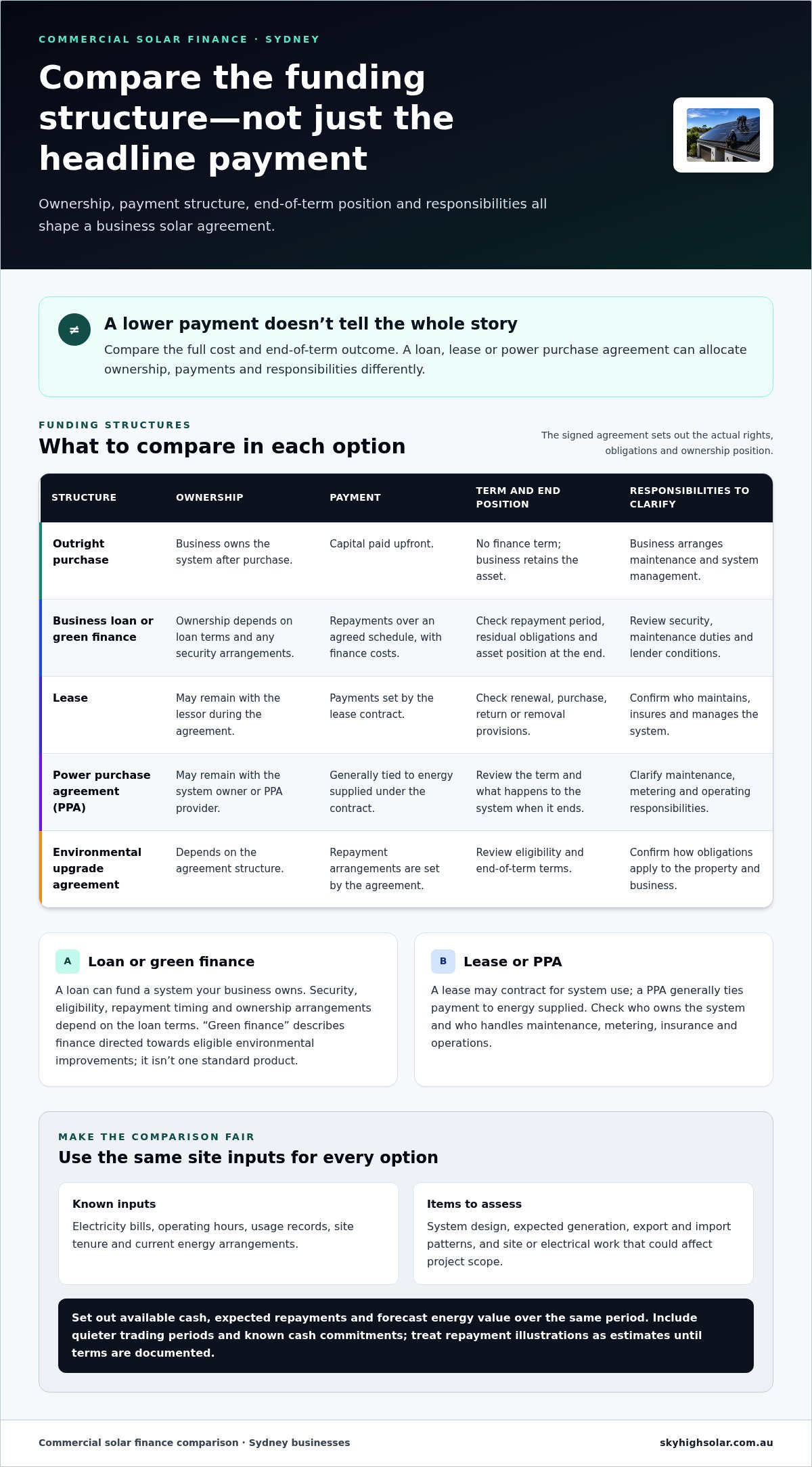
Funding structures differ in who owns the equipment, how payments are calculated and who manages day-to-day responsibilities. For commercial solar financing Australia, compare the full cost and end-of-term outcome, not just the initial payment or product label.
A loan funds a system your business may own; a lease or power purchase agreement may instead contract for system use or the solar energy it produces. The signed agreement sets out the actual rights, obligations and ownership position.
| Structure | Ownership | Payment structure | Term and end position | Responsibilities to clarify |
|---|---|---|---|---|
| Outright purchase | Business owns the system after purchase. | Capital paid upfront. | No finance term; business retains the asset. | Business arranges maintenance and system management. |
| Business loan or green finance | Ownership depends on the loan terms and any security arrangements. | Repayments over an agreed schedule, with finance costs. | Check the repayment period, residual obligations and asset position at the end. | Review security, maintenance duties and any lender conditions. |
| Lease | May remain with the lessor during the agreement. | Payments set by the lease contract. | Check renewal, purchase, return or removal provisions. | Confirm who maintains, insures and manages the system. |
| Power purchase agreement (PPA) | May remain with the system owner or PPA provider. | Payment is generally tied to energy supplied under the contract. | Review the term and what happens to the system when it ends. | Clarify maintenance, metering and operating responsibilities. |
| Environmental upgrade agreement | Depends on the agreement structure. | Repayment arrangements are set by the agreement. | Review eligibility and end-of-term terms. | Confirm how obligations apply to the property and business. |
Loans and green finance: funding a system your business owns
A business loan can fund a system your business owns, but security, eligibility, repayment timing and ownership arrangements depend on the loan terms. “Green finance” describes finance directed towards eligible environmental improvements; it isn’t one standard product. The Clean Energy Finance Corporation (CEFC) provides information on clean energy finance and investment. Ask your accountant to assess current tax treatment and any potential interest implications for your circumstances.
Leasing and power purchase agreements: compare the contract, not the label
A lease and a PPA can both reduce the need to purchase a system outright, but their payment basis and asset ownership may differ. Compare the full term, payment calculations, maintenance responsibilities, insurance, system access and end-of-contract choices. If an environmental upgrade agreement is part of your comparison, include its eligibility requirements and terms in the assessment.
Map each option against your ownership preference, cash-flow capacity and willingness to manage the asset. Sky High Solar and Electrical can scope the commercial solar project and system requirements. As you prepare to compare finance terms, discuss your commercial solar project.
Assess commercial solar finance against your site’s energy use
A credible project forecast starts with how your Sydney premises actually uses electricity. Site load and tariff assumptions drive a commercial solar forecast, so both need to reflect your business rather than a generic model. Use these steps to test the project before comparing funding options.
- Review interval data. Gather electricity bills and interval usage records showing when the site draws power. Check differences between trading days, weekends and seasonal operating periods.
- Match system design to daytime use. Compare expected solar generation with the site’s operating hours and electricity demand. Assess the design against the premises’ load, roof conditions and electrical capacity, not annual consumption alone.
- Model imports and exports. Estimate how much generated electricity may be used on site and how much may flow to the grid. Base export assumptions on the arrangements and tariff details shown in current bills and contracts.
Use Sydney business energy patterns in the project model
Check whether demand is steady during daylight or concentrated outside solar generation hours. Include the site’s actual tariff structure, any demand charges and export arrangements shown on current bills. Roof area, orientation, shading and available electrical capacity also need site assessment. These are design inputs, not proof that a particular system size or output will be suitable.
Separate measured data from estimates. Record the source and period for each input, then note uncertainties such as planned changes to operating hours or equipment. This helps show which assumptions have the greatest effect on the forecast.
Compare total commitments, not just the repayment figure
Model project cash flow with and without finance over the same period, using identical assumptions for energy use, generation, tariffs, exports and operating conditions. For a financed option, include the full agreement term and all documented commitments, not only the scheduled repayment. Review applicable fees, repayment changes, residual amounts and early termination conditions.
Test how the result changes if electricity prices, consumption, export values or operating patterns differ from the base case. Use scenarios grounded in available information and label uncertain inputs clearly. A forecast is a decision tool, not a promise of savings or payback.
- Base case: Use current bills, observed operating patterns and the proposed system design.
- Changed conditions: Test plausible shifts in usage, tariffs, exports or business operations.
- Finance comparison: Apply the same scenarios to each funding option and compare total cash flows across its full term.
This approach helps separate the system’s site-specific value from the cost and conditions of funding it. It also gives your business a clearer basis for comparing commercial solar financing Australia options without relying on a headline repayment or an untested savings estimate.
Check Australian incentives, NSW requirements and finance documents
Potential incentives can affect a commercial solar proposal, but they are not assured funding. Before adding a benefit to your forecast, check current Australian Government and NSW Government rules, scheme dates and eligibility for the specific system and business. Incentive eligibility is separate from finance approval: qualifying for one does not guarantee the other, and neither should be assumed until requirements and decisions are confirmed.
Verify incentives and tax treatment before using them in forecasts
Small-scale Technology Certificates (STCs) may apply only where the system and business meet current scheme requirements. Confirm project eligibility and how any proposed discount is calculated using current authoritative guidance. For batteries, check whether a relevant NSW program applies to the project and business, including its current eligibility and terms. An older proposal or general description of a scheme is not evidence that your project qualifies.
Tax treatment also depends on your business and asset arrangements. Ask your accountant to review current guidance alongside the proposed ownership structure, finance agreement and your business circumstances. Treat tax outcomes as advice to obtain, not as a guaranteed saving in the project model.
Review site, contract and electrical compliance details
Check that the proposal accurately describes the site, system scope, design assumptions and responsibilities. The contract should set out who arranges installation, maintenance, insurance and site access, as well as what happens at the end of the agreement. Compare these details with the finance documents, including any conditions that could affect payments or your ability to use or alter the system.
For relevant electrical work, a certificate of compliance electrical work (CCEW) is official documentation confirming that the work meets Australian safety standards and is legally compliant. Include applicable compliance documentation in the project records and clarify which work it covers.
Use this checklist before relying on an incentive or signing:
- Proposal: Confirm the system scope, site assumptions, responsibilities and any incentive amount shown.
- Finance terms: Review the full term, payment conditions, fees, changes, residual obligations and early termination provisions.
- Energy records: Match the forecast to current bills, usage patterns, tariff details and export arrangements.
- Site information: Record site control, roof and electrical assessment findings, and conditions that could affect installation or access.
- Eligibility and advice: Verify federal and NSW scheme requirements, and obtain independent accounting advice on tax and asset ownership.
- Compliance: Identify relevant electrical documentation, including a CCEW where applicable.
Keep evidence for each assumption, such as current bills, scheme guidance and signed contract terms. This gives you a clearer basis for comparing commercial solar financing Australia options without building the business case around unverified benefits. Sky High Solar and Electrical can help define system scope and electrical requirements for your project. Discuss your commercial solar project.
Plan a finance-ready commercial solar project with Sky High Solar
A clear project scope gives your business a sound basis for comparing finance terms. Sky High Solar and Electrical has served Sydney since 2013, providing commercial solar planning alongside licensed electrical work. We assess site and system requirements so you can understand the technical scope behind a proposal. Finance approval and funding terms are separate decisions.
Prepare the information needed for a useful project assessment
Bring together the records that describe your energy use and premises. This grounds the assessment in your operating conditions and helps identify details that need further investigation.
- Recent electricity bills and interval data, if available.
- Operating hours, expected changes in energy use and any battery requirements.
- Premises details, including roof access, known electrical constraints and planned site changes.
- The names or roles of people who approve the project and review its financial and contract assumptions.
If you lease the premises, include relevant site-control information and expected occupancy plans. Note which details are confirmed and which still need assessment so estimates are not mistaken for fixed project facts.
Move from finance comparison to a Sydney solar plan
Site assessment informs the proposed system design and related electrical scope. Roof conditions, existing electrical infrastructure and business requirements can all affect the project. A proposal should state its assumptions clearly so you can compare the technical scope with the obligations in a finance agreement.
Licensed electrical work also brings compliance considerations. Where applicable, a certificate of compliance electrical work (CCEW) documents that electrical work meets Australian safety standards and is legally compliant. Sky High Solar and Electrical plans commercial solar and related electrical work, providing technical project support rather than arranging finance.
Use this sequence to move from preparation to a considered decision:
- Assemble records: Gather bills, usage data, operating hours and premises information.
- Assess the project scope: Review site conditions, system requirements and any related electrical work.
- Compare funding terms: Match the documented payment schedule, ownership arrangements and responsibilities to your business priorities.
- Confirm decisions: Have the relevant business decision-makers review the project assumptions, finance documents and applicable professional advice before proceeding.
This process keeps system design, project assumptions and finance terms connected without treating forecast benefits as guaranteed. If you’re planning commercial solar financing Australia for a Sydney site, start with information your business can verify and build the proposal from there.
Discuss a commercial solar project with Sky High Solar and Electrical to plan your site-specific solar and electrical requirements.
Make your next solar decision with confidence
Before committing, turn the proposal into a clear internal decision brief. Record the assumptions behind the forecast, the obligations your business would accept and the conditions that could change the project’s value. Set out who will approve the investment and what information they need. This gives finance, operations and site decision-makers a shared basis for reviewing the proposal.
For businesses considering commercial solar financing Australia options, align the project scope with your organisation’s priorities and the premises’ practical requirements. If an assumption remains unresolved, identify it before proceeding and establish how it will be addressed. This keeps the decision grounded in evidence while helping your business plan for a lower-emissions energy future at a pace that suits its circumstances.
Sky High Solar and Electrical can support the site-specific solar and electrical planning behind that decision. Discuss your commercial solar project to plan a Sydney solar solution around your site and business requirements.
Frequently Asked Questions
Is commercial solar financing available in Australia for small businesses?
Yes, small businesses may be able to access finance for commercial solar, subject to the lender’s criteria and the business’s financial position. Options and approval requirements vary, so compare the full repayment commitment with your cash-flow capacity. For commercial solar financing Australia, prepare business financial information and a clearly scoped project proposal to support discussions with a finance provider. Sky High Solar and Electrical can assist with solar project planning, not finance brokerage.
What is the difference between a commercial solar loan and a solar lease?
A loan provides funds to acquire a system, while a lease gives the business use of equipment under a rental agreement. With a loan, the business may own the system, subject to the finance terms; with a lease, ownership may remain with the lessor. A business weighing long-term asset ownership against equipment use should compare total payments, responsibilities and end-of-term options in the actual contracts.
Can a business finance solar panels for leased premises?
Yes, it may be possible, but the arrangement needs to account for the lease and the building owner’s rights. Clarify consent for rooftop work, access for installation and maintenance, and what happens to the equipment if the tenancy ends. A business with several years remaining on its lease should compare that period with the proposed finance term and document any agreed arrangements with the property owner.
Are commercial solar finance repayments tax deductible in Australia?
Not automatically. Tax treatment can depend on the finance structure, who owns the system, how the asset is used and the business’s circumstances. Loan repayments may include principal and interest, which can receive different treatment, while leases may have separate accounting and tax considerations. Don’t assume the full repayment is deductible. Ask your accountant to review the agreement and current Australian Taxation Office guidance before including a tax benefit in forecasts.
Can commercial solar finance include battery storage?
It can, if the funding arrangement and project scope allow the battery to be included. A business may assess storage alongside solar where its operating pattern, tariff structure or energy management needs make it relevant. Compare the combined equipment scope and obligations with a solar-only proposal, and check how the agreement treats battery ownership, maintenance and replacement responsibilities. Assess any incentive separately against current eligibility rules.
What happens to a financed commercial solar system if the business moves?
The outcome depends on the finance contract, system ownership and arrangements for the premises. The business may need to negotiate a transfer, arrange removal, settle outstanding obligations or agree a new site arrangement. A company planning to relocate before its finance term ends should review transfer and early termination clauses before signing. Also consider whether the new premises can accommodate the system and whether the property owner will permit installation.
Do Australian businesses receive incentives for commercial solar in 2026?
Potential support may include Small-scale Technology Certificates (STCs) for eligible solar systems, federal battery incentives for eligible businesses and batteries, and NSW battery support under the Peak Demand Reduction Scheme (PDRS). Eligibility, scheme dates and requirements vary by project. In 2026, the SRES eligibility cap for solar PV systems increased to 1 MW from 1 October, according to current scheme information. Verify the latest Australian Government and NSW Government guidance before including any benefit in your project forecast.