

 Sydney
 0452 243 240
Blog
Comparing Solar Panel Warranties: 2026 Sydney Guide


A 25-year solar panel warranty can look reassuring, but it may not cover the labour, freight or installation fault that turns a claim into an unexpected bill. If you’re researching what to look for in a solar panel warranty comparison, ask a bigger question: who will help if your system fails years from now?
It’s reasonable to worry about a solar company closing, technical terms hiding important exclusions, or claim costs appearing when you need support. In Sydney, your system also needs to suit local conditions, so a long warranty term alone isn’t enough. Panel performance, product defects and installation workmanship may be covered separately, with different terms for each.
This guide gives you a practical checklist for comparing quotes, checking the manufacturer’s Australian support and spotting possible costs for freight or labour. You’ll also learn how to assess workmanship coverage, understand key warranty wording and see how Australian Consumer Law rights sit alongside a manufacturer’s warranty. The aim is to help you choose a system with clear protection, not just an impressive number of years on paper.
Key Takeaways
- Separate product, performance and labour coverage so a long headline warranty doesn’t obscure gaps in protection.
- Use what to look for in a solar panel warranty comparison to assess degradation terms, claim conditions and the manufacturer’s Australian support.
- Compare inverter and battery cover on more than years alone, including how performance is measured and what conditions apply.
- Check who pays for labour, freight and replacement work before choosing a system for your Sydney home.
- Use a quote checklist to compare warranty terms and understand how Australian Consumer Law sits alongside manufacturer cover.
The Three Pillars of a Solar Panel Warranty: Product, Performance, and Labour
A “25-year warranty” headline can sound decisive, but it may describe only one part of your system’s protection. A photovoltaic system includes panels, an inverter and other electrical components, and each may have separate warranty terms. For Sydney homeowners, comparing product, performance and installation coverage helps reveal who is responsible if something goes wrong, and whether claim costs such as labour or freight are included.
Product Warranty vs. Performance Warranty
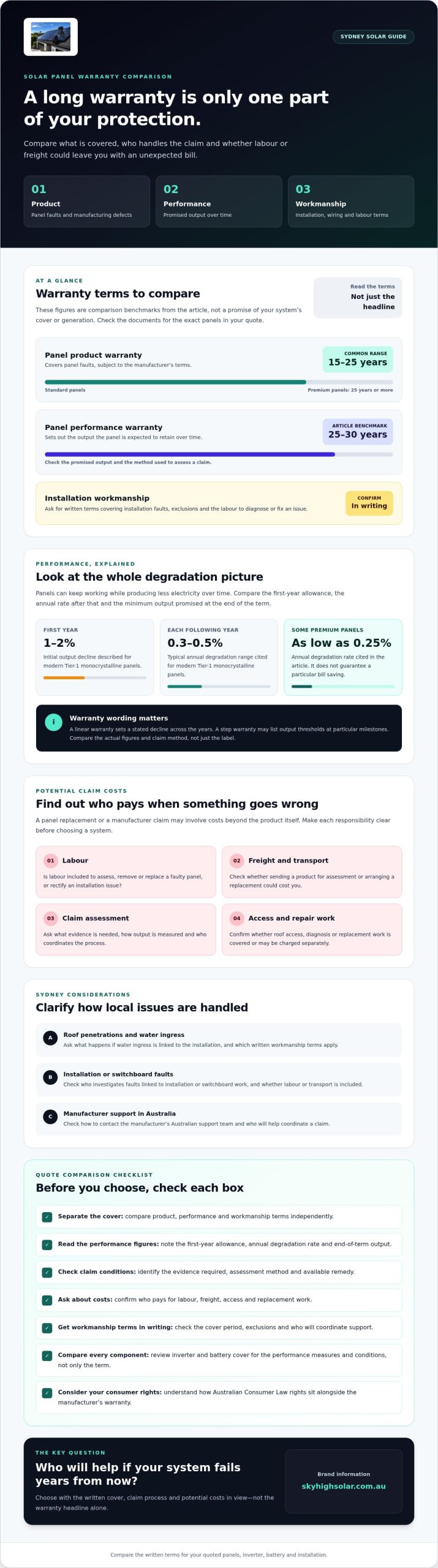
A product warranty covers faults in the panel itself, such as manufacturing defects or hardware failure, subject to the manufacturer’s terms. A performance warranty instead sets out how much power the panel is expected to retain over time. If product coverage ends after 10 years but performance cover runs for 25, a panel failure after the product period may not be handled in the same way as an output shortfall. Check what each warranty covers and how to make a claim.
In the 2026 market, standard panel product warranties commonly range from 15 to 25 years, while premium panels may offer 25 years or more for product coverage alongside a performance warranty of 25 to 30 years. Treat these as comparison benchmarks, not a substitute for checking the exact terms attached to the panels in your quote.
Don’t compare warranty length alone. Look for the remedies offered, whether assessment or replacement costs are addressed, and what evidence the manufacturer requires. A performance promise is only useful if the claim process and measurement method are clear.
The Role of the Installation Warranty
The third pillar covers the “how”: the workmanship involved in mounting panels, wiring the system and completing the electrical installation. A manufacturer’s product warranty may not cover a fault caused by poor installation. Ask for the installer’s written workmanship terms, including the cover period, exclusions and whether labour to diagnose or rectify an issue is included.
In Sydney, water ingress around roof penetrations and faults linked to installation or switchboard work are practical concerns to clarify before signing. These issues aren’t automatically covered by every installation warranty, so ask what happens if a fault is traced to the original work. Confirm who coordinates the claim and whether you could be charged for access, labour or transport.
Sky High Solar and Electrical is a Sydney-based provider of solar installation, electrical services and solar system servicing. When comparing quotes, ask what support the installer provides if you need help understanding a system issue or warranty process. Review the written coverage in your quote and ask how the installer will assist with manufacturer claims. Don’t assume local servicing means every repair or claim cost is included. For details about the business, visit Sky High Solar and Electrical.
For what to look for in a solar panel warranty comparison, treat labour terms as a core part of the decision, not an optional extra. A strong panel warranty cannot resolve an installation fault if responsibility and claim costs are unclear.
Evaluating Performance: Degradation Rates and Long-Term Yield
A panel can keep working for decades while producing less electricity each year. That gradual decline affects how much solar power is available for household use and export, which can influence your quarterly bills over time. Light Induced Degradation (LID) is an initial drop in panel output after exposure to sunlight. Check how the performance warranty accounts for this first-year change, rather than focusing only on the end-of-term figure.
In 2026, modern Tier-1 monocrystalline panels typically degrade by around 0.3% to 0.5% per year after an initial first-year decline of 1% to 2%; some premium panels have rates as low as 0.25% per year. Use these as comparison points, not a promise of your system’s actual generation. Roof orientation, shade, temperature and system design also affect output. A lower warranted degradation rate can help preserve more of the panel’s rated capacity over time, but it doesn’t guarantee a specific bill saving.
Reading the Degradation Curve
Open the panel datasheet and warranty document, then check the first-year allowance, the annual degradation rate after that, and the minimum output promised at the end of the term. A linear warranty sets a stated decline across the years; a step warranty may list output thresholds at particular milestones. Compare the actual figures and claim method, not labels such as “Tier 1”, which alone don’t define a warranty. N-type and TOPCon cell designs are among the technologies associated with current high-efficiency panels, but confirm the specific product’s warranted figures.
The year-one figure matters because it sets the starting point for the later performance calculation. If a warranty allows a larger initial drop, the panel may begin its long-term warranty period at a lower output level than you assumed. Ask the retailer to explain how the warranty calculates output and what evidence you’d need to support a claim. The Clean Energy Council’s guide to buying solar is another useful reference as you assess your quote and retailer.
Sydney’s Environmental Impact on Performance
Heat, humidity and coastal salt-mist exposure are relevant conditions to consider for Sydney rooftops, especially near the harbour. Don’t assume every panel responds the same way. Check the manufacturer’s stated environmental limits and whether the warranty excludes corrosion or damage linked to salt exposure. Review the backsheet and materials covered, too. If a clause is unclear, ask for a written explanation before you commit.
Keep records of system performance and follow the manufacturer’s maintenance requirements. Professional solar system servicing can help identify issues such as soiling or visible damage. Check the warranty terms to confirm which maintenance tasks are required and whether any exclusions apply. For support assessing a system or its servicing needs, contact Sky High Solar and Electrical.
In what to look for in a solar panel warranty comparison, prioritise the degradation schedule, first-year allowance and Sydney-relevant exclusions. Those details give you a clearer basis for comparing long-term output claims.
The ‘Local Presence’ Test: Is the Manufacturer Actually in Australia?
A long warranty is only useful if you can reach the business responsible for honouring it. If the manufacturer has no Australian office or service contact, you may face extra steps to establish who handles the claim, where equipment must go and who pays for transport or labour. A “back-to-base” clause deserves close attention. Check whether you must arrange and pay to return a panel or component, and whether removal and reinstallation are covered.
Check the legal entity named on the warranty, not just the brand printed on the panel. If the warranty names a different entity from the seller, or the responsible party is unclear, ask for written clarification. A name change alone doesn’t prove that a company is avoiding its obligations, but you should be able to identify who is responsible if the original installer or supplier is no longer operating.
Australian Consumer Law and Your Rights
Australian Consumer Law (ACL) rights exist alongside manufacturer warranties. For a major failure, consumer remedies can include repair, replacement or refund, depending on the circumstances. The party responsible may depend on who supplied the product and the nature of the claim. If a brand has no Australian entity, the Australian importer may have obligations as the manufacturer under the ACL, but don’t assume this makes a claim simple to pursue.
Before signing, record the seller’s legal business name and ABN, and ask which Australian entity will manage warranty claims. Check the ACCC website for consumer warnings or product safety notices, and use the relevant business registers to confirm the entity details. Keep your quote, invoice, warranty documents and claim correspondence together. That paperwork can help establish what was supplied and who to contact.
Manufacturer Solvency and “Bankability”
A BloombergNEF Tier 1 listing is a project-finance classification, not a product-quality certification, warranty endorsement or guarantee that a manufacturer will remain solvent. Treat it as one data point, not proof that a future claim will be honoured. Established brands such as Tesla and Enphase have Australian support, which can make it easier to find a local contact, but brand recognition alone can’t guarantee a particular claim outcome.
Ask the retailer to identify the Australian warranty contact and explain the claim process. If they mention a NSW warehouse or technical team, ask for the location and contact details rather than relying on a verbal assurance. Confirm whether claims are handled locally or referred overseas, and whether “back-to-base” terms could leave you responsible for freight, removal or labour.
For what to look for in a solar panel warranty comparison, prioritise a named Australian contact, clear claim steps and written responsibility for costs. A Sydney-based installer such as Sky High Solar and Electrical can help you understand who to approach if a system issue arises. Local support is valuable, but always check the specific warranty terms and the installer’s written commitments.
Comparing Inverter and Battery Warranties: SigenStor and FOX ESS
Panels may carry longer warranty terms, but an inverter or battery fault can affect how your system operates and stores energy. Inverters contain electronic components that convert solar power for household use, so check their coverage as carefully as the panel warranty. In 2026, 10 years is a common benchmark for inverter and battery warranties, but the term alone won’t tell you what a claim covers.
Compare the written warranty for each component, including who handles the claim, what labour is included and whether coverage depends on monitoring or an internet connection. Some battery warranties require a constant internet connection for updates and remote monitoring, so check the conditions that apply to the exact model in your quote.
Inverter Warranty Traps
A “5+5-year” offer may not mean the same thing as a single 10-year warranty. Ask whether the second period is automatic or requires registration, payment or other conditions, and whether coverage changes after the first term. Check if the warranty includes parts and labour, and what applies if monitoring software or Wi-Fi connectivity stops working. Don’t assume a connectivity issue voids cover; look for the actual clause.
GoodWe and Enphase are among the brands Sky High Solar and Electrical works with. Ask who manages claims and where technical support is based. Warranty service arrangements can vary by product and supplier, so check the documents for the exact model in your quote.
Battery Throughput and Capacity Guarantees
Battery warranties may set limits by years, energy throughput or both. Throughput measures the total energy discharged over the battery’s life, often expressed in megawatt-hours (MWh). A year-based term tells you how long the warranty lasts; a throughput limit helps show how much use is covered. If your household expects frequent charging and discharging, compare both limits and check which one ends coverage first.
Also check the end-of-warranty capacity figure. Some warranties specify a minimum retained capacity, such as 70%, but the exact threshold and measurement conditions vary. FOX ESS battery performance cover is stated as 70% retained capacity at the end of the 10-year term or after specified energy throughput, whichever comes first. SigenStor offers a 10-year product and performance warranty, with 70% energy retention after 10 years; its Gateway device has a separate warranty term. Confirm the current documents for the system you’re considering.
An integrated system such as SigenStor can bring components under one manufacturer’s warranty, which may simplify the claim pathway. It doesn’t remove the need to check exclusions, labour cover or separate device terms. NSW battery incentives have their own eligibility rules, so don’t assume rebate eligibility guarantees a particular warranty standard. Review current scheme requirements alongside the product documents.
For what to look for in a solar panel warranty comparison, include inverter and battery claim conditions, not just panel cover. Explore Sydney solar and battery options and ask for the relevant warranty documents before choosing a system.
Your Solar Warranty Comparison Checklist for 2026
Use this checklist to compare quotes on equal terms. Ask each retailer to provide the warranty documents for the exact panels, inverter, battery and installation in the proposal. A verbal summary or a single warranty headline isn’t enough to assess what’s covered.
- Check product cover: As a 2026 comparison benchmark, look for at least 15 years of panel product coverage. Confirm which defects are covered and what remedy the manufacturer offers.
- Confirm labour cover: Ask for the installer’s workmanship warranty in writing. A 5 to 10-year term is a useful comparison range, but check who provides it, what work it covers and whether labour is included in a claim.
- Verify Australian support: Identify the manufacturer’s Australian legal entity and claim contact. Ask for the physical office address and local support arrangements, rather than relying on a PO box or overseas contact details alone.
- Read replacement terms: Check whether a replacement includes shipping and handling, and who pays for diagnosis, removal and reinstallation. “Full replacement” can mean different things across warranty documents.
The ‘Fine Print’ Red Flag List
Read exclusions closely. If a warranty excludes “acts of God”, ask the provider to explain how that wording applies to storm damage at your Sydney property and what evidence is needed for a claim. Check whether professional servicing is required, how often it must be done, and whether you need to keep service records. Don’t assume a 2 to 3-year servicing interval applies unless the warranty states it. Finally, confirm whether cover transfers to a new owner if you sell the home, and whether you or the buyer must notify the manufacturer.
Making the Final Decision
The lowest quote isn’t automatically poor value, and a higher price doesn’t guarantee stronger protection. Compare the equipment, installation scope, warranty periods, exclusions and claim costs side by side. If one quote is cheaper, ask what differs. It may have shorter labour cover, different products or less support with manufacturer claims. Choose the option whose terms you can understand and whose responsibilities are clear.
A Sydney-based installer can help you understand system documentation and the steps involved in raising a claim. Sky High Solar and Electrical provides solar system servicing. Ask what support is included in your quote and get the answer in writing.
For what to look for in a solar panel warranty comparison, focus on the full claim pathway, not just the warranty duration. Get a fair dinkum solar quote with local Sydney support.
Choose Solar Protection Built for the Long Term
A dependable solar investment needs more than a long warranty headline. Compare product, performance and labour cover separately, then check claim costs, exclusions and who will support you in Australia. For Sydney homes, also read the terms for environmental exposure and required servicing. These details help you judge what to look for in a solar panel warranty comparison and whether the protection is clear enough to rely on.
Sky High Solar and Electrical provides solar installation, electrical services and solar system servicing in Sydney. Ask for the relevant warranty documents and clarify what support is included before you choose. Talk with Sky High Solar and Electrical about solar options for your Sydney home.
With the right questions and written terms in hand, you can compare quotes with greater confidence and choose a system designed for dependable performance over time.
Frequently Asked Questions
Does a solar panel warranty cover hail damage in Sydney?
It depends on the panel warranty’s exclusions and the cause of the damage. Some warranties cover manufacturing defects but exclude damage from external events, which may include hail or storms. Check the wording for impact damage, weather events and any assessment requirements. If hail damages your Sydney system, photograph the damage from a safe location, avoid touching damaged equipment and contact your installer or insurer to clarify the next steps.
What happens to my warranty if my solar installer goes out of business?
Your manufacturer’s product warranty may still apply, but you could lose the original installer as your point of contact for diagnosis, labour or claim support. Keep your quote, invoice, system documents and warranty details, including the manufacturer’s Australian contact information. Australian Consumer Law rights may also apply, depending on the circumstances and the businesses involved. Before installation, ask who handles claims if the installer stops trading.
Is a 25-year performance warranty the same as a 25-year product warranty?
No. A product warranty covers qualifying defects or hardware failures, while a performance warranty promises a minimum level of power output over time. A panel may have long performance cover but shorter product cover, so check both terms separately. Compare the first-year output allowance, later degradation rate, end-of-term output threshold and claim process. This is central to what to look for in a solar panel warranty comparison.
Do I need to clean my solar panels to keep the warranty valid?
Not necessarily. Cleaning requirements depend on the manufacturer’s warranty and maintenance instructions, so check the documents for your specific panels before arranging work. Some terms may require maintenance or records, but don’t assume a set cleaning schedule applies to every system. In Sydney, dust, leaves and bird droppings can affect panel surfaces. If you’re unsure, ask your installer about safe cleaning and professional solar system servicing.
How do I make a warranty claim if I think my panels are underperforming?
Start by checking your inverter or monitoring app and recording the dates and output readings. Compare performance with the system’s expected output, allowing for weather, shading and seasonal changes. Contact your installer with the system details, evidence and warranty documents, and ask whether they’ll assess the issue or refer it to the manufacturer. Don’t remove panels or carry out electrical work yourself. Keep copies of all claim correspondence.
Are microinverter warranties better than string inverter warranties?
Not automatically. The best option depends on the equipment warranty, claim process, labour coverage and suitability for your roof and system design. Compare the exact terms for each inverter, including any registration conditions, connectivity requirements and who pays for diagnosis or replacement labour. Ask your Sydney installer how faults are identified and whether support is available locally. A longer warranty can be useful, but only if its conditions are clear.
Can I transfer my solar warranty to the new owner if I sell my Sydney home?
Some warranties may transfer with the property, while others require notification, registration or approval. Check the manufacturer’s terms for panels, inverter and battery separately, as transfer conditions can differ across components. Keep installation and maintenance records for the buyer, and contact the manufacturer before settlement if the process isn’t clear. Confirm any deadlines or documents required in writing so the new owner knows how to access support.
What is the ‘Solar Cowboy’ warranty and how do I avoid it?
“Solar Cowboy warranty” is an informal phrase, not a standard warranty category. It usually describes vague promises from a seller or installer that don’t clearly identify the responsible business, coverage or claim process. Before accepting a quote, ask for the manufacturer’s warranty and the installer’s workmanship terms in writing. Check the legal business name, exclusions, labour and freight costs, and Australian support contact. Avoid relying on verbal assurances alone.