

 Sydney
 0452 243 240
Blog
Is a 10kW Solar System Too Big for Your Sydney Home?

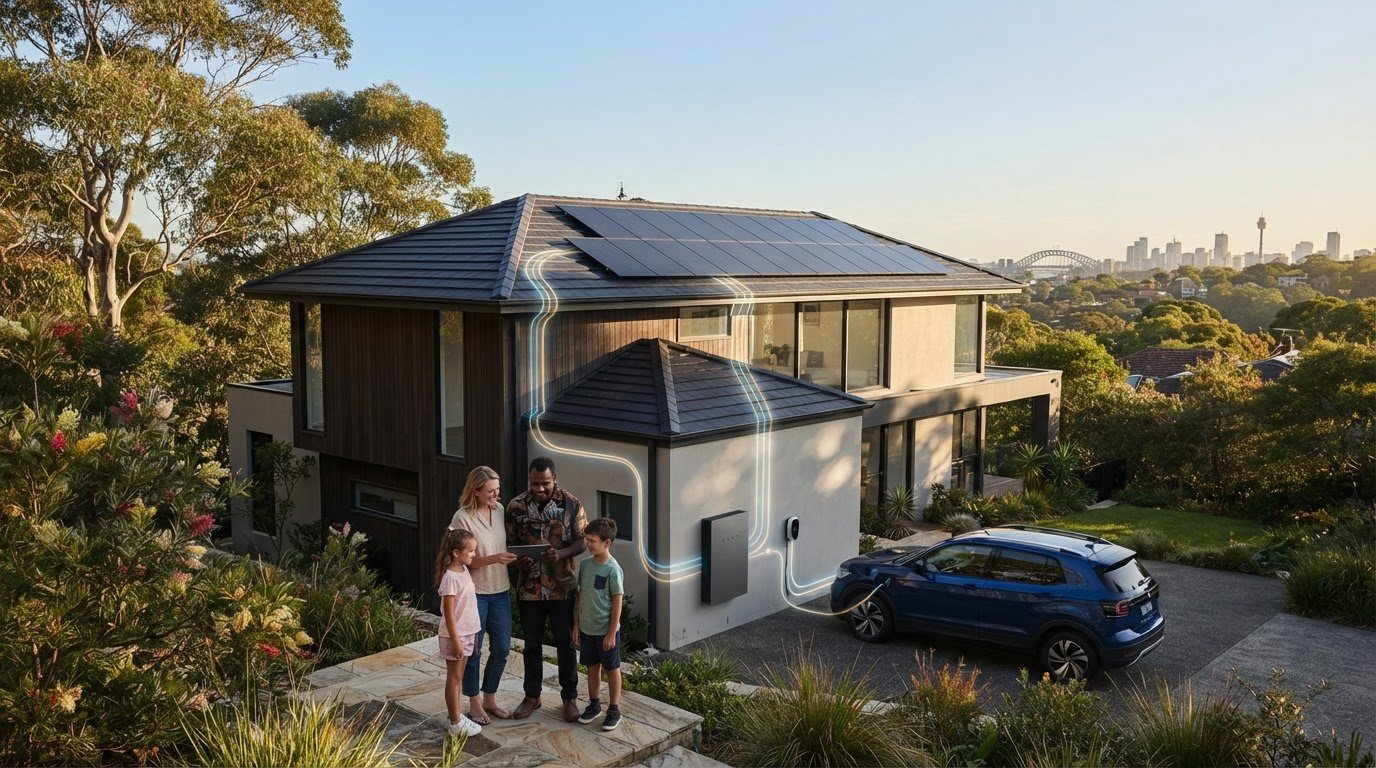
Could a larger solar system deliver less value if your household can’t use or export its extra power? Is a 10kw system too big for my home? Not necessarily. The answer depends on how much electricity you use, when you use it and whether you expect demand to grow.
A 10kW system’s suitability also depends on your roof, electricity connection and export arrangements. In Sydney, those details matter alongside your daytime electricity use and whether a battery or future EV charging could help you make better use of solar generation.
This guide explains how to compare a 10kW system with a smaller option, using your bills, household routines and plans. You’ll also find a practical checklist to help you prepare for a system design based on your home, rather than the capacity figure alone.
Key Takeaways
- Whether a 10kW system is too big depends on how its generation matches your household use, export options and future plans.
- Look beyond total electricity consumption. When you use power affects how much solar you can use directly and whether battery storage may suit your needs.
- Compare 10kW and 6.6kW systems against your household loads, usable roof space and likely changes, rather than assuming one size suits every Sydney home.
- Review your electricity bills, daytime habits, planned appliances, roof conditions and connection details before choosing a system size.
- A site-specific design can balance expected solar generation with your home’s needs and available export arrangements.
Is a 10kW solar system too big for a Sydney home?
Not automatically. A 10kW system may be oversized if its likely generation regularly exceeds what your household can use, store or export, and you don’t expect demand to increase. The right size isn’t determined by floor area or the number of people in your home alone. Household routines, roof conditions and your electricity connection all matter.
If you’re asking, “is a 10kw system too big for my home”, first distinguish the system’s rated capacity from the energy your household consumes. A 10kW system may suit a home with substantial daytime loads or planned electric appliances. But if generation regularly exceeds your needs and export options are restricted, some of that extra power may be worth less than electricity used at home.
What does a 10kW solar system size describe?
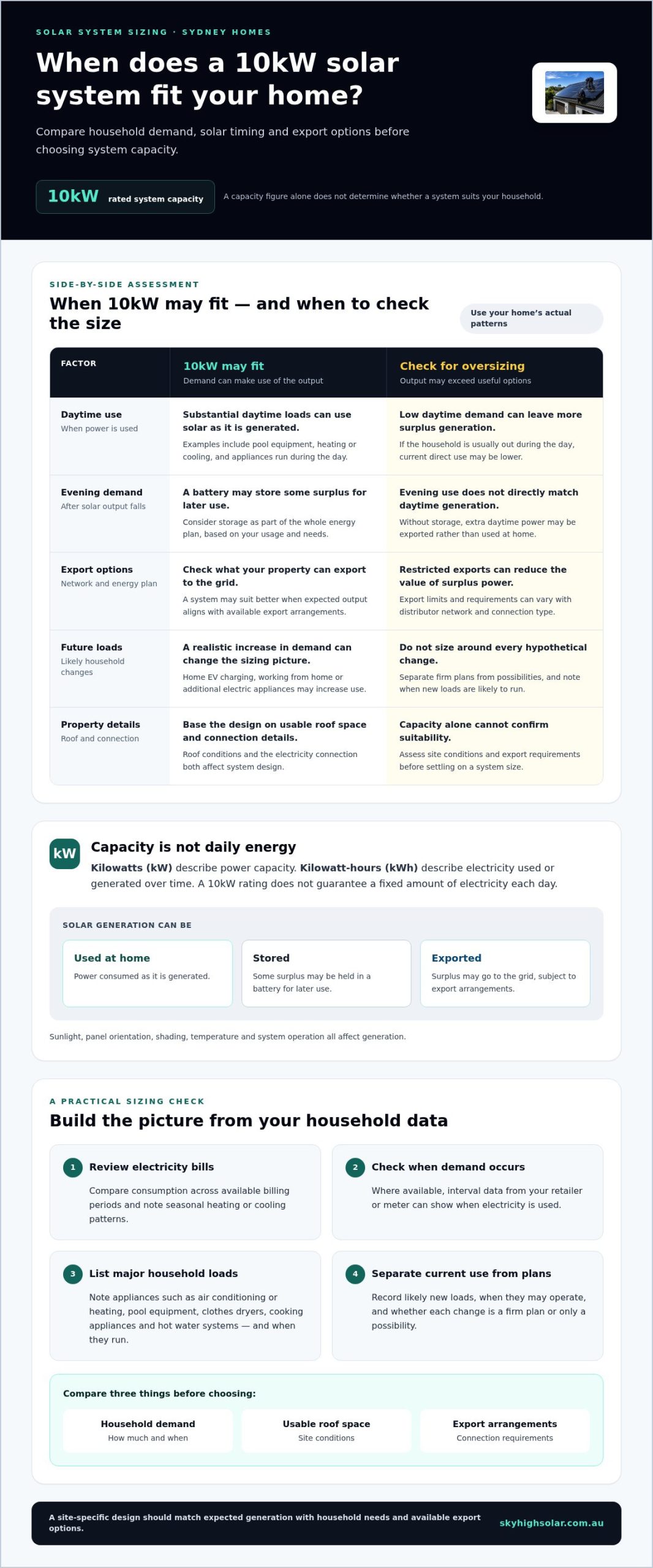
Kilowatts (kW) measure power capacity, while kilowatt-hours (kWh) measure the amount of electricity used or generated over time. A 10kW solar system’s rating describes its nominal capacity. It doesn’t guarantee a fixed amount of electricity each day. Sunlight, panel orientation, shading, temperature and system operation all affect generation. A photovoltaic system produces electricity that can be used immediately, stored in a battery or exported to the grid.
Why might a household worry that 10kW is oversized?
Solar panels generally generate most strongly during daylight, while many households use more electricity in the evening. If your daytime demand is low, surplus generation may be exported. The value of exported electricity depends on your energy plan, and the amount you can export may depend on your network connection and its requirements. A battery can store some surplus for later use, but whether it suits your home depends on your usage and plans.
That doesn’t mean a larger system is wasteful. A household planning to charge an electric vehicle at home or add other electricity-consuming appliances may have higher future demand than current bills show. A sound design accounts for likely changes without assuming every household needs the same capacity.
For a Sydney property, connection details matter as well as panel capacity. Export arrangements can vary between distributor networks and connection types, while site conditions can also affect system design. Assess the requirements and export options for the property before settling on a system size.
- Review your current electricity use and any planned changes.
- Consider when people are home and which appliances run during the day.
- Estimate how much generation could be used directly, stored or exported.
A 10kW system is a better fit when its expected output aligns with household demand, export arrangements and realistic future plans. A smaller home can still use a lot of electricity, while a larger home may have modest daytime demand. Base the system size on how your household operates, not the building alone.
How household use and solar timing determine whether 10kW fits
Your total electricity use is only part of the picture. Two households with similar consumption can have different solar needs if one uses most of its power during the day and the other uses it after sunset. Compare your usage patterns with solar generation, then consider whether a battery or planned changes could help bridge the gap.
Read your electricity use before choosing system size
Start with your electricity bills. Compare consumption across the billing periods you have and note seasonal patterns, such as higher heating or cooling use. A bill shows how much electricity you used over a period, but may not show exactly when you used it. Where available, interval data from your retailer or meter can help reveal when demand occurs.
Next, list the larger electricity loads in your home and note when they usually run. Include air conditioning or heating, pool equipment, clothes dryers, cooking appliances and hot water systems. A pool pump that runs during the day, for example, may use solar generation directly. Evening cooking and appliance use may draw more power after solar output has fallen.
Separate established routines from possible changes. Working from home could add daytime computer, lighting and climate-control use. If your household is usually out during the day, current daytime demand may be lower. This helps you judge whether a proposed system reflects how you live now or a change you genuinely expect.
Self-consumption is the share of your solar electricity that your household uses directly, instead of storing or exporting it. A bi-directional smart meter records electricity consumed from the grid and electricity exported, helping you understand how energy moves between your home and the network.
Consider batteries and future household loads
A battery can store surplus solar generation for later use, such as in the evening when panels aren’t producing. It can change how much of your system’s output your household uses over time, but the right approach depends on your consumption pattern and storage needs. Treat a battery as part of your overall energy plan, not as a reason on its own to choose a larger array.
Then list likely new loads. An electric vehicle charged at home, additional cooling or new electric appliances could raise demand or create more opportunities to use solar during the day. Note when each load is likely to operate and whether it’s a firm plan or only a possibility. That gives your design a realistic basis instead of sizing for every hypothetical change.
To answer “is a 10kw system too big for my home?”, compare your bills, daily routines, available meter data and likely new loads. If you’re considering how storage could fit into that plan, the Sydney home solar battery storage guide explains the key considerations. A project-specific home solar system design can bring those household factors together.
10KW vs 6.6kW: which solar system size suits your household?
A 6.6kW system and a 10kW system suit different energy profiles. Neither is automatically the better choice for a Sydney home. Compare how much electricity your household uses, when you use it, how much suitable roof area is available and whether demand may grow. Use the table as a starting point, then assess the property and connection before deciding.
| Factor | 6.6kW may be a closer fit | 10kW may be worth considering |
|---|---|---|
| Household load | Current demand is comparatively modest, with limited plans to add major electrical loads. | Current use is higher, or planned appliances could raise demand. |
| Timing | Your daytime use can make good use of solar generation, and evening demand is limited. | Daytime loads are substantial, or a battery could store surplus for later use. |
| Roof capacity | Usable roof area or layout may suit a smaller array more readily. | There’s enough suitable, relatively unshaded roof area for the planned array. |
| Future demand | Your household’s energy needs are likely to remain similar. | You’re planning electrification, such as home EV charging or additional appliances. |
When could a 6.6kW system be a closer fit?
A 6.6kW system may suit a home with comparatively modest electricity demand, limited daytime loads and no firm plans to add major electrical equipment. It may also work where usable roof space or its orientation limits the array layout. These are examples, not rules based on household size. Check your bills, daily routines and likely changes before deciding.
When could a 10kW system make more sense?
A 10kW system may suit higher electricity use, substantial daytime demand or planned electrification. The roof still needs enough suitable space, and panel placement must account for orientation and shading. In Sydney, export arrangements can differ by network and connection, so the value of surplus generation partly depends on the options available for your specific project.
Panel capacity and inverter capacity are related but distinct. The 133% oversizing rule allows solar panel capacity to be up to 133% of the inverter rating to maximise energy production. For example, a 10kW inverter could be paired with up to 13.3kW of panels under that ratio. Check how the rule applies to the proposed design and any relevant system or network limits, rather than assuming the ratio alone determines what can be installed.
If you’re weighing “is a 10kw system too big for my home”, compare both sizes against your actual roof layout, demand and export arrangements. The 6.6kW Sydney solar system guide provides more detail to help you assess the smaller option against your household’s needs.
Is 10kW right for your home? A practical checklist
Before settling on a system size, work through these five checks. Together, your bills, household plans and property details provide a clearer brief for a site-specific solar design.
- 1. Review your electricity bills. Gather bills across the billing periods available and note total use, seasonal changes and any time-of-use information. This can reveal whether demand changes with heating, cooling or other regular patterns.
- 2. Map your daily usage. List the appliances and systems that use the most electricity, and note when they run. Separate daytime loads from evening demand to see when solar generation may be used directly.
- 3. Record planned changes. Note likely additions such as home EV charging or new electric appliances. Distinguish firm plans from possibilities, and consider when each new load would operate.
- 4. Assess the roof. Usable roof area, orientation and shading affect panel placement and array layout. A site-specific design can assess these factors together instead of relying on roof size alone.
- 5. Check the connection. Identify the property’s electricity distributor and connection details. Sydney-area export and connection requirements can vary, so confirm the conditions that apply to the address before finalising the design.
How to interpret surplus generation and export limits
Solar electricity used by appliances in your home is consumed on site. Generation your household doesn’t use or store may flow to the grid as an export, subject to the connection’s export conditions. The value of exported power depends on your electricity plan and the arrangements applying to your property. Don’t assume every extra unit will be worth the same as electricity used at home.
A larger array isn’t automatically a better fit just because it can generate more. Nor does adding a battery guarantee that surplus will be used in the most suitable way. Consider expected daytime demand, how much electricity may be exported and whether storage matches your evening use. These checks help answer “is a 10kw system too big for my home?” based on your household and site, rather than a rule of thumb.
Use your answers to guide a project-specific design that balances household use, roof suitability and export conditions. Discuss a solar system for your home with Sky High Solar and Electrical.
How Sky High Solar designs a 10kW system around your Sydney home
A suitable system starts with your household, not a standard panel count. Sky High Solar and Electrical installs 6.6kW and 10kW solar systems for homes across Sydney and surrounding regions. The design brings your energy use, roof and connection details together to assess which system size suits your property and plans.
What a tailored solar assessment should account for
Your bills and usage patterns help shape the design. A site assessment considers usable roof area, orientation, shading and the property’s electrical setup. The design also accounts for relevant export requirements and planned changes in household demand. Expected generation and financial outcomes should reflect the specific system and site conditions, not its capacity label alone.
Eligible solar installations may receive an upfront discount through Small-scale Technology Certificates under the federal Small-scale Renewable Energy Scheme (SRES). The discount depends on the system’s eligibility and the applicable certificate value, so it isn’t a fixed amount.
Sky High Solar and Electrical installs solar and battery systems, including FOX ESS battery storage and hybrid inverter options. Battery selection and system design should reflect your household’s usage, storage needs and electrical configuration.
From system design to compliant installation
After assessing the home and project requirements, Sky High Solar and Electrical designs and installs a system to suit the property. The company has been a licensed electrical contractor since 2013. A post-installation review checks the completed work, including relevant compliance requirements and rebate registration.
A certificate of compliance electrical work (CCEW) documents that electrical work meets applicable Australian safety standards and is legally compliant. Keep this record with your solar system documentation for a clear handover and future reference.
For a system designed around your household and property, discuss a tailored solar installation with Sky High Solar and Electrical.
Make your next solar decision with confidence
Your household’s energy needs may change over time. A considered solar design should suit how you use electricity now and account for changes you’re genuinely planning, rather than sizing around every possible future scenario. This gives you a clearer basis for choosing a system that fits your home and supports your longer-term energy goals.
The question “is a 10kw system too big for my home” is best answered with a design grounded in your property and household needs. Use your assessment to discuss the system options, expected generation and how the design accounts for your plans. Clear assumptions make it easier to understand what the proposed system is intended to do and whether it matches your home.
Take the next step with a plan shaped around your household, not a one-size-fits-all recommendation. Discuss a solar system designed around your Sydney home with Sky High Solar and Electrical.
Frequently Asked Questions
Is a 10kW solar system too big for an average home?
There isn’t a single system size that suits every “average” home. Start by checking the annual kilowatt-hour total on your bills and comparing it with your household’s plans for the property. The question “is a 10kw system too big for my home” is best answered using those records and a design specific to your site, rather than a general household label.
Can a 10kW solar system produce more electricity than my home can use?
Yes. You may be able to shift flexible electricity use into daylight hours to use more generation at home. For example, consider running a dishwasher or washing machine while solar is producing, if that suits your routine and the appliance instructions. This can help you use available solar power, but it won’t suit every appliance or household schedule. Actual system output also varies with conditions.
How do I know whether I need a 6.6kW or 10kW solar system?
Ask for the proposed design to state the panel capacity, inverter rating and assumptions behind its generation estimate. Those details make it easier to compare what each option is designed to deliver. Check that the estimate reflects your roof layout and any shading at the property. Keep a copy of the design so you can refer to its assumptions after installation.
Does a 10kW solar system need a large roof?
Not every part of a roof is necessarily suitable for panels. Roof faces can differ in orientation, while skylights, chimneys or nearby structures may limit placement. Ask for the proposed layout to show which roof sections are used and how panels are arranged. This gives you a clearer view of how the system fits the actual roof, rather than relying on its total area.
Can I add a battery to a 10kW solar system later?
It may be possible, but planning for a later battery is easier when the original design records the inverter and electrical configuration. Keep the system documentation and note any requirements identified for future storage. If you add a battery later, consider its capacity against the loads you want it to support, such as essential evening circuits, rather than matching it to the solar system’s headline size.
Does the 133% oversizing rule mean a 10kW system is allowed on every home?
No. The ratio alone doesn’t establish whether a proposed installation can proceed at a particular address. Review the system design alongside the connection application and the distributor’s response, including any conditions attached to the connection. The approved equipment and settings should align with the final installation. Keep this paperwork with your system records so you can compare the installed configuration with the approved design.
Will a 10kW solar system eliminate my electricity bills?
No. A solar system can’t guarantee that your bill will be eliminated. Check your retailer’s bill breakdown for daily supply charges, electricity imported from the grid and any credits for exported power. These items depend on your plan and can remain even when solar reduces the amount of electricity you buy. Review your bill after installation to understand how your actual charges and credits compare with previous bills.