

 Sydney
 0452 243 240
Blog
Cost to Install 3 Phase EV Charger Sydney: 2026 Buying Guide

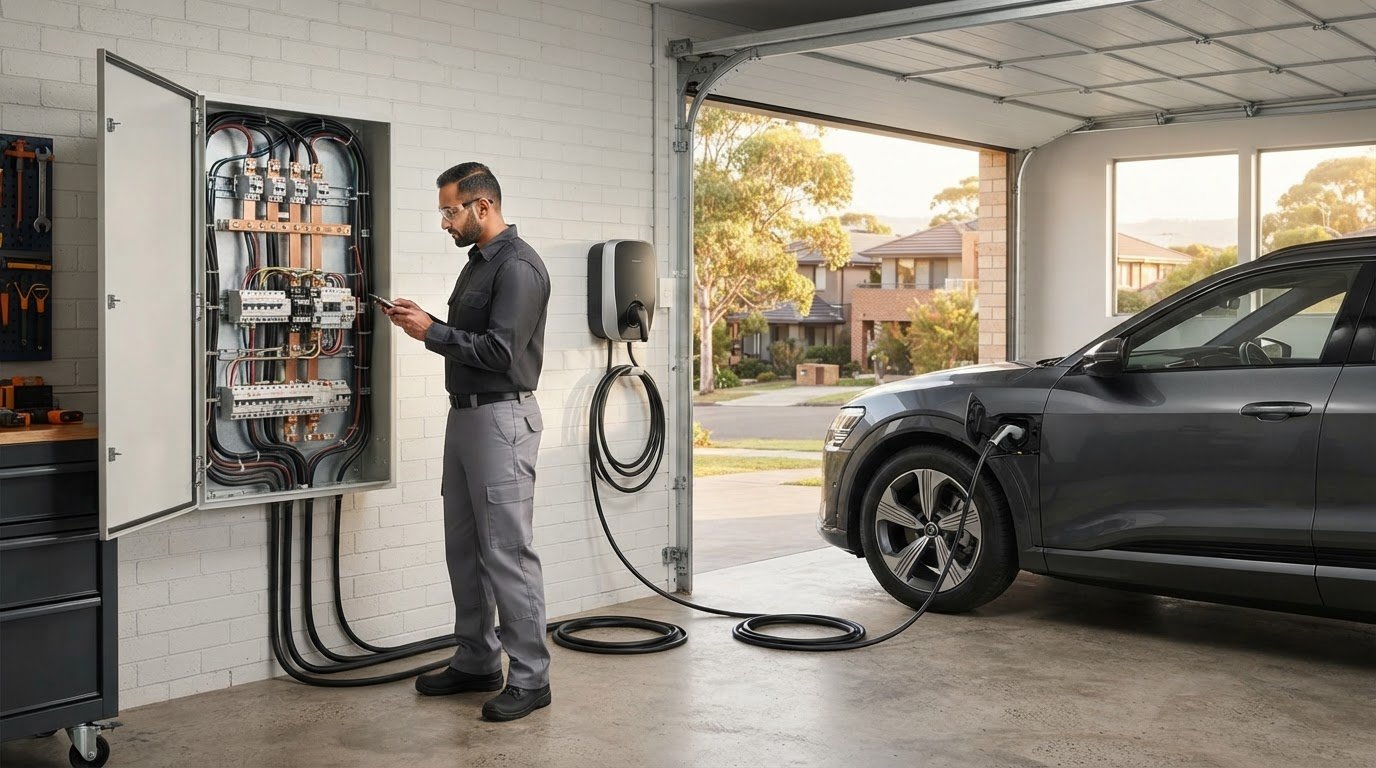
The hardware mounted on your garage wall is rarely the primary driver of your final invoice. When calculating the real cost to install 3 phase EV charger Sydney homeowners often discover that the deciding expense sits behind the meter box rather than in the charging unit itself.
If you have struggled with vague estimates that gloss over local distributor rules, or you feel uncertain about whether your property actually has an active 415V supply, your hesitation is completely justified. Fast charging an electric vehicle demands serious electrical capacity. Without clear answers on whether your switchboard can handle the extra load alongside heavy household appliances, budgeting can quickly feel like guesswork.
This guide explains the genuine infrastructure variables, equipment options, and electrical requirements that determine your installation investment. You will learn how to verify your existing phase capacity, identify when a switchboard upgrade is essential, and ensure your setup meets strict Australian standards with a valid certificate of compliance electrical work (CCEW).
Key Takeaways
- Uncover how property layout and cable runs dictate the true cost to install 3 phase EV charger Sydney properties need, far beyond the base wallbox unit.
- Understand the performance jump between standard single-phase 7.4kW charging and high-speed 415V three-phase setups delivering up to 22kW.
- Learn how to determine if your home requires a switchboard upgrade with modern RCBOs and mandatory certificate of compliance electrical work (CCEW) documentation.
- Use a clear quote checklist to uncover concealed costs, from heavy-gauge cable specifications to Sydney network connection rules.
- Discover how dynamic load management and rooftop solar integration keep fast charging efficient without overloading your home’s main service fuse.
Core Factors Influencing 3-Phase EV Charger Installation Costs in Sydney
Every home layout presents distinct electrical challenges. Fixed-rate quotes often overlook these real-world conditions, leaving owners with unexpected charges once an installer steps on site. The baseline cost to install 3 phase EV charger Sydney homes require is shaped by your property’s spatial layout, cable distances, and existing switchgear capacity.
Delivering high-capacity charging relies on three-phase electric power running across a dedicated circuit directly from your distribution board. Meeting Australian standards requires heavy-duty components designed for sustained high amperage:
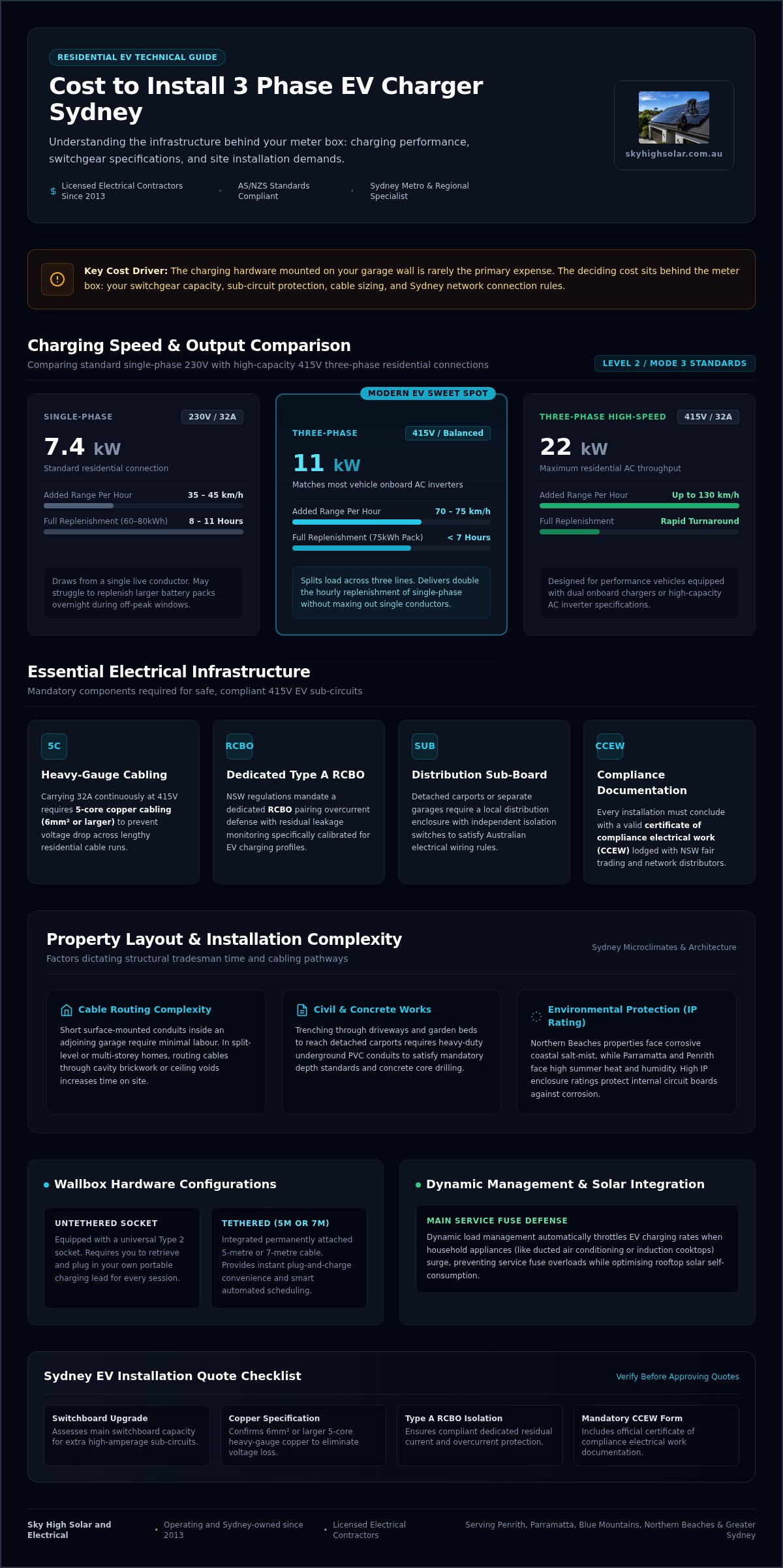
- Cable sizing and distance: Carrying 32A continuously over 415V demands 5-core heavy-gauge copper cabling, typically 6mm² or larger to prevent voltage drop over long distances.
- Circuit safety hardware: NSW network regulations mandate dedicated Type A RCBO protection on the charging sub-circuit, pairing overcurrent defence with residual leakage monitoring.
- Sub-board additions: Detached carports or garages set away from the primary structure often require a separate local distribution enclosure with independent isolation.
Hardware Specifications and Charging Capabilities
The charging wallbox accounts for an important part of your initial hardware budget. Basic untethered units feature a simple Type 2 universal socket, requiring you to retrieve your own lead each day. Premium tethered units offer integrated 5-metre or 7-metre cables, adding convenience along with smart capabilities like Wi-Fi control, solar tracking, and automated off-peak scheduling.
Sydney’s regional microclimates also influence your choice of equipment. Homes along the Northern Beaches face constant coastal salt mist, while properties in Parramatta and Penrith endure extreme summer humidity and heat. Selecting enclosures with high IP ratings ensures internal circuit boards remain protected against external dust, moisture, and corrosion over years of daily exposure.
Physical Installation Complexity Across Sydney Properties
The structural route between your switchboard and parking space often shapes your final installation fee. A short surface-mounted run inside an adjoining garage requires minimal labour. In contrast, routing cabling through cavity brickwork, ceiling voids, or across multiple storeys in modern split-level homes demands considerable tradesman time.
Complex layouts frequently require specialised structural work. Core drilling through reinforced concrete slabs or suspended masonry adds time on site. Where cables must cross driveways or garden beds to reach a freestanding garage, trenching and heavy-duty underground PVC conduits are needed to protect your heavy-gauge conductors and satisfy electrical depth standards.
Single-Phase vs 3-Phase EV Charging: Speed, Capacity, and Long-Term Value
Weighing up the cost to install 3 phase EV charger Sydney homes require begins with understanding what single-phase systems can realistically deliver. Standard residential connections operate on 230V single-phase power, which maxes out at 7.4kW (32A). Stepping up to a 415V three-phase connection provides up to 22kW of throughput, fundamentally changing how your home manages high-draw energy demands.
Most residential wallboxes fall under Level 2 / Mode 3 charging standards. While a standard circuit draws from a single live conductor, a 415V arrangement splits current across three separate phases. This delivers significantly higher energy transfer without overloading a single wire.
Charging Speed and Kilometres Added Per Hour
Real-world replenishment speeds depend on your vehicle’s onboard AC inverter, which converts grid alternating current into battery-ready DC. While select performance models take the full 22kW, the sweet spot for the vast majority of modern passenger EVs sits at 11kW.
- Single-phase (7.4kW): Supplies roughly 35 to 45 km of driving range per hour, taking around 8 to 11 hours to replenish a typical 60kWh to 80kWh battery.
- Three-phase (11kW): Adds approximately 70 to 75 km of range per hour, recharging an empty 75kWh pack in under 7 hours.
- Three-phase (22kW): Adds up to 130 km of range per hour for capable vehicles, completing full replenishments in 3 to 4 hours.
For daily commuters, 11kW provides rapid turnaround between afternoon arrivals and evening outings, while commercial fleet vehicles benefit immensely from fast daytime top-ups.
Long-Term Return on Property Investment
A multi-phase connection delivers substantial equity and operational resilience to modern households. Distributing heavy electrical draw across three active lines prevents switchboard nuisance trips when ducted air conditioning, induction cooktops, and vehicle chargers run together. It also future-proofs your garage for multi-EV adoption, allowing two cars to share 22kW dynamically without requiring another supply upgrade later.
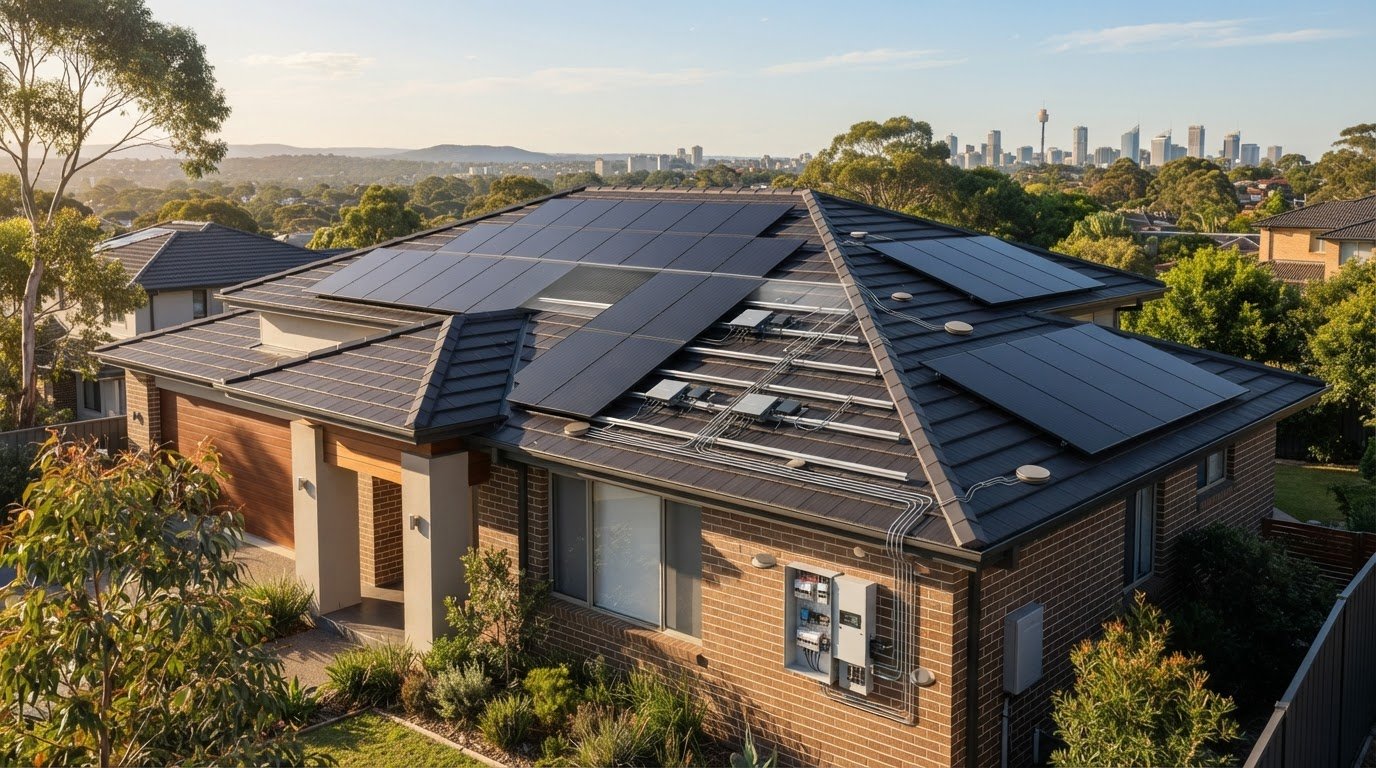
Generating matching clean energy during the day transforms your operational payback. Pairing high-output charging with an on-site 10kW solar power system lets you route surplus daytime generation straight into your car battery. If you want to assess your property’s electrical balance and switchgear before committing, consulting the team at Sky High Solar and Electrical ensures your energy assets work seamlessly together.
Sydney Electrical Infrastructure: Switchboard Upgrades and Grid Connections
A major gap in generic pricing is the assumption that your home is electrically prepared for high-output charging. When reviewing the overall cost to install 3 phase EV charger Sydney households face, upstream grid connections and meter panel conditions frequently represent the deciding financial component.
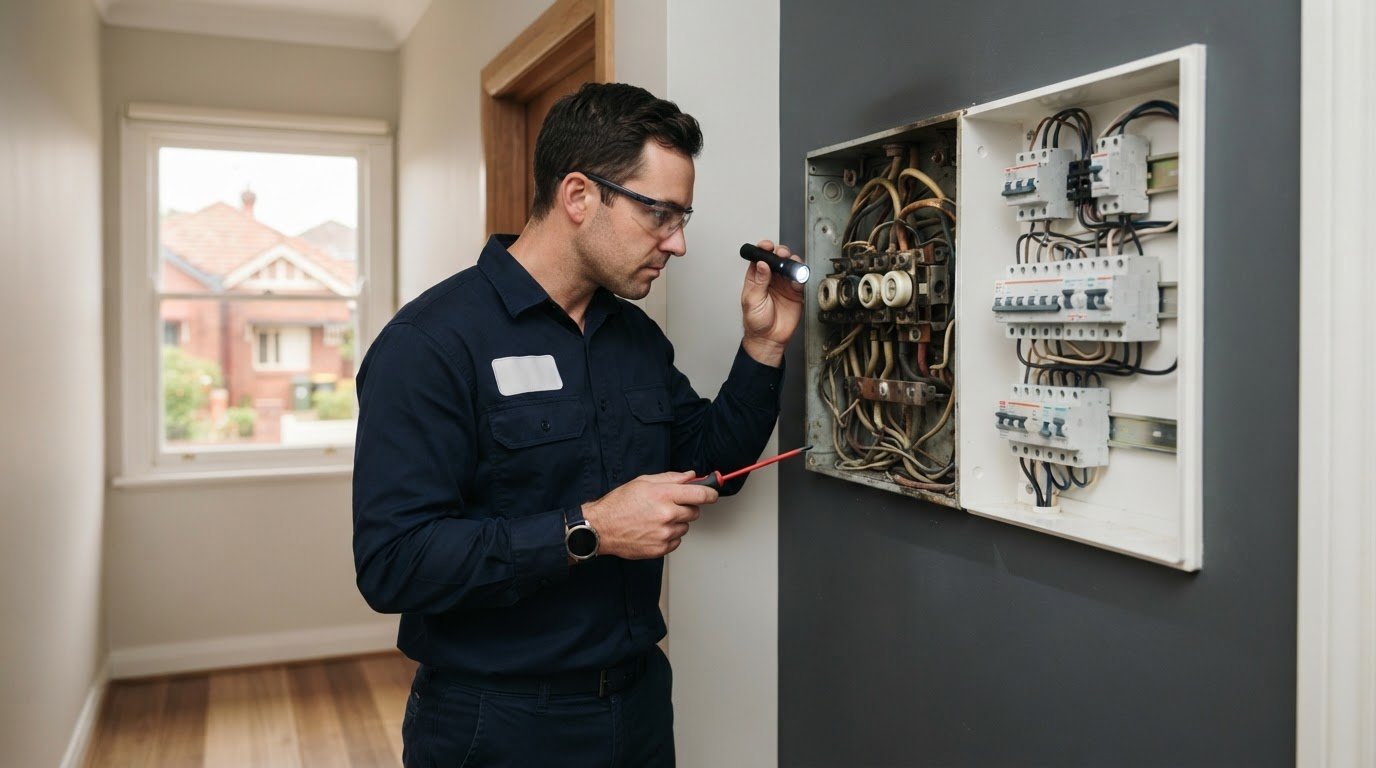
Older properties across Sydney Metro, Parramatta, and the Inner West often rely on single-phase 60A service mains installed decades ago. Adding a continuous 32A three-phase load to these existing setups will quickly trigger main service overloads, requiring substantial electrical modernisations before an installer can run a single cable.
Assessing Your Existing Switchboard Capacity
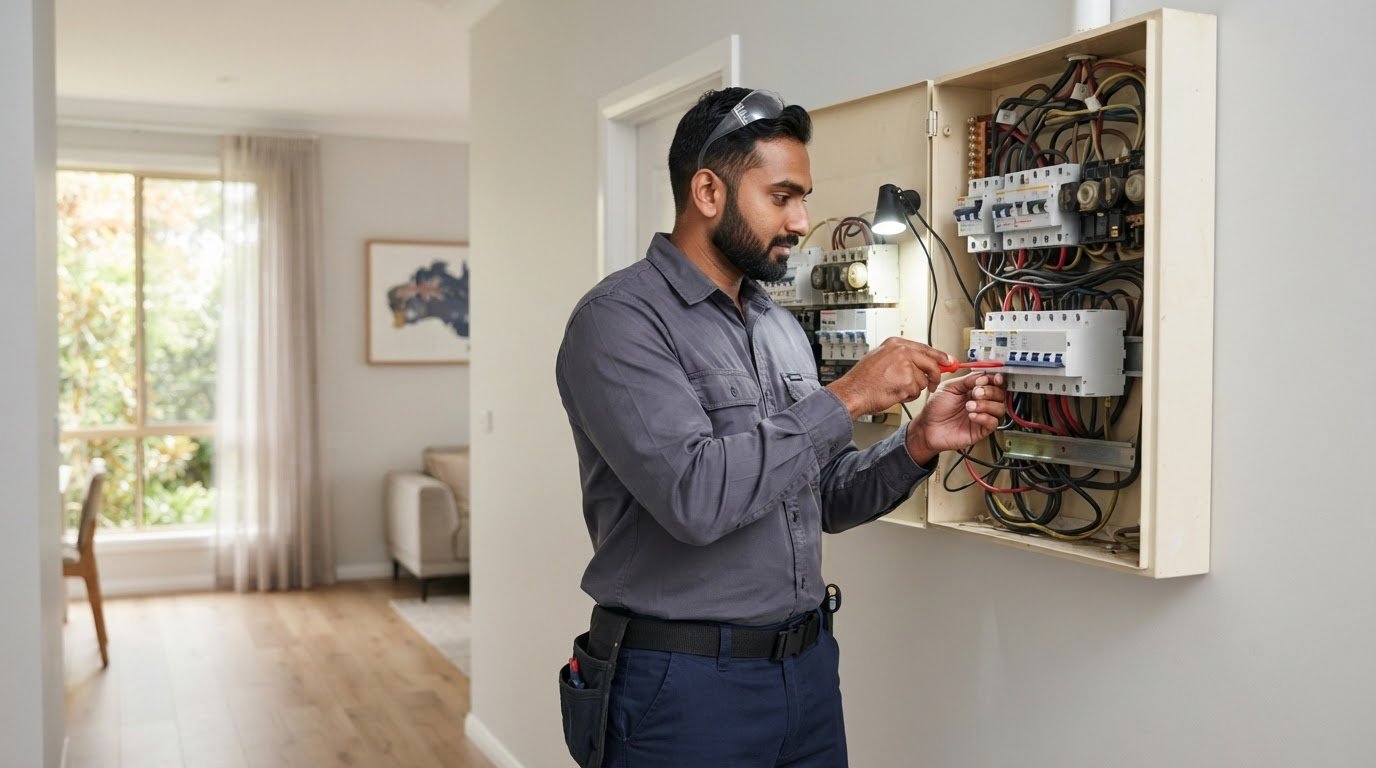
A quick inspection of your meter enclosure reveals initial clues about property readiness. A genuine 415V arrangement features a linked three-pole main isolating switch alongside three distinct service fuses. If you see only a single main toggle or individual ceramic wire fuses, your property runs purely on single-phase power.
Older panels present distinct physical challenges:
- Missing enclosure space: Multi-pole circuit breakers, surge arrestors, and residual protection gear require wide DIN rail allowances that older enclosures lack.
- Substrate safety hazards: Many mid-century Sydney switchboards contain compressed asbestos backing panels, requiring certified abatement before modern switchgear can be secured.
- Outdated earthing systems: Adding high-draw continuous vehicle circuits demands a modern MEN (Multiple Earthed Neutral) connection and an approved earth stake installation.
Completing a full switchboard upgrade replaces fragile rewirable fuses with modern miniature circuit breakers and dedicated RCBO protection to guarantee rapid fault isolation.
The Role of Level 2 ASP Electricians in Sydney
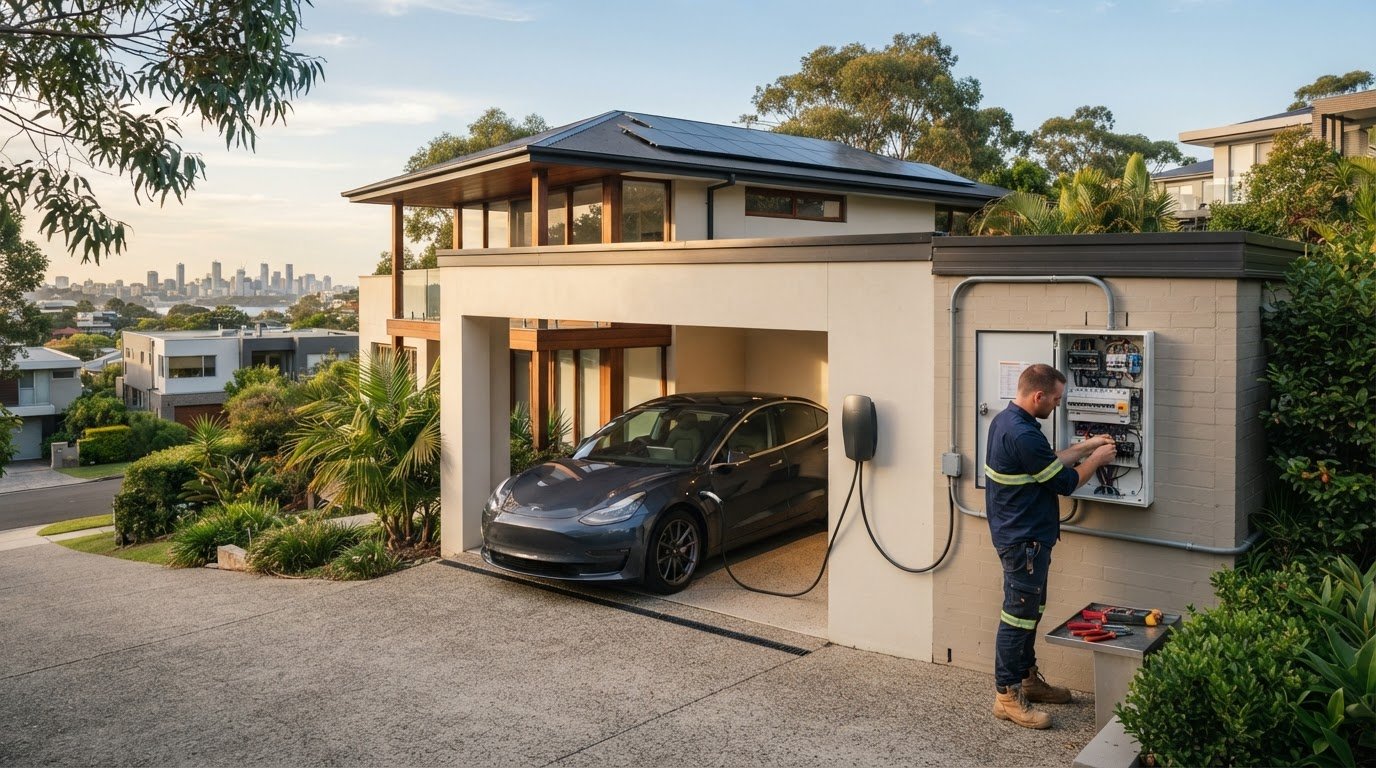
Standard electrical contractors work downstream from your main board, but converting a home to multi-phase power requires a certified Level 2 Authorised Service Provider (ASP). These accredited specialists hold statutory authority to work directly on overhead and underground network assets connecting your property to the street grid.
Grid infrastructure rules depend on your Sydney energy distributor. Ausgrid manages network operations across Sydney’s inner suburbs, Northern Beaches, and North Shore, while Endeavour Energy handles Western Sydney and the Blue Mountains. Both distributors require formal connection applications before upgrading consumer mains.
A Level 2 ASP pulls new heavy-gauge copper lines from the street pole or underground pillar box to your boundary. Finally, your energy retailer coordinates with the network to commission a modern bi-directional smart meter, ensuring high-draw import consumption and rooftop solar exports are tracked accurately across every phase.
Evaluating Installation Quotes: Essential Checklist to Avoid Hidden Fees
Vague quotes are the primary reason homeowners end up paying far more than anticipated. A low initial figure often excludes mandatory switchgear, isolation switches, or distribution paperwork. When comparing the cost to install 3 phase EV charger Sydney contractors quote, an itemised proposal protects you from unexpected variations on installation day.
Always verify that your installer holds an unrestricted NSW electrical contractor licence and active public liability cover. Transparent quotes specify cable cross-sectional dimensions, switchgear brands, labour allocations, and any administrative fees tied to network notifications.
Five Critical Questions to Ask Your Electrician
Before accepting any proposal, put these specific technical queries directly to your prospective installer:
- Residual protection: Does your proposal include a dedicated Type A or Type B RCBO matching the EV charger manufacturer’s specifications?
- Safety testing: Will you conduct a formal post-installation review to measure earth continuity and maximum fault loop impedance?
- Network lodgements: Are network connection notifications and paperwork for Ausgrid or Endeavour Energy handled directly by your team?
- Cable sizing: What copper conductor size are you installing to eliminate line losses and thermal degradation over the run?
- System commissioning: Does your service include active load-testing and assistance with mobile app configuration before sign-off?
Mandatory NSW Compliance and Certification
Under NSW legislation, adding a high-draw multi-phase charging circuit is major electrical work. Your electrical contractor is legally required to submit a certificate of compliance electrical work (CCEW) to NSW Fair Trading and your local network distributor within 30 days of completion. You must also receive a copy for your records.
Securing a valid CCEW protects your property investment. Without this formal record, an insurer can reject property damage claims resulting from an electrical fault, and vehicle manufacturers may refuse warranty repairs if charging issues arise from substandard wiring. A certified contractor tests the installation under load, confirms safety switch trip times, and ensures your home stays protected.
To avoid shortcuts and secure complete peace of mind, request an itemised quote from Sky High Solar and Electrical for safe, compliant charging infrastructure installed by local specialists.
Maximising Value: Integrating 3-Phase Chargers with Sydney Solar and Battery Systems
Offsetting grid electricity with self-generated power changes the financial equation of fast charging. When assessing the overall cost to install 3 phase EV charger Sydney systems require, pairing your hardware with rooftop generation delivers the fastest payback by bypassing expensive peak electricity rates.
Running high-speed charging directly from the grid during peak afternoon hours can quickly inflate your power bills. Aligning your vehicle’s charging cycle with rooftop solar output keeps your running costs remarkably low while taking full advantage of your 415V connection.
Solar Diverter Technology and Dynamic Load Management
Smart wallboxes communicate directly with energy monitors installed inside your main board. Using current transformer (CT) clamps on each incoming phase, dynamic load management constantly tracks how much power your home draws from the street. If your air conditioning and oven cycle on simultaneously, the charger automatically dialles down vehicle current so your main service fuses never blow.
Solar-tracking features take this control a step further. Instead of exporting clean energy for minimal feed-in tariffs, diverter systems match charging speed directly to live solar generation. If you work away from home during daylight hours, pairing your setup with modern solar battery storage in Sydney lets you capture midday sunshine and route that stored energy into your vehicle after dark.
Advanced Storage Integration with SigenStor
Traditional setups use separate hardware for solar, home storage, and vehicle charging, causing efficiency losses as power converts back and forth between alternating current and direct current. Modern unified platforms eliminate this friction.
The SigenStor integrated energy hub brings a hybrid inverter, modular battery storage, and a bidirectional EV DC charger together inside a single stack. By feeding direct current straight from your solar panels and battery cells into the vehicle pack, you bypass internal AC inverter bottlenecks and eliminate multi-stage conversion losses.
Selecting the right hardware combination requires a complete view of your property’s electrical layout. You can consult with Sky High Solar and Electrical to assess your home infrastructure, evaluate phase capacity, and build an integrated energy system that delivers reliable charging for years to come.
Take Control of Your Home EV Charging Setup
Calculating the true cost to install 3 phase EV charger Sydney properties require comes down to property infrastructure rather than retail wallbox pricing. Reviewing switchboard space, cable pathing, and network supply upfront eliminates costly surprises on installation day. When paired with smart load management and rooftop solar, a 415V system future-proofs your home for multi-vehicle demands while keeping running costs low.
Sky High Solar and Electrical has delivered trusted energy solutions across Sydney since 2013. As licensed electrical contractors, our team manages the entire process from Level 2 mains coordination to final testing. Every installation includes a mandatory certificate of compliance electrical work (CCEW), ensuring your charging setup is completely safe, fully insured, and built to Australian standards.
Ready to upgrade your home with high-speed charging? Request an on-site electrical assessment and EV charger consultation with Sky High Solar and Electrical today, and start powering your drive with confidence.
Frequently Asked Questions
Do I need 3-phase power at my Sydney home to install a 3-phase EV charger?
Yes, you must have an active 415V three-phase connection to operate a three-phase EV charger at full capacity. While some multi-phase wallboxes can be configured to run on a standard 230V single-phase circuit, they are restricted to 7.4kW. If your switchboard only receives single-phase power, upgrading your service mains via a Level 2 electrician forms a necessary part of the cost to install 3 phase EV charger Sydney homes require.
How can I check if my Sydney property currently has 3-phase power connected?
You can check your main switchboard or your latest electricity bill to determine your phase connection. Open your meter box and look at the main switch; a three-phase setup features a wide breaker spanning three linked poles or three separate service fuses labelled Phase A, B, and C. Alternatively, review your retail energy bill under meter configuration details, where distributor supply codes specify single-phase or three-phase network metering.
What is the speed difference between a 7kW single-phase and a 22kW 3-phase charger?
A 22kW three-phase wallbox charges up to three times faster than a standard 7.4kW single-phase unit. A 7.4kW charger adds roughly 40 kilometres of driving range per hour, taking around eight to ten hours to fully charge a typical 60kWh battery. A 22kW charger can deliver up to 130 kilometres of range per hour, completing the identical battery recharge in just under three hours for capable vehicles.
Does my electric vehicle actually accept 22kW AC charging speeds?
Most electric vehicles currently sold in Australia cap internal AC charging at 11kW rather than 22kW. While select European models feature 22kW onboard inverters, many popular models operate with an 11kW limit across three phases. Even with an 11kW vehicle cap, installing a 22kW-capable three-phase wallbox provides substantial future-proofing, allowing dual-vehicle simultaneous charging or maximum speed support if you upgrade your vehicle down the track.
What is a CCEW and why is it legally required for EV charger installations in NSW?
A certificate of compliance electrical work (CCEW) is a mandatory legal document issued by licensed NSW electricians to certify safety and regulatory compliance. Under NSW Fair Trading regulations, electricians must submit this certification within 30 days of completing high-voltage work. The CCEW proves your charger was installed according to AS/NZS 3000 wiring standards, protecting your building insurance coverage and ensuring manufacturer vehicle warranties remain completely valid.
Can I charge my car with solar power using a 3-phase EV charger?
Yes, modern smart chargers integrate directly with solar setups to charge your vehicle entirely on self-generated clean power. Systems featuring solar divergence or dynamic load management monitor generation across all three phases in real time. They automatically adjust vehicle charge rates to absorb surplus solar rather than exporting it for minimal feed-in tariffs, dramatically lowering the ongoing operational cost to install 3 phase EV charger Sydney properties rely on.
Why do switchboard upgrades often accompany 3-phase EV charger installations in Sydney?
Many established Sydney homes still rely on older electrical panels equipped with outdated rewirable fuses or single-phase 60A service mains. Adding a heavy continuous 32A charging circuit pushes these legacy switchboards past safe operating limits. A switchboard upgrade replaces obsolete switchgear with modern DIN-rail enclosures and individual RCBO protection, guaranteeing proper phase balancing, surge mitigation, and sufficient capacity to run household appliances safely alongside fast vehicle charging.