

 Sydney
 0452 243 240
Blog
Enphase Microinverters: The 2026 Sydney Homeowner’s Guide to Smart Solar

Your solar panels are currently fighting a silent, daily battle against Sydney’s corrosive salt-mist and punishing 2026 summer humidity. While many residents believe a solar installation is a “set and forget” investment, the reality is that traditional systems often struggle with the city’s unique shading and coastal environment. If you’ve felt uncertain about how your roof performs under a passing cloud or near overhanging trees, you aren’t alone. Choosing enphase microinverters shifts the focus from simple power generation to intelligent, panel-level management that ensures one shaded module doesn’t compromise your entire array.
We understand that navigating the 2026 solar market can feel overwhelming, especially with shifting NSW rebate eligibility and the pressure to future-proof your home. This guide will show you how to maximise your investment and secure a reliable system with a 25-year life. We’ll preview the latest smart monitoring technology, explain the financial impact of the Peak Demand Reduction Scheme (PDRS), and outline the steps to achieving energy independence during grid outages. By the end, you’ll have a clear, expert roadmap to making a smarter energy choice for your Sydney property.
Key Takeaways
- Learn why enphase microinverters are the superior choice for Sydney’s salt-mist and humidity, offering panel-level resilience that standard string inverters cannot match.
- Discover how the IQ8 series provides grid-forming technology; this allows your home to maintain power during local grid outages even without a battery.
- Understand how to maximise your return on investment by accessing federal STC discounts and the NSW Peak Demand Reduction Scheme (PDRS) payments for 2026.
- Find out why complex Sydney rooflines benefit from split-array configurations and how every professional installation is backed by a Certificate of Compliance Electrical Work (CCEW).
- Explore the long-term financial security of a 25-year warranty and learn how to avoid “high FiT traps” by prioritising true energy independence.
What are Enphase Microinverters and Why Do They Suit Sydney Homes?
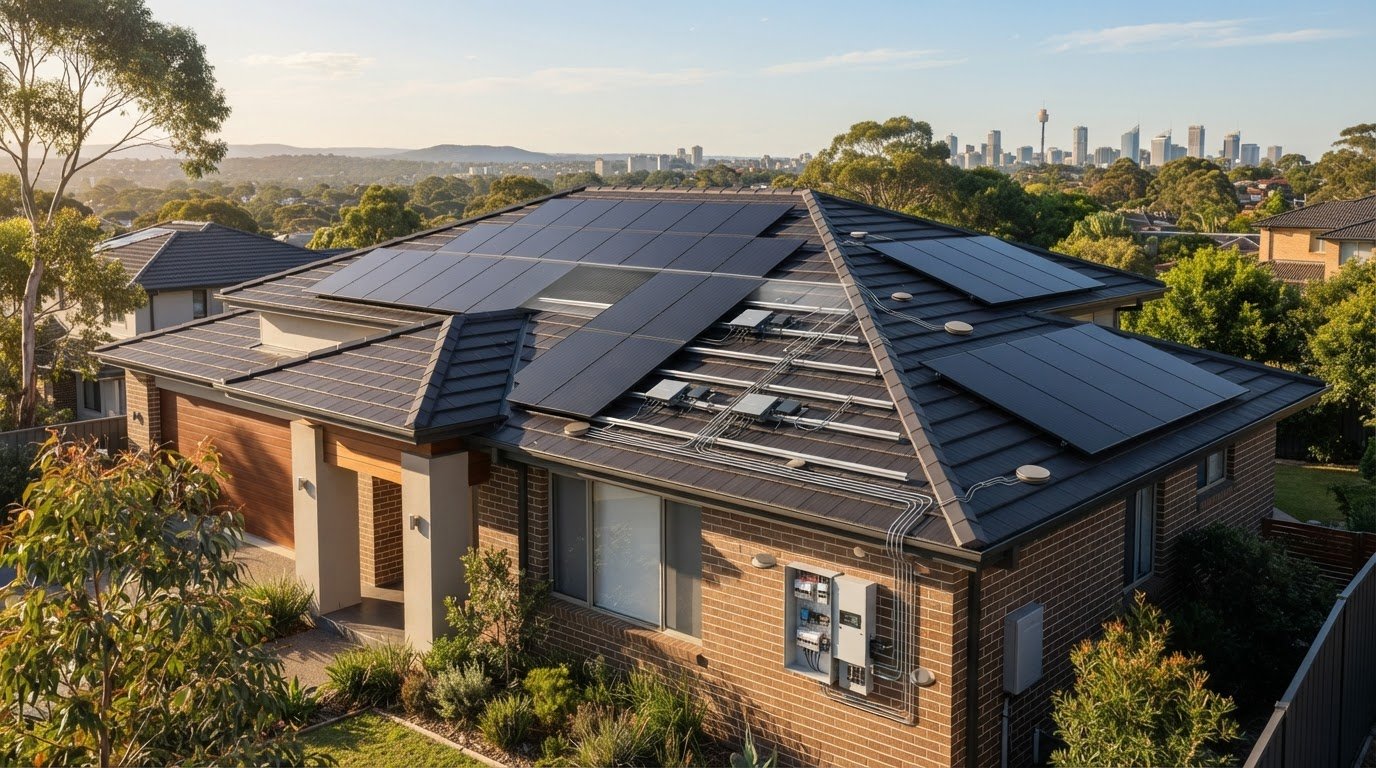
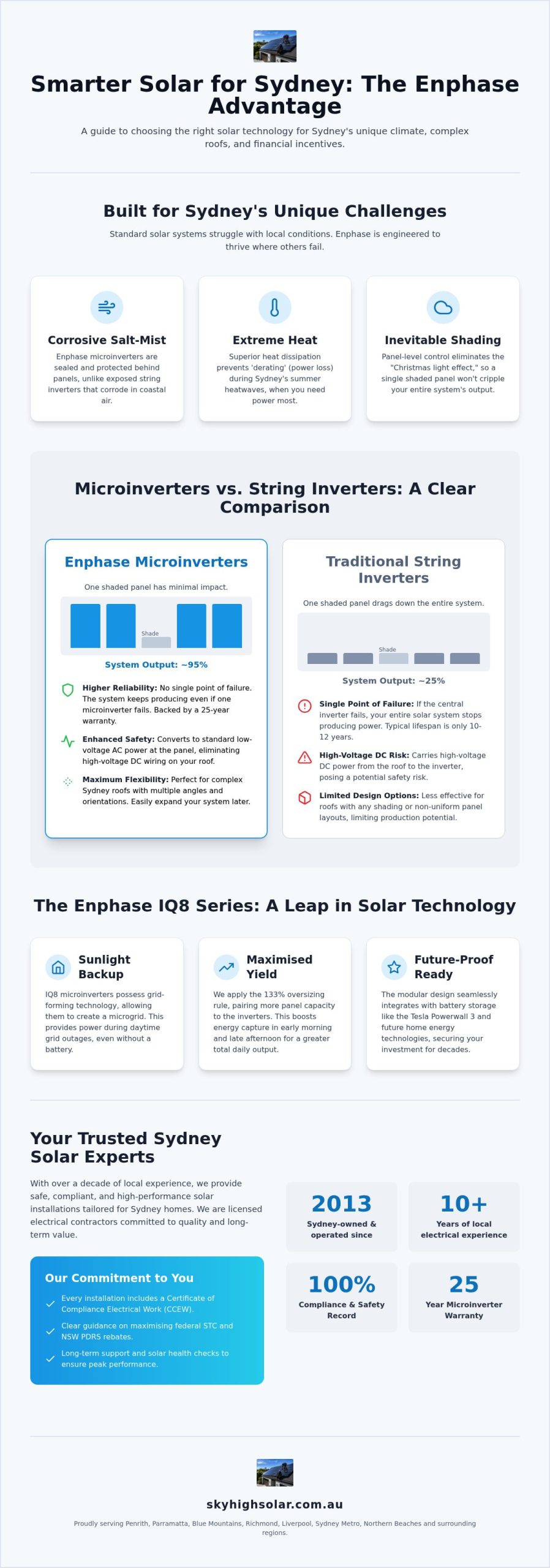
Traditional solar systems rely on a single string inverter, essentially a central brain that handles the power from every panel. If that brain fails, the whole system goes dark. Solar micro-inverter technology changes this by placing a small, intelligent device under every individual panel. This decentralised approach is why enphase microinverters have become the gold standard for Sydney homeowners looking for long-term reliability and maximum efficiency.
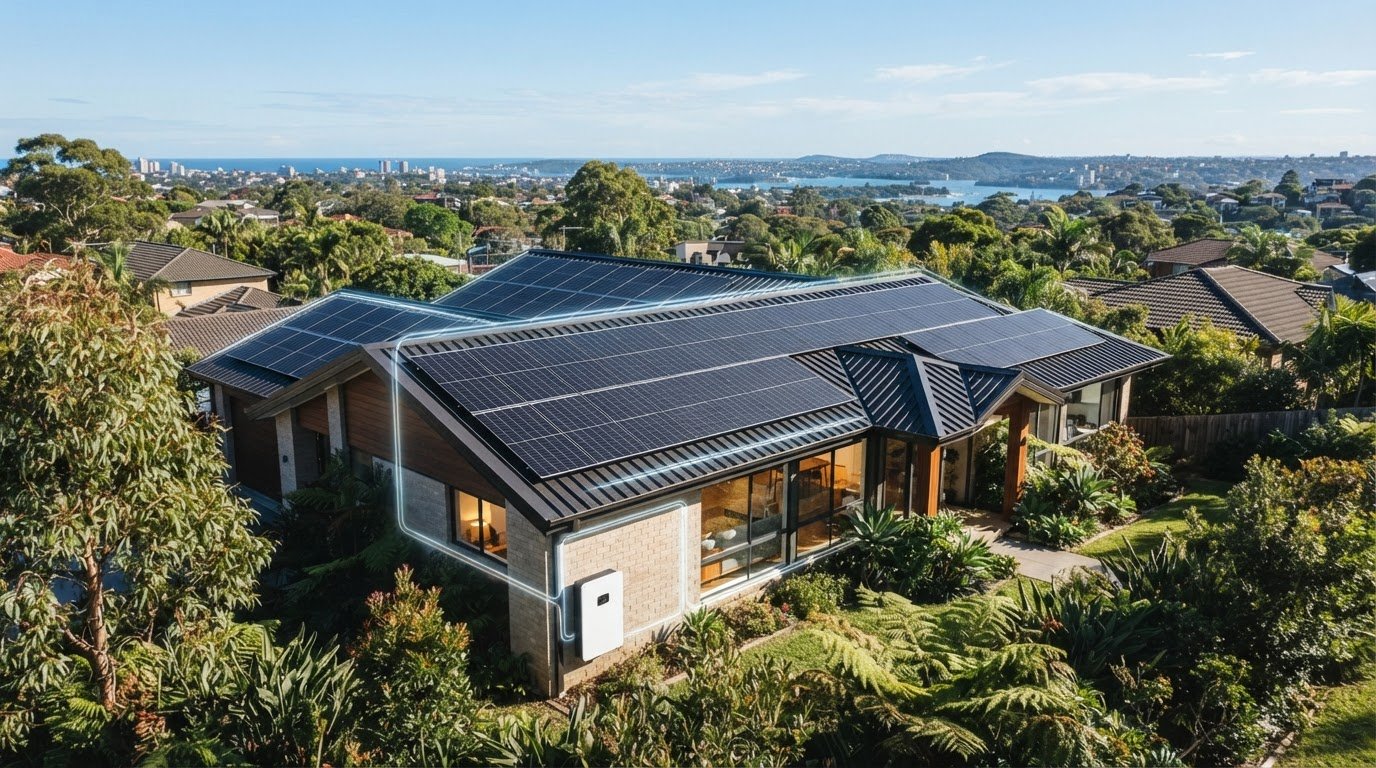
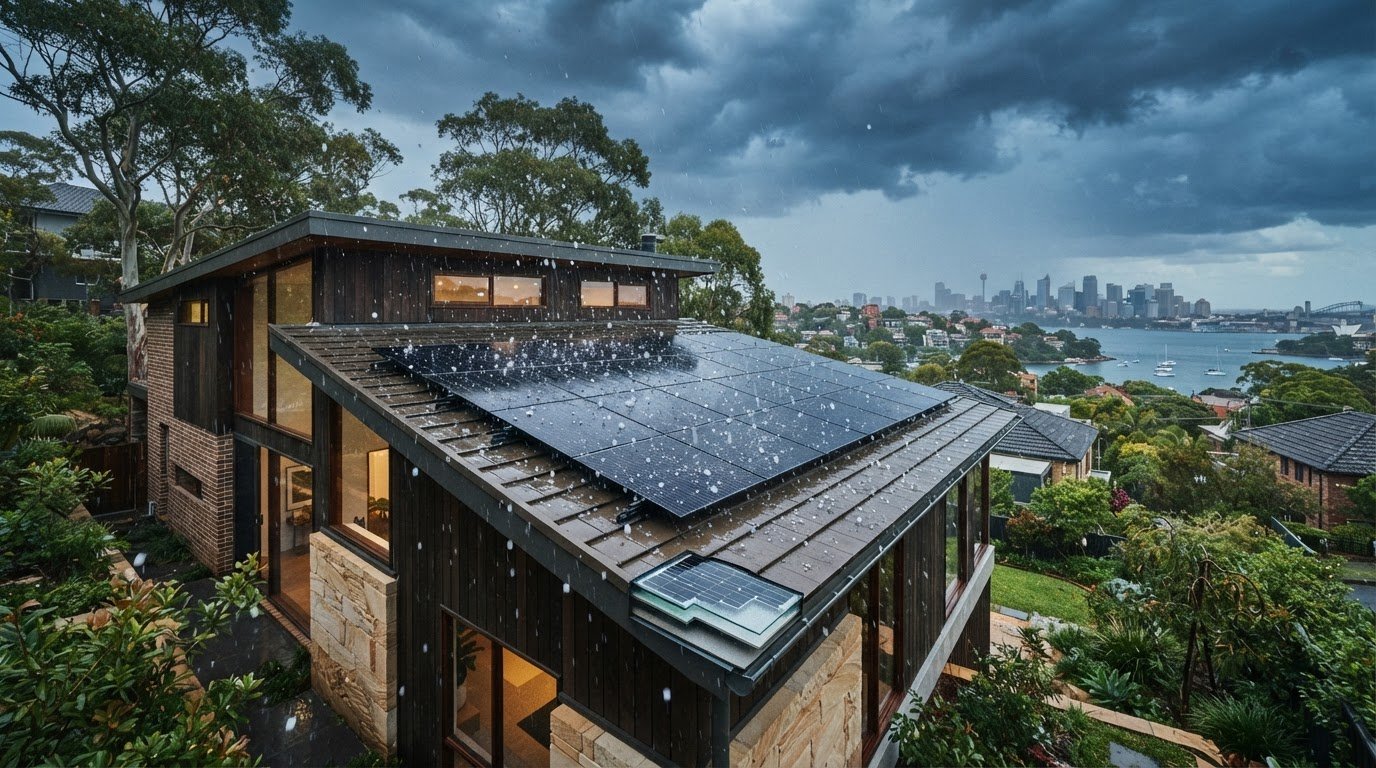
Sydney’s climate presents unique challenges that standard equipment often fails to handle. Between the corrosive salt-mist of the Northern Beaches and the intense humidity of the 2026 summer, electrical components are under constant stress. Enphase hardware is designed to withstand these specific environmental pressures. It ensures your path to energy independence isn’t cut short by equipment that can’t handle local conditions.
The End of the ‘Christmas Light’ Effect
In a traditional string system, panels are connected like old-fashioned Christmas lights; if one panel is shaded by a gum tree in Penrith or a neighbouring multi-storey development in Parramatta, the performance of the entire string drops to that lowest level. This is a significant issue for Sydney’s leafy suburbs where partial shading is almost inevitable throughout the day. By using enphase microinverters, each panel operates as a self-contained power plant. Microinverters isolate individual panel issues to ensure that localised shading or debris never compromises the energy yield of your entire solar investment.
Built for the Sydney Coast
Durability is non-negotiable when your roof is fighting a daily battle against salt air and extreme heat. String inverters are often installed on external walls where they’re exposed to the elements, creating a single point of failure for the entire home. In contrast, microinverters are tucked safely behind the panels and lack the high-voltage DC wiring that can degrade over time. This robust engineering is why the 25-year warranty is so valuable for long-term residents. It provides a level of peace of mind that central inverters, which typically require replacement every 10 to 12 years, simply cannot offer. Every installation we perform at Sky High Solar and Electrical includes a Certificate of Compliance Electrical Work (CCEW), confirming that your decentralised system meets the highest Australian safety standards and is built to last.
The IQ8 Series: Panel-Level Intelligence for 2026
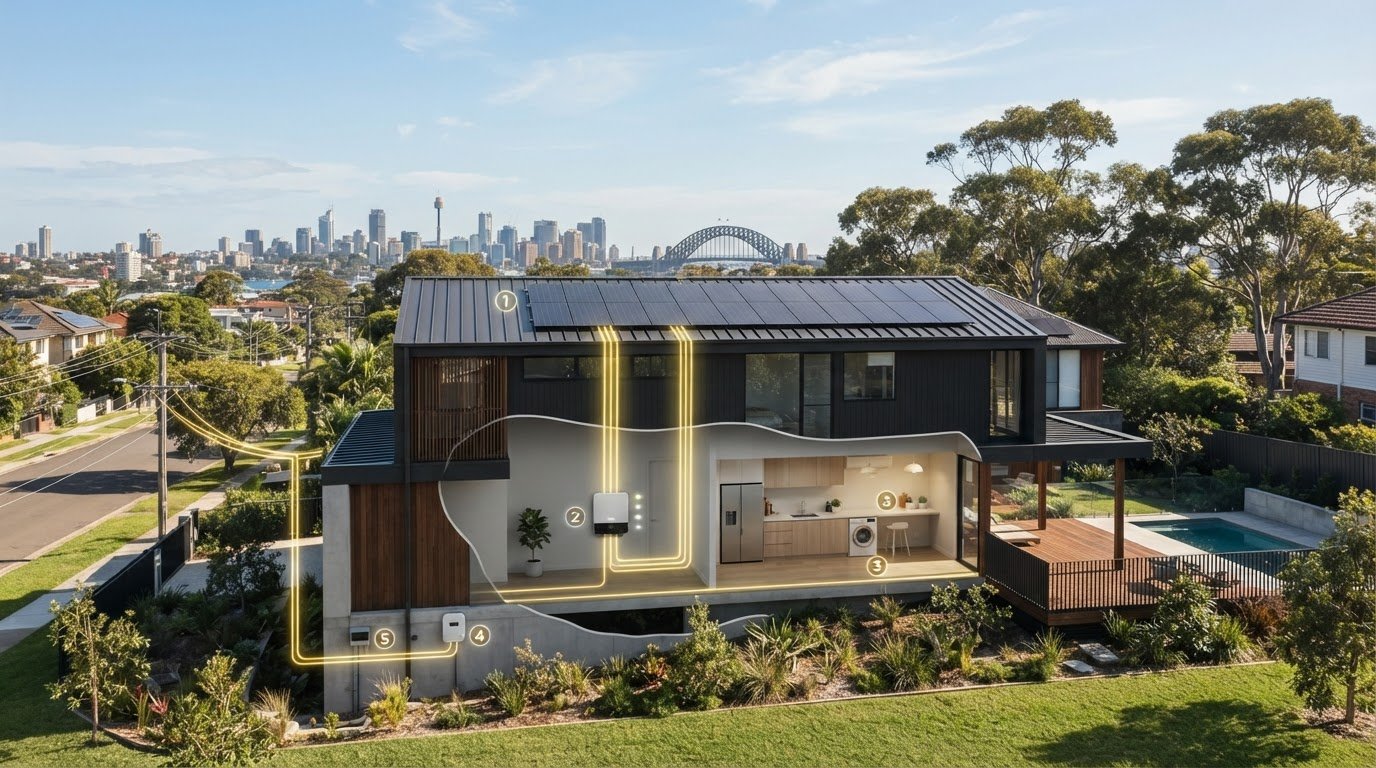
The IQ8 series represents a significant leap in solar technology, moving beyond simple conversion to true grid-forming capability. Unlike previous generations, enphase microinverters in the IQ8 range can create their own microgrid. This means that during a daytime grid outage, your system can continue to provide power directly to your home even without a battery. This resilience is vital as Sydney’s grid faces increasing pressure from extreme weather events and peak demand periods.
Safety remains a core priority for every installation. Every IQ8 unit includes built-in anti-islanding protection, which instantly disconnects the system from the grid during a blackout to protect utility workers. To get the most out of your roof, we apply the 133% oversizing rule. This regulation allows us to pair a larger capacity of solar panels with your inverters, ensuring your system reaches its peak production earlier in the morning and maintains it longer into the evening, even on overcast days.
IQ8AC vs IQ8P: Which Model Fits Your Roof?
Choosing between the IQ8AC and the IQ8P depends on your specific panel choice and energy goals. The IQ8AC is the standard-bearer for premium residential 6.6kW or 10kW systems, perfectly matched with high-efficiency modules. For homeowners opting for larger, high-current bifacial panels, the IQ8P offers the higher burst power needed to capture every watt of available energy.
Western Sydney summers are notoriously harsh, with temperatures often climbing above 40 degrees. While traditional string inverters often “derate” or slow down to prevent overheating, the distributed nature of enphase microinverters allows for superior heat dissipation. This means your system continues to perform at its peak when you need your air conditioning most, ensuring your solar investment isn’t throttled by the heat.
Smart Monitoring with the Enphase App
The Enphase App transforms your solar array into a transparent energy management tool. You can track the production of every individual panel in real-time, allowing you to spot issues instantly. Most Sydney families use this data to shift their energy-intensive loads, such as pool pumps or dishwashers, to the middle of the day when solar production is at its highest.
Accurate reporting relies on a bi-directional smart meter, which records exactly how much power you consume versus how much you export. This transparency helps you avoid the “High FiT trap” by focusing on self-consumption. If you’re ready to see how this intelligence looks on your own roof, you can explore our residential solar solutions to find the right fit for your home.
Microinverters vs String Inverters: A Comparison for Sydney Homeowners
Deciding between a traditional string inverter and enphase microinverters often comes down to a choice between lower upfront costs and superior long-term value. While a string inverter might save you money on day one, it creates a single point of failure. If that central unit fails, your entire system stops. Because most string inverters require replacement every 10 to 12 years, the 25-year lifespan of an Enphase system often results in lower total ownership costs over the life of the panels. It’s a steady investment that removes the hidden expense of future hardware replacements.
Installation flexibility is another area where microinverters excel, particularly for complex Sydney rooflines. Whether you have a heritage terrace in Paddington with limited space or a modern home with multiple roof angles, a split-array configuration allows us to place panels on any available surface. You aren’t restricted by string lengths or matching orientations. This modularity also means you can expand your system easily. If you buy an EV next year, you can simply add a few more panels without needing to replace your existing inverter infrastructure.
Performance in Shading and Low Light
In the shorter days of a Sydney winter, every minute of sunlight counts. Enphase systems feature a lower “start-up voltage,” meaning they begin generating power earlier in the morning and continue later into the evening than string alternatives. This advantage is amplified by environmental factors like dust or bird droppings. In a string system, one dirty panel reduces the output of every other panel in that sequence. With enphase microinverters, the dirty panel is isolated, allowing the rest of the array to harvest energy at its maximum potential.
Safety, Compliance, and the CCEW
Safety is a significant differentiator for residential properties. Traditional systems run high-voltage DC power across your roof and through your walls, which carries a higher risk of arc faults. Enphase systems are “all-AC,” converting power to safer 240V AC right at the panel. This eliminates high-voltage DC hazards entirely. To ensure these safety benefits are fully realised, a switchboard upgrade is often recommended for older Sydney homes to meet current standards. Every project we complete is documented with a Certificate of Compliance Electrical Work (CCEW). This official paperwork confirms the installation meets Australian safety regulations, which is a vital requirement for your home insurance and rebate eligibility. Only licensed electrical contractors with specialist solar training should handle these sophisticated installations to guarantee long-term system integrity.
Maximising ROI: NSW Rebates and Financial Benefits
Investing in enphase microinverters is a decision that balances premium technology with significant financial incentives available in 2026. While the hardware represents a higher tier of quality, the return on investment is accelerated by various state and federal schemes designed to lower the barrier to entry for Sydney homeowners. By combining these incentives with the long-term reliability of a 25-year warranty, the path to a carbon-neutral home becomes both practical and profitable.
The 2026 outlook for energy in NSW heavily rewards grid stability. Beyond simple solar generation, the NSW Peak Demand Reduction Scheme (PDRS) provides upfront payments to households that install battery storage capable of supporting the grid during peak times. Pairing your microinverters with grid-stable battery storage allows you to access these incentives while ensuring your home remains powered during local outages. This shift in government focus from simple generation to “smart” storage makes the intelligent management of the Enphase system more valuable than ever.
Understanding the Federal STC Rebate
The Small-scale Renewable Energy Scheme (SRES) remains the primary driver for solar affordability in Sydney. For a typical 6.6kW system in Zone 3, homeowners can currently expect an upfront discount of approximately A$1,700 to A$1,800. This value is determined by the number of Small-scale Technology Certificates (STCs) the system generates. Because the federal government reduces the rebate value every year until its scheduled end in 2030, acting in 2026 allows you to capture a higher certificate count before the next annual reduction. The STC discount is applied automatically at the point of sale by your installer to reduce your out-of-pocket costs immediately.
Avoiding the High FiT Trap
Many energy retailers lure customers with a “High FiT trap,” offering a misleadingly high feed-in tariff that masks significantly higher daily supply charges and peak usage rates. This often results in a higher net electricity bill despite the credits earned from exporting power. Enphase monitoring changes the game by giving you panel-level data to focus on self-consumption rather than exports. By using your own solar energy to power heavy appliances during the day, you achieve true energy independence and protect your household from volatile market prices.
Focusing on using every watt you produce is the most effective way to lower your bills in the current Sydney market. If you are ready to see how these incentives apply to your specific roofline, you can request a quote for a 6.6kW or 10kW system to get a clear breakdown of your potential savings.
Why Choose Sky High Solar and Electrical for Your Enphase Installation?
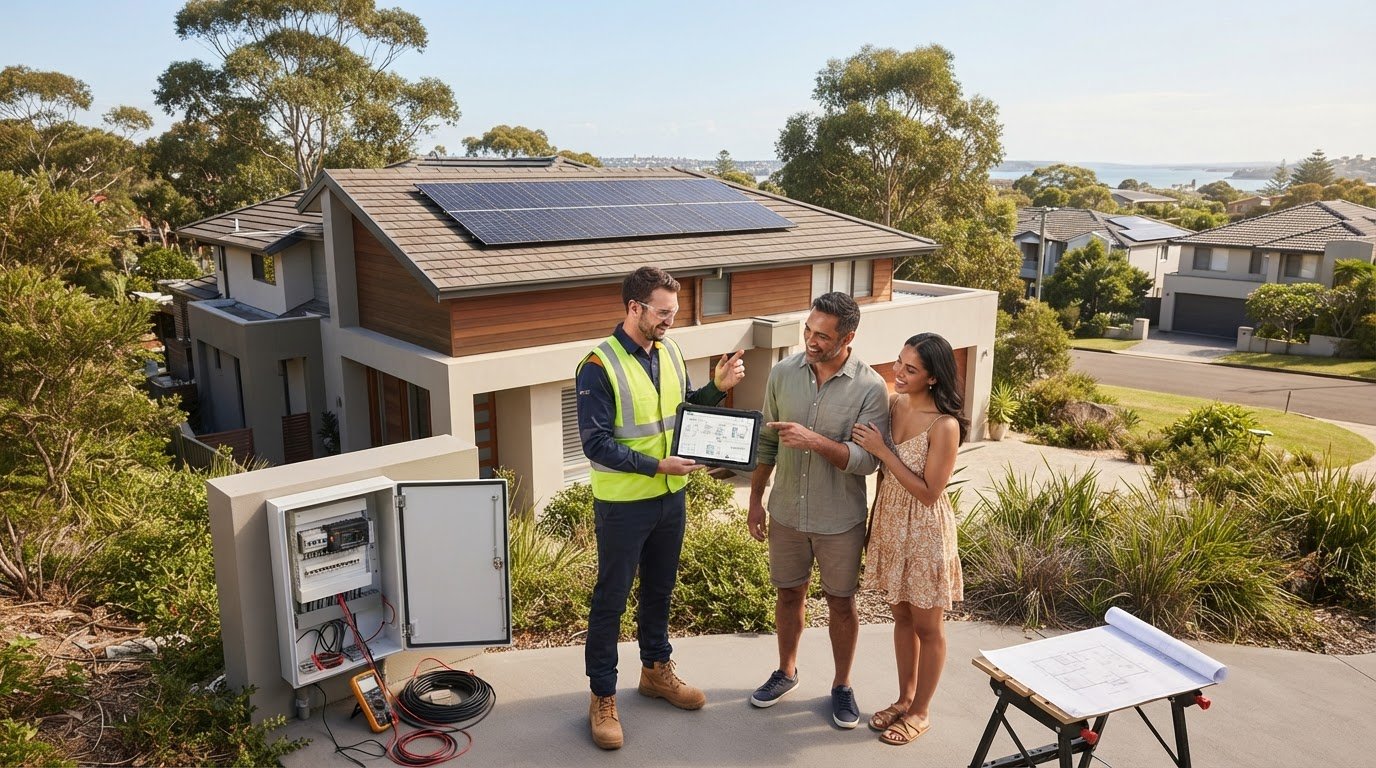
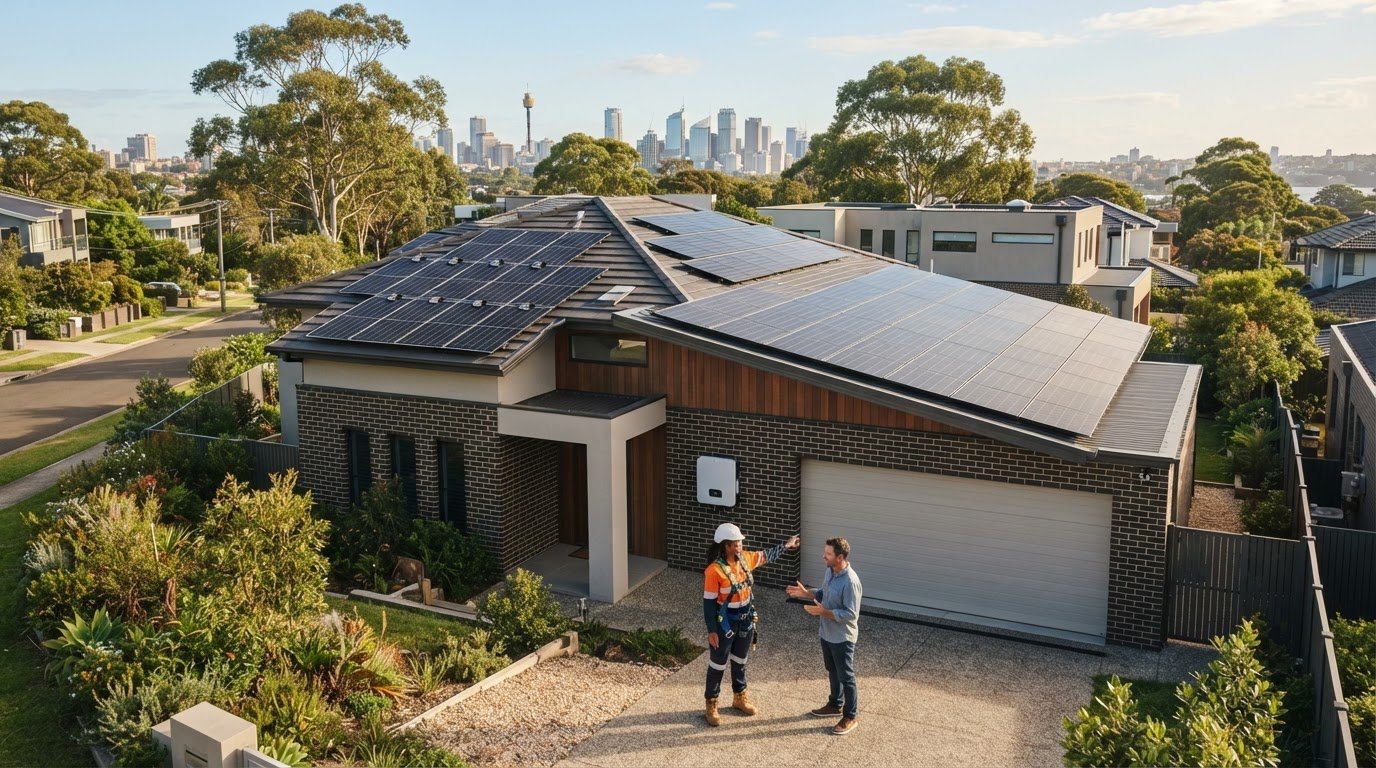
Sky High Solar and Electrical has been a steady hand in the local industry since 2013. We understand that your choice of enphase microinverters is a long-term commitment to quality, so we match that with a high standard of technical expertise. Serving regions from Penrith and Parramatta to the Northern Beaches, we bring over 10 years of Sydney-specific electrical experience to every rooftop. Our team consists of licensed electrical contractors rather than general sub-contractors, ensuring that precision is maintained from the first panel to the final connection.
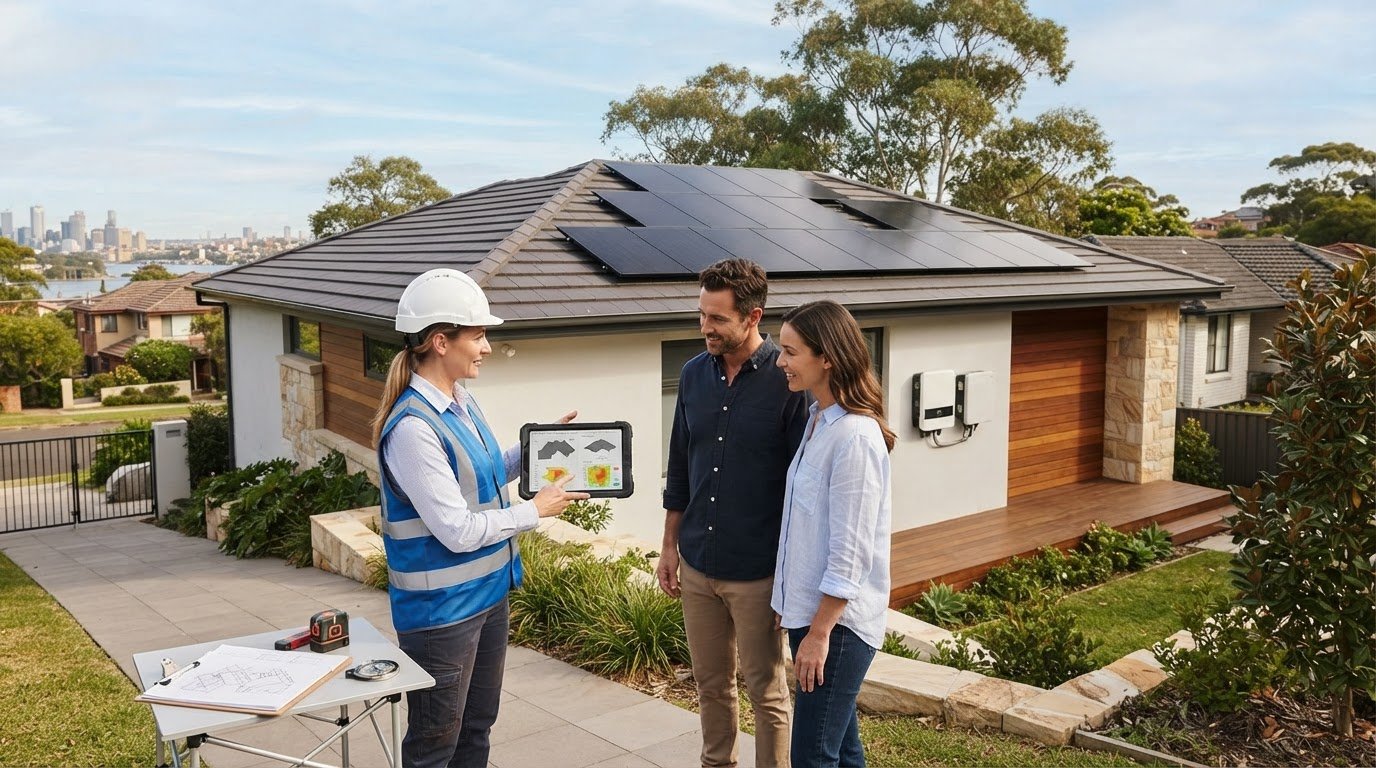
Safety and compliance are integrated into our core workflow to protect your household and your investment. We install an RCBO (Residual Current Breaker with Over-current protection) to combine RCD and MCB functions in one device, which is particularly important for older Sydney switchboards that may not have been updated in decades. Every project concludes with the provision of a Certificate of Compliance Electrical Work (CCEW), which is your legal guarantee that the work meets all Australian standards. Our post-installation review involves a final check to confirm compliance and ensure you’re correctly registered for all applicable rebates.
A Steady Hand in the Sydney Solar Industry
Since starting operations in 2013, we’ve remained a trusted local specialist while the solar landscape has evolved. We act as a partner for homeowners by offering ongoing support through professional solar health checks and system servicing. These checks are designed to identify any environmental impacts from Sydney’s salt-mist or humidity before they affect your energy yield. Our deep knowledge of local regulations ensures your system remains compliant throughout its 25-year life. We don’t just install panels; we manage the long-term health of your energy generation.
Ready to Modernise Your Sydney Home?
The transition to a smarter energy footprint is most effective when it’s tailored to your unique needs. Whether you’re looking for a standalone solar array or a system integrated with a Tesla Powerwall 3 or FOX ESS CQ7 battery, we provide the technical guidance to help you achieve total energy independence. Our specialists design systems that account for your specific roof orientation and daily energy usage patterns. You can Contact Sky High Solar and Electrical for an Enphase Quote to begin your journey toward a more efficient and reliable home energy solution.
Secure Your Energy Future with Intelligent Solar
Choosing the right solar technology is about more than just current savings; it’s about building a system that survives Sydney’s coastal air and humid summers for decades. As we’ve explored, enphase microinverters offer the resilience and panel-level intelligence needed to overcome shading issues and maximise your return on investment. By focusing on self-consumption and accessing current NSW incentives like the PDRS, you can protect your household from rising electricity costs while achieving true energy independence.
Sky High Solar and Electrical has been Sydney-owned and operated since 2013, providing a steady hand in an ever-changing industry. Our CEC Accredited Installers ensure every project meets strict Australian standards, with CCEW compliance guaranteed on every installation. We don’t just provide hardware; we deliver peace of mind through technical expertise and a commitment to long-term system health. If you’re ready to modernise your property with advanced inverter technology, we are here to guide you through every step of the transition.
Request a Tailored Enphase Solar Quote for Your Sydney Home
Take control of your energy bills today and enjoy the security of a reliable, high-performance solar array for the next 25 years.
Frequently Asked Questions
How much more do Enphase microinverters cost than string inverters in Sydney?
Enphase systems typically require a higher initial investment compared to standard string inverters. This is because you are purchasing individual power management for every panel rather than one central unit. However, the 25-year warranty and the lack of a central failure point often lead to lower total costs over the system’s life. Most string inverters need replacing every decade, whereas enphase microinverters are built to last as long as the panels themselves.
Can I expand my Enphase solar system later if I buy an EV?
Yes, the modular nature of this technology makes expansion straightforward. Unlike string systems that require matching panel counts and specific inverter capacities, you can add as few or as many panels as your roof space allows. This is ideal for Sydney families planning to buy an electric vehicle or install an EV DC charger in the future. You simply add a new microinverter with each additional panel without redesigning the entire array.
Do Enphase microinverters work with the Tesla Powerwall 3?
Enphase systems integrate seamlessly with the Tesla Powerwall 3. While the Powerwall 3 has its own internal inverter, it can still function alongside an Enphase array to provide a robust home energy solution. This combination allows you to benefit from the panel-level optimisation of enphase microinverters while utilising Tesla’s high-capacity storage. It is a popular choice for homeowners seeking maximum energy independence and blackout protection during grid instability.
What happens if one Enphase microinverter fails on my roof?
If a single microinverter fails, only the panel it is connected to stops producing power. The rest of your solar array continues to operate at full capacity. This is a major advantage over string inverters, where a single component failure shuts down the entire system. Because Enphase reports a field failure rate of less than 0.05%, these occurrences are rare, and the individual unit is easily replaced under its long-term warranty.
Are microinverters safer than traditional string inverters for my family?
Microinverters are significantly safer for residential properties because they eliminate high-voltage DC wiring. Traditional systems can carry up to 600V or 1000V of direct current across your roof, which poses a higher risk of arc faults. Enphase systems convert power to 240V AC at the panel level. This “all-AC” approach reduces fire risks and ensures your family is protected by the same safety standards as the rest of your home’s electrical wiring.
How do I claim the NSW solar battery rebate with an Enphase system?
Claiming rebates is a streamlined process when working with a licensed installer. Your federal STC discount is usually applied at the point of sale to reduce the upfront cost. For the NSW Peak Demand Reduction Scheme (PDRS), we handle the technical documentation and compliance checks required for eligibility. We ensure your system meets all Australian standards and provide the necessary Certificate of Compliance Electrical Work (CCEW) to confirm your installation is registered correctly.
Is a switchboard upgrade necessary for an Enphase installation?
A switchboard upgrade is frequently necessary for older Sydney homes to ensure the system is safe and compliant. Modern solar installations require specific protection devices, such as RCBOs, to manage the two-way flow of electricity. We evaluate your current electrical infrastructure during the initial site check. Upgrading your board ensures your home can handle the increased load of a 6.6kW or 10kW system while meeting current Australian safety regulations for residential properties.
How does the Enphase IQ8 handle Sydney’s summer heatwaves?
The IQ8 series is specifically engineered to perform in extreme temperatures without “derating” or losing efficiency. Central string inverters often struggle in 40-degree Western Sydney heatwaves because they generate significant internal heat. Because microinverters are distributed under the panels, they dissipate heat much more effectively. This ensures your solar production remains high even during the hottest parts of the day when your air conditioning demand is at its peak.